Plantar Fasciitis Treatment, Symptoms & Causes
Plantar fasciitis is painful thickening of the plantar fascia where it joins the heel bone. Learn the symptoms, causes, treatment and recovery time.
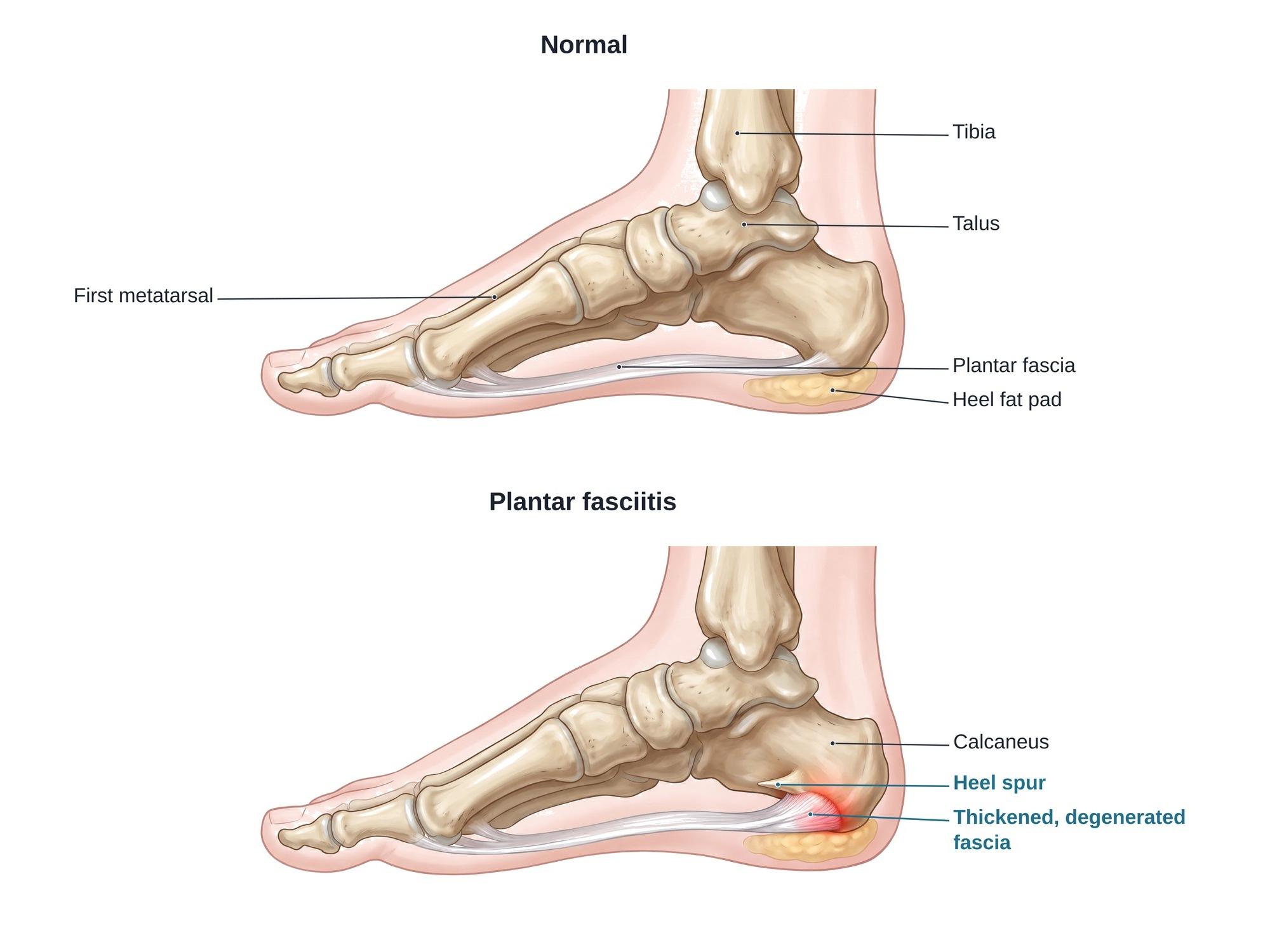
Plantar fasciitis is pain and thickening of the plantar fascia where it attaches to the heel bone. The plantar fascia (also called the plantar aponeurosis) is a thick, tough band of connective tissue under the sole. It runs from the bottom of the heel bone (calcaneus) to the bases of the toes and holds up the arch like a bowstring (see foot bones anatomy). Repeated strain causes small tears and wear at its heel attachment. Despite the name, it is more a slow breakdown of the tissue (fasciopathy) than true inflammation. It is the most common cause of pain under the heel. About 10% of adults aged 50 and over have plantar heel pain in a given month (Thomas et al., 2019).
Types
| Type | What it means | Typical features |
|---|---|---|
| Acute | Pain for less than about 6 weeks | Sharp first-step pain after a jump in activity |
| Chronic | Pain for more than about 3 to 6 months | Thick, worn fascia on imaging; harder to treat |
| With heel spur | A bony spur on the bottom of the calcaneus | Spur seen on X-ray; it does not cause the pain by itself |
| Plantar fascia rupture | A sudden tear of the fascia near the heel | A pop, bruising and a flatter arch |
Causes
The fascia tightens every time the heel lifts and the toes bend up, at push-off. This is called the windlass mechanism. Too much load, too often, causes small tears faster than the tissue can heal. Common causes and risk factors include:
- Long hours standing or walking on hard floors, as in nursing, factory, warehouse, retail and security work
- A sudden increase in running or walking distance
- Extra body weight. In a meta-analysis of active people, those with plantar fasciitis had a body mass index about 2 points higher than those without it (Hamstra-Wright et al., 2021).
- Tight calf muscles and a tight Achilles tendon, which limit upward bending of the ankle (dorsiflexion)
- Flat feet or high arches, and thin, worn-out or unsupportive shoes
- Age 40 to 60 and female sex
New cases are common in primary care. In Dutch general practice, about 4 people per 1,000 were seen with new plantar heel pain each year, and the rate was higher in women (Rasenberg et al., 2019).
Symptoms
Plantar fasciitis symptoms follow a typical pattern:
- Sharp pain under the inner heel with the first steps in the morning
- Start-up pain after sitting or driving, which eases after a few minutes of walking
- An ache that builds after long standing or at the end of a shift
- Tenderness when pressing the bottom of the heel, toward the inner side
- Pain when the toes are bent up, which stretches the fascia
Numbness, burning or tingling are not typical. They suggest a trapped nerve, such as tarsal tunnel syndrome or compression of the first branch of the lateral plantar nerve (Baxter's nerve) (see lower limb nerves).
Diagnosis
The diagnosis is usually made from the history and examination alone. The doctor presses on the medial calcaneal tubercle, the bony bump on the inner underside of the heel, where the fascia attaches. Bending the toes up (the windlass test) may bring on the pain.
Imaging helps when the pain does not improve or the diagnosis is unclear. Ultrasound shows a thickened, darker fascia near the heel. In a meta-analysis of ultrasound studies (612 people with heel pain, 587 without), the fascia near the heel was about 2 mm thicker in people with heel pain. A thickness over 4 mm is a common cutoff for plantar fasciitis (Drake et al., 2022). X-rays may show a heel spur, and they rule out a fracture. MRI can show swelling of the fascia and bone, a partial tear, or a calcaneal stress fracture.
Other causes of heel pain to rule out include a stress fracture of the calcaneus, nerve entrapment, heel fat pad atrophy, Achilles tendon problems (see Achilles tendon rupture) and arthritis. Pain in the ball of the foot between the toes is more likely a Morton's neuroma.
Treatment
Plantar fasciitis treatment starts simple. Most people get better without surgery.
First-line care (the first 6 weeks or so):
- Relative rest. Cut back on long standing, running and barefoot walking, without stopping activity completely.
- Stretching. Calf stretches and a plantar fascia-specific stretch (pulling the toes back before the first steps of the day).
- Shoes and inserts. Cushioned, supportive shoes, heel cups or over-the-counter arch supports.
- Ice and pain relievers. Ice massage and short courses of anti-inflammatory medicine (NSAIDs) for pain.
- Taping. Low-Dye taping can ease pain in the short term.
- Weight loss when body weight is high.
If pain lasts (6 weeks to 6 months):
- Night splint. Holds the ankle at 90 degrees overnight so the fascia and calf stay stretched. It helps morning pain for some people.
- Physical therapy. Strengthening of the foot and calf muscles, and a supervised stretching plan.
- Corticosteroid injection. A steroid shot into the heel can ease pain for a few weeks. It is not a cure. In a review of 47 trials with 2,989 people, steroid injection was not more effective than a placebo injection (Whittaker et al., 2019).
- Extracorporeal shockwave therapy (ESWT). Sound waves are aimed at the heel in a few sessions. It is used for chronic plantar fasciitis.
- Platelet-rich plasma (PRP). An injection made from the patient's own blood. It is still being studied.
Surgery (after 6 to 12 months of failed care):
- Gastrocnemius recession. The surgeon lengthens the tight tendon part of the calf muscle (gastrocnemius) through a small cut at the back of the calf. This lowers strain on the fascia.
- Partial plantar fasciotomy. The surgeon cuts part of the inner fascia near the heel, through an open cut or with a small camera (endoscopic). A heel spur may be removed at the same time, though the spur is rarely the cause of the pain.
Recovery
Most people improve within months, but it is slow. Recovery is often uneven, with good and bad weeks. In a Danish study of 174 patients diagnosed in a hospital clinic, those whose pain went away had symptoms for about 2 years on average. About 10 years after the pain started, 46% still had some symptoms. Women and people with pain in both heels did worse, and having a heel spur made no difference (Hansen et al., 2018).
Things that help recovery:
- Keep stretching daily, even after the pain eases
- Return to running or long shifts on your feet step by step
- Replace worn shoes and avoid going barefoot on hard floors
- After surgery, expect a few weeks in a boot and several months before full activity
Complications
- Chronic heel pain that limits walking, standing and work
- Plantar fascia rupture, a sudden tear of the fascia
- Changes in gait. Limping to protect the heel can cause knee, hip or back pain.
- After plantar fasciotomy: a flatter arch and pain on the outer side of the foot (lateral column pain), mostly when too much of the fascia is cut, plus nerve injury, wound problems and ongoing pain
References
- Thomas MJ, Whittle R, Menz HB, et al. Plantar heel pain in middle-aged and older adults: population prevalence, associations with health status and lifestyle factors, and frequency of healthcare use. BMC Musculoskeletal Disorders. 2019;20(1):337.
- Hamstra-Wright KL, Huxel Bliven KC, Bay RC, et al. Risk factors for plantar fasciitis in physically active individuals: a systematic review and meta-analysis. Sports Health. 2021;13(3):296-303.
- Rasenberg N, Bierma-Zeinstra SM, Bindels PJ, et al. Incidence, prevalence, and management of plantar heel pain: a retrospective cohort study in Dutch primary care. British Journal of General Practice. 2019;69(688):e801-e808.
- Drake C, Whittaker GA, Kaminski MR, et al. Medical imaging for plantar heel pain: a systematic review and meta-analysis. Journal of Foot and Ankle Research. 2022;15(1):4.
- Whittaker GA, Munteanu SE, Menz HB, et al. Corticosteroid injection for plantar heel pain: a systematic review and meta-analysis. BMC Musculoskeletal Disorders. 2019;20(1):378.
- Hansen L, Krogh TP, Ellingsen T, et al. Long-term prognosis of plantar fasciitis: a 5- to 15-year follow-up study of 174 patients with ultrasound examination. Orthopaedic Journal of Sports Medicine. 2018;6(3):2325967118757983.
Related pages
- Foot anatomyThe normal anatomy of the foot.
- Avulsion injuryAn avulsion is tissue torn away from where it belongs: a flap of skin and fat, or a chip of bone pulled off by a tendon.
- Lisfranc injuryA Lisfranc injury is a sprain, fracture or dislocation of the midfoot joints. Learn the types, symptoms, why it is often missed, and treatment.
- Morton's neuromaMorton's neuroma is a thickened, pinched nerve between the third and fourth toes. Learn the symptoms, the squeeze test, the best shoes and treatment options.
- Turf toeTurf toe is a sprain of the big toe joint from bending the toe too far back. Learn the grades, symptoms, treatment, taping and recovery time.
FAQ
What is the fastest way to get rid of plantar fasciitis?+
There is no quick cure, but a few steps help most people sooner. Cut back on long standing and running for a while, stretch the calf and the plantar fascia every day, and wear supportive shoes or a heel cup instead of going barefoot. A night splint helps some people with bad morning pain. A steroid injection can ease pain for a few weeks, but it does not fix the cause.
How long does plantar fasciitis last?+
It often lasts longer than people expect. In a Danish study of patients diagnosed in a hospital clinic, 80% still had symptoms after 1 year, those whose pain went away had symptoms for about 2 years on average, and close to half still had some pain about 10 years later.
Why won't my plantar fasciitis go away?+
Common reasons are going back to long standing or running too soon, tight calf muscles, extra body weight, worn-out or flat shoes, and stopping the stretches once the pain eases. Pain on both sides is linked with a slower recovery. If heel pain lasts more than a few months despite treatment, a doctor should rule out other causes, such as a stress fracture or a trapped nerve.
How do you know it's plantar fasciitis?+
The classic sign is sharp pain under the inner part of the heel with the first steps in the morning, or after sitting for a while. The pain eases as you walk, then builds again after a long day on your feet. Pressing on the bottom of the heel, just in front of the fat pad, is tender. Numbness, burning or night pain point to something else.
Is a heel spur the same as plantar fasciitis?+
No. A heel spur is a small bony outgrowth on the bottom of the heel bone. It is common in people with plantar fasciitis, but many people have a spur with no pain. The pain comes from the fascia, not the spur, and the spur rarely needs to be removed.
What is the worst thing to do with plantar fasciitis?+
Walking barefoot on hard floors, wearing flat or worn-out shoes, and pushing through pain with long runs or long shifts standing all make it worse.
Does plantar fasciitis need surgery?+
Rarely. Most people get better with stretching, shoe changes and time. Surgery is considered only after 6 to 12 months of good nonsurgical care has failed. The main options are lengthening a tight calf muscle (gastrocnemius recession) or partly cutting the plantar fascia (partial plantar fasciotomy).
Can plantar fasciitis be caused by work?+
Long hours standing or walking on hard floors is a known risk factor, along with extra body weight and tight calves. People in manual and routine jobs report heel pain more often. Plantar fasciitis is usually an overuse problem that builds up over weeks, not a single injury, though a sudden hard push-off can tear the fascia.
Need this illustration for a patient or a case?
Describe the injury or upload a scan and get a clear, labeled medical illustration for a consult, a chart or a case exhibit.
Try Natomy →