Morton's Neuroma: Symptoms, Test, Shoes & Treatment
Morton's neuroma is a thickened, pinched nerve between the third and fourth toes. Learn the symptoms, the squeeze test, the best shoes and treatment options.
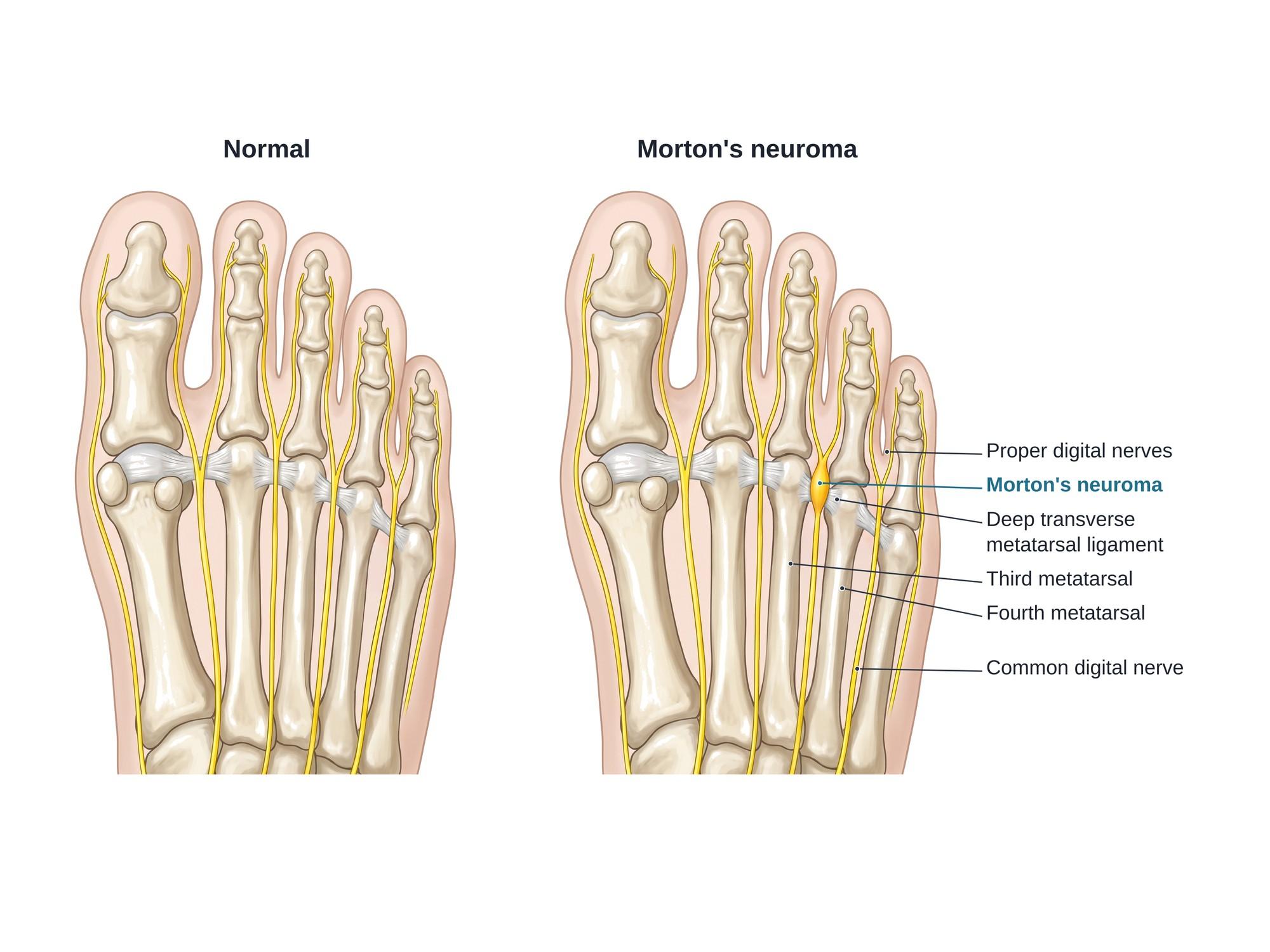
Morton's neuroma is a painful thickening of a nerve in the ball of the foot. It is a pinched nerve (compressive neuropathy) of a common plantar digital nerve, the nerve that runs between two long foot bones (metatarsals) to supply the facing sides of two toes. The nerve passes under the deep transverse metatarsal ligament, a short band that ties the metatarsal heads together (see foot bones anatomy and nerves of the lower limb). Pressure against this ligament scars and thickens the nerve. Despite the name, it is not a true tumor. It most often forms between the third and fourth metatarsal heads (StatPearls, 2026). In UK primary care, about 50 per 100,000 men and 88 per 100,000 women see a doctor for it each year (Latinovic et al., 2006). The illustration above shows a normal forefoot beside a Morton's neuroma.
Types of neuroma
The word neuroma covers several different problems. Morton's neuroma is the one in the foot caused by pressure.
| Type | What it is | Where |
|---|---|---|
| Morton's neuroma | Scarred, thickened nerve from pressure, not a tumor | Between the metatarsal heads, usually the third web space |
| Traumatic neuroma | Tangle of regrowing nerve fibers after a cut or crush | Any injured nerve |
| Stump neuroma | Traumatic neuroma at the cut end of a nerve | After a neurectomy or amputation |
| Acoustic neuroma | True benign tumor (vestibular schwannoma) | Hearing and balance nerve, inside the skull |
For how nerves are injured and heal, see types of nerve injury.
Causes
The nerve is pinched between the metatarsal heads and the ligament above it each time the forefoot takes weight. Over time the nerve and the tissue around it become scarred, a change called perineural fibrosis (Mak et al., 2021). Doctors still debate exactly why it starts.
Things that add pressure on the forefoot raise the risk:
- High heels and narrow, pointed shoes, which push the metatarsal heads together and load the ball of the foot
- Sex and age. Women are affected more often than men. New cases peak at ages 55 to 64 (Latinovic et al., 2006).
- Running and court sports, which load the forefoot over and over
- Foot shape, such as bunions, hammertoes, flat feet or a high arch
- A tight calf, which shifts weight forward onto the ball of the foot
One theory for why the third web space is the usual site: the nerve there often gets branches from both the medial and lateral plantar nerves, so it may be thicker and less mobile.
Symptoms
- Burning or sharp pain in the ball of the foot, usually between the third and fourth toes
- Pain that shoots into the toes
- A feeling of walking on a pebble or a fold in the sock (Matthews et al., 2024)
- Tingling or numbness on the facing sides of two toes
- Pain that is worse in tight shoes or heels and better with the shoe off and the foot rubbed
Pain on top of the foot or in the big toe is less typical. Heel pain points to a different problem, such as plantar fasciitis.
Diagnosis
The diagnosis is mostly clinical, based on the story and the exam. These are the main tests for Morton's neuroma:
- Web space tenderness. Pressing between the metatarsal heads on the sole reproduces the pain.
- Squeeze test. The doctor squeezes the forefoot from side to side. This brings back the pain or shooting feeling.
- Mulder's click. While squeezing, the doctor presses on the web space. A painful click is felt as the swollen nerve pops between the metatarsal heads.
Imaging confirms the diagnosis and rules out other causes. Ultrasound shows the neuroma as a small, dark, oval mass between the metatarsal heads. MRI shows it as a small soft tissue mass at the level of the ligament. In a meta-analysis of 14 studies checked against surgery, ultrasound found 91% of neuromas and MRI found 90% (Bignotti et al., 2015). X-rays do not show the nerve but can rule out a stress fracture or arthritis.
Other causes of forefoot pain include a plantar plate tear, intermetatarsal bursitis, a metatarsal stress fracture, arthritis of the toe joints and a pinched nerve in the lower back (radiculopathy).
Treatment
Treatment starts simple and steps up only if pain lasts. Only 3% of new cases in UK primary care had surgery (Latinovic et al., 2006).
- Shoes. The best shoes for Morton's neuroma have a wide, deep toe box, a low heel and a cushioned sole. A rocker sole helps some people. Avoid high heels and pointed shoes.
- Metatarsal pad or orthotic. A pad placed just behind the metatarsal heads spreads them apart and lifts pressure off the nerve.
- Activity changes and stretching, such as calf stretches and less time on hard surfaces.
- Steroid injection. A corticosteroid with local anesthetic is injected into the web space, best guided by ultrasound. In two trials, ultrasound guidance gave less pain and better function than injecting by feel (Matthews et al., 2024). Relief often fades. In a review of 469 patients, 30% went on to surgery after injections (Choi et al., 2021).
- Other procedures, such as alcohol injection, radiofrequency ablation or cryoablation, are used at some centers. The evidence for them is limited.
- Surgery. A neurectomy removes the thickened nerve segment through a cut on the top or the sole of the foot. A neurolysis frees the nerve by cutting the deep transverse metatarsal ligament and leaves the nerve in place.
A meta-analysis of 35 studies (2,998 patients) compared these options. Complete pain relief came after 43% of injections, 68% of neurolysis operations and 74% of neurectomies (Lu et al., 2021). Further surgery was needed after 15% of injections and 5% of neurectomies.
Recovery
Shoe changes and pads can take several weeks to help. Injections can ease pain, but the effect may wear off. After neurectomy, most people walk in a stiff post-operative shoe and move back to roomy normal shoes as the wound heals. Numbness between the two toes is expected after a neurectomy, because the nerve to that skin has been removed.
Complications
- Permanent numbness of the facing sides of the two toes after neurectomy
- Stump neuroma, a new painful neuroma at the cut end of the nerve, which can need a second operation
- Ongoing pain from a missed second neuroma or a wrong diagnosis
- Scar pain, especially after a cut on the sole of the foot
- Skin and fat pad thinning after steroid injections. In two trials of steroid plus anesthetic injections, 3.9% had mild skin thinning and 2.6% had thinning of the fat pad under the ball of the foot (Matthews et al., 2024).
References
- Dixon M, Munir U, Tafti D. Morton Neuroma. StatPearls Publishing, 2026.
- Latinovic R, Gulliford MC, Hughes RA. Incidence of common compressive neuropathies in primary care. J Neurol Neurosurg Psychiatry. 2006;77(2):263-265.
- Mak MS, Chowdhury R, Johnson R. Morton's neuroma: review of anatomy, pathomechanism, and imaging. Clin Radiol. 2021;76(3):235.e15-235.e23.
- Matthews BG, Thomson CE, Harding MP, et al. Treatments for Morton's neuroma. Cochrane Database Syst Rev. 2024;2:CD014687.
- Bignotti B, Signori A, Sormani MP, et al. Ultrasound versus magnetic resonance imaging for Morton neuroma: systematic review and meta-analysis. Eur Radiol. 2015;25(8):2254-2262.
- Choi JY, Lee HI, Hong WH, et al. Corticosteroid injection for Morton's interdigital neuroma: a systematic review. Clin Orthop Surg. 2021;13(2):266-277.
- Lu VM, Puffer RC, Everson MC, et al. Treating Morton's neuroma by injection, neurolysis, or neurectomy: a systematic review and meta-analysis of pain and satisfaction outcomes. Acta Neurochir (Wien). 2021;163(2):531-543.
Related pages
- Foot anatomyThe normal anatomy of the foot.
- Avulsion injuryAn avulsion is tissue torn away from where it belongs: a flap of skin and fat, or a chip of bone pulled off by a tendon.
- Lisfranc injuryA Lisfranc injury is a sprain, fracture or dislocation of the midfoot joints. Learn the types, symptoms, why it is often missed, and treatment.
- Plantar fasciitisPlantar fasciitis is painful thickening of the plantar fascia where it joins the heel bone. Learn the symptoms, causes, treatment and recovery time.
- Turf toeTurf toe is a sprain of the big toe joint from bending the toe too far back. Learn the grades, symptoms, treatment, taping and recovery time.
FAQ
What does Morton's neuroma feel like?+
Most people describe a burning or sharp pain in the ball of the foot that shoots into the third and fourth toes. Many say it feels like walking on a pebble or a fold in the sock. The toes can tingle or go numb. Taking off the shoe and rubbing the foot usually helps.
What is the test for Morton's neuroma?+
The doctor squeezes the forefoot from side to side with one hand while pressing on the sore web space with the other. Pain, or a click felt as the swollen nerve slips between the metatarsal heads (Mulder's click), points to a neuroma. Ultrasound or MRI can confirm it. Both find about 9 in 10 neuromas.
What shoes are best for Morton's neuroma?+
Shoes with a wide, deep toe box, a low heel and a cushioned, fairly stiff sole. A rocker sole or a metatarsal pad placed just behind the ball of the foot can take pressure off the nerve. High heels and narrow, pointed shoes squeeze the metatarsal heads together and make it worse.
Can Morton's neuroma cause numbness in the big toe?+
Usually not. Morton's neuroma most often affects the space between the third and fourth toes, and less often the second and third. Numbness in the big toe points to another problem, such as a pinched nerve in the lower back, tarsal tunnel syndrome or a nerve injury, and should be checked.
What are the different types of neuromas?+
Morton's neuroma is a thickened, scarred nerve in the foot from pressure, not a tumor. A traumatic neuroma is a tangle of nerve fibers that forms where a nerve was cut or crushed. A stump neuroma is the same thing at the cut end of a nerve after surgery or amputation. An acoustic neuroma is a true benign tumor of the hearing and balance nerve.
What exercises help Morton's neuroma?+
Calf stretches, toe spreading and gentle toe curls can ease pressure on the forefoot. Rolling the arch over a ball may help some people. Exercise alone rarely cures a neuroma. It works best with wider shoes, a metatarsal pad and less time in heels.
Is there a hard lump with Morton's neuroma?+
Usually there is no lump you can see or feel from the outside. The swollen nerve lies deep between the metatarsal heads. A hard lump on the side of the foot that feels like bone is more often a bunion, a bone spur or a small bony bump called a tailor's bunion.
Does Morton's neuroma need surgery?+
Most do not. Wider shoes, pads and injections help many people. In a UK study, only 3% of new cases seen by family doctors had surgery. Surgery to remove the nerve (neurectomy) or free it from the ligament is for pain that lasts despite these steps.
Need this illustration for a patient or a case?
Describe the injury or upload a scan and get a clear, labeled medical illustration for a consult, a chart or a case exhibit.
Try Natomy →