Turf Toe: Grades, Symptoms, Treatment & Recovery
Turf toe is a sprain of the big toe joint from bending the toe too far back. Learn the grades, symptoms, treatment, taping and recovery time.
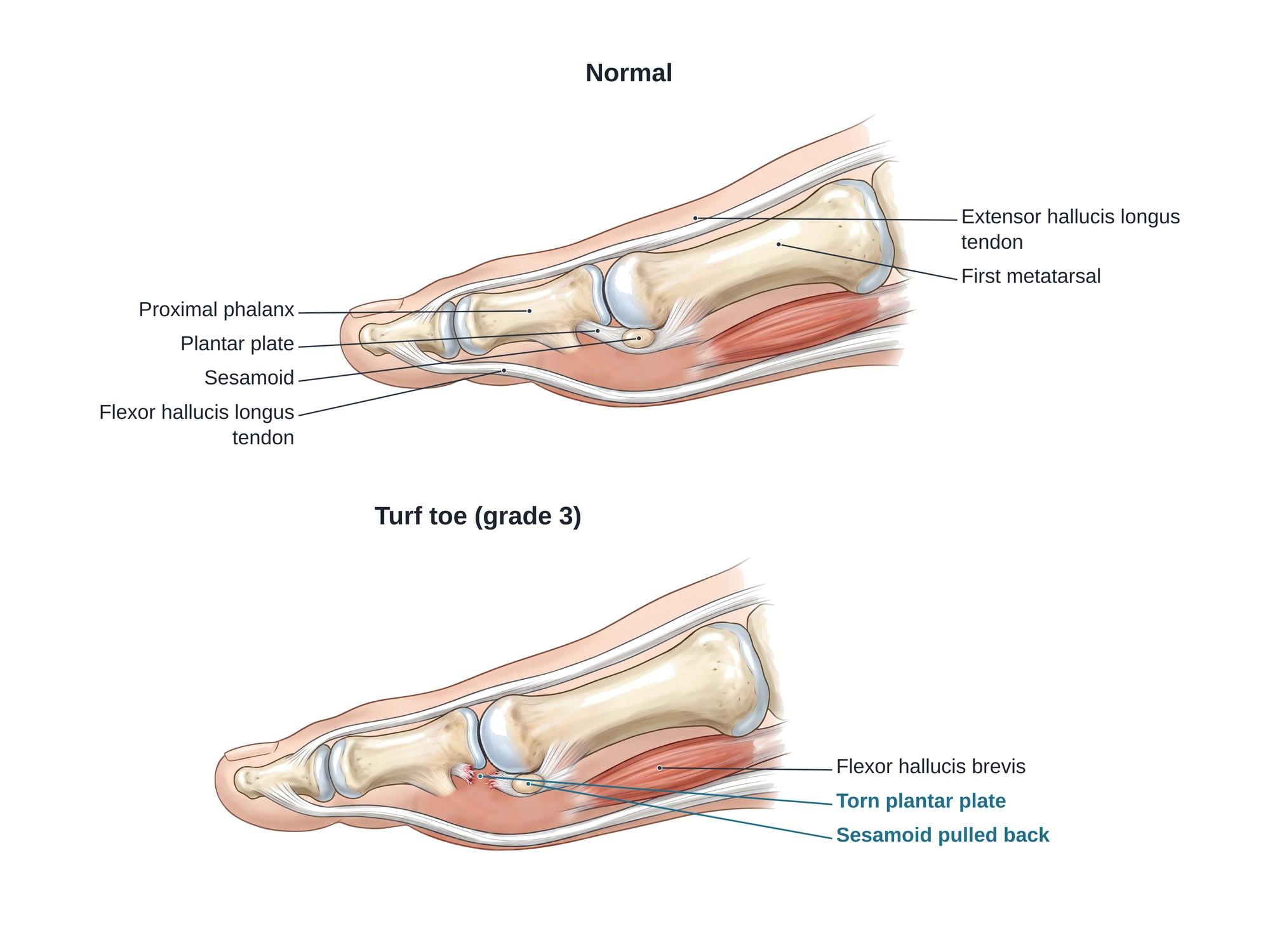
Turf toe is a sprain of the big toe joint. The joint is the first metatarsophalangeal (MTP) joint, where the first long foot bone (metatarsal) meets the first bone of the big toe (proximal phalanx). Under this joint lies the plantar plate, a thick pad of tough tissue that stops the toe from bending too far back (see foot bones anatomy). Two small bones, the sesamoids, sit in this pad under the head of the metatarsal. Turf toe happens when the big toe is forced too far up, which doctors call hyperextension. The plantar plate stretches or tears. In a survey of 80 professional football players, 45% had had turf toe, and 83% of them were first hurt on artificial turf (Rodeo et al., 1990). The illustration above shows a normal joint beside a complete (grade 3) tear.
Grades
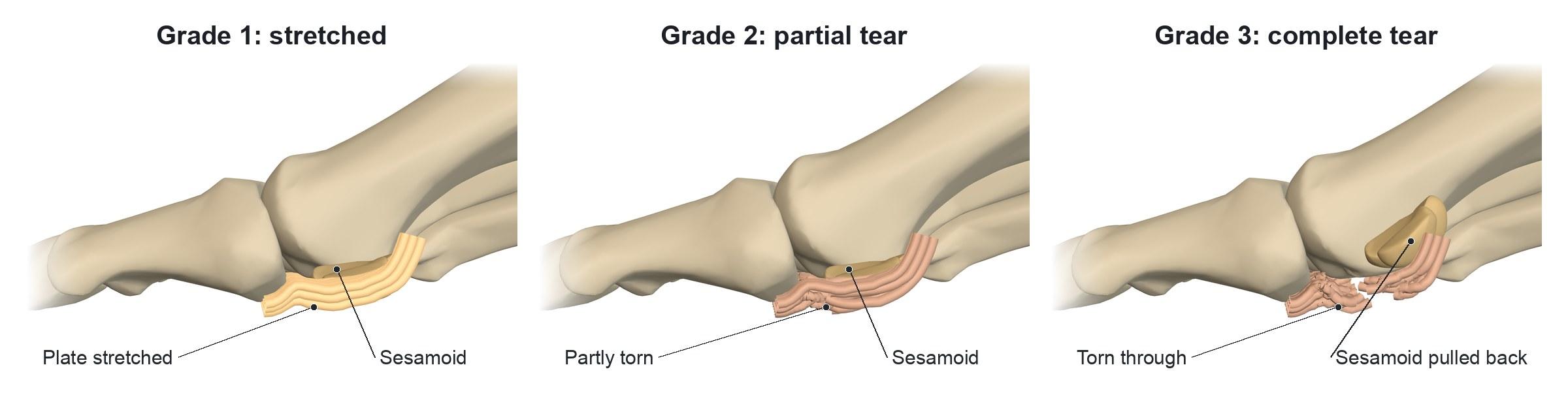
Turf toe is graded by how badly the plantar plate and joint capsule are torn (McCormick and Anderson, 2010). Grade 2 return times follow a newer review (Gupta et al., 2023).
- What is torn
- Plantar plate and capsule stretched
- What the doctor sees
- Mild swelling, little bruising
- Usual return to play
- As pain allows
- What is torn
- Partial tear
- What the doctor sees
- Moderate swelling, pain limits motion
- Usual return to play
- About 2 to 4 weeks, often with taping
- What is torn
- Complete tear
- What the doctor sees
- Marked swelling and bruising, weak toe, loose joint
- Usual return to play
- 10 to 16 weeks
A grade 3 tear, like the one in the illustration, often lets the sesamoids slide back toward the heel. The short flexor muscle of the big toe (flexor hallucis brevis) pulls them back once the plate no longer holds them.
Causes
The classic injury is a player on the ball of the foot, with the heel up and the big toe bent up. A load from behind, such as a tackle or another player falling on the leg, drives the big toe even further back. The plantar plate tears under the joint. In professional football players, hyperextension caused the injury in 85% of the players studied (Rodeo et al., 1990).
Risk factors include:
- Artificial turf. In college football, the injury rate was about 9 per 100,000 athlete-exposures on newer artificial turf, compared with about 5 on natural grass (George et al., 2014).
- Games. Players were nearly 14 times more likely to get turf toe in games than in practice (George et al., 2014).
- Position and sport. Running backs and quarterbacks were hurt most often. Turf toe also occurs in soccer, basketball, dance and wrestling (Gupta et al., 2023).
- Flexible shoes, which let the big toe bend further than a stiff sole would.
Symptoms
- Pain under and around the big toe joint, worse when pushing off
- Swelling of the big toe joint
- Bruising under the ball of the foot (grade 3)
- Pain or stiffness when bending the big toe up
- A weak big toe that cannot press down well
- A joint that feels loose, with a complete tear
Diagnosis
The doctor checks the joint for swelling, tenderness under the sesamoids, and the strength of the big toe. A drawer test, similar to the Lachman test of the knee, checks whether the toe slides up and down too much on the metatarsal head. Looseness suggests a complete tear.
Imaging helps grade the injury (McCormick and Anderson, 2010):
- X-rays look for a broken sesamoid or a chip of bone pulled off the toe. Comparing both feet shows whether the sesamoids have moved back toward the heel. On a side view with the toe bent up, the sesamoids fail to move forward with the toe when the plate is torn.
- MRI shows the soft tissues directly. It shows whether the plantar plate is stretched, partly torn or fully torn, and where.
Treatment
Most turf toe heals without surgery. In college football players, fewer than 2% of turf toe injuries needed an operation (George et al., 2014).
- Rest, ice, compression and elevation in the first days, with anti-inflammatory medicine for pain.
- Walking boot or cast for higher grades, with the toe held slightly bent down. This takes stress off the plantar plate while it heals.
- Taping the big toe so it cannot bend far back, once the first painful phase passes.
- A stiff shoe insert, such as a carbon-fiber turf toe plate, or an orthotic with a stiff extension under the big toe (a Morton's extension).
- Gentle motion of the joint, often starting 3 to 5 days after injury, so the joint does not stiffen.
- Surgery for a complete tear with a loose joint, a sesamoid that has pulled back, a broken sesamoid with a gap, the big toe drifting toward the second toe (traumatic hallux valgus), loose bone or cartilage in the joint, or pain that does not improve with treatment. The surgeon sews the torn plantar plate back to the proximal phalanx or to its torn edge.
Recovery
Recovery time depends on the grade and the treatment. A review of 121 turf toe injuries in athletes found a median return to sport of about 6 weeks without surgery and about 15 weeks after surgery (Vopat et al., 2019). Rehab after surgery protects the repair. The toe is usually kept non-weight-bearing in a splint for about 4 weeks, then the patient walks in a boot (McCormick and Anderson, 2010).
Athletes with low-grade injuries usually reach their old level of play. Among athletes with higher-grade injuries, about 70% keep their level of performance (Gupta et al., 2023). For a general look at ligament injuries elsewhere in the body, see sprain vs strain.
Complications
- Stiffness and arthritis of the big toe joint (hallux rigidus)
- Weak push-off, which affects running, jumping and cutting
- Traumatic hallux valgus, the big toe drifting toward the second toe after the inner side tears
- Sesamoid problems, such as a sesamoid that stays pulled back, a broken sesamoid or ongoing pain under the ball of the foot
- Chronic instability of the joint when a complete tear is missed or returns to sport too early
References
- Rodeo SA, O'Brien S, Warren RF, et al. Turf-toe: an analysis of metatarsophalangeal joint sprains in professional football players. Am J Sports Med. 1990;18(3):280-285.
- McCormick JJ, Anderson RB. Turf toe: anatomy, diagnosis, and treatment. Sports Health. 2010;2(6):487-494.
- George E, Harris AH, Dragoo JL, et al. Incidence and risk factors for turf toe injuries in intercollegiate football: data from the National Collegiate Athletic Association injury surveillance system. Foot Ankle Int. 2014;35(2):108-115.
- Gupta A, Singh PK, Xu AL, et al. Turf toe injuries in the athlete: an updated review of treatment options, rehabilitation protocols, and return-to-play outcomes. Curr Rev Musculoskelet Med. 2023;16(11):563-574.
- Vopat ML, Hassan M, Poppe T, et al. Return to sport after turf toe injuries: a systematic review and meta-analysis. Orthop J Sports Med. 2019;7(10):2325967119875133.
Related pages
- Foot anatomyThe normal anatomy of the foot.
- Avulsion injuryAn avulsion is tissue torn away from where it belongs: a flap of skin and fat, or a chip of bone pulled off by a tendon.
- Lisfranc injuryA Lisfranc injury is a sprain, fracture or dislocation of the midfoot joints. Learn the types, symptoms, why it is often missed, and treatment.
- Morton's neuromaMorton's neuroma is a thickened, pinched nerve between the third and fourth toes. Learn the symptoms, the squeeze test, the best shoes and treatment options.
- Plantar fasciitisPlantar fasciitis is painful thickening of the plantar fascia where it joins the heel bone. Learn the symptoms, causes, treatment and recovery time.
FAQ
Why is it called turf toe?+
The name comes from American football. It was first described in 1976 in football players on artificial turf. The hard surface and flexible shoes let the big toe bend too far back. It can also happen on grass.
How long does turf toe take to heal?+
It depends on the grade. A grade 1 sprain often lets an athlete return as soon as pain allows. A grade 2 tear usually needs about 2 to 4 weeks. A complete grade 3 tear can take 10 to 16 weeks, whether or not it needs surgery. In one review, athletes treated without surgery returned to sport after a median of about 6 weeks.
What are the grades of turf toe?+
Grade 1 is a stretch of the plantar plate and capsule with mild swelling. Grade 2 is a partial tear with more swelling and pain that limits motion. Grade 3 is a complete tear with marked swelling, bruising, a weak big toe and a loose joint.
Can you walk with turf toe?+
With a mild sprain, walking is usually possible, though pushing off the big toe hurts. With worse tears, the doctor may limit walking and use a boot or cast to protect the joint while it heals.
Does turf toe need surgery?+
Rarely. Fewer than 2% of turf toe injuries in college football players needed surgery. Surgery is for complete tears with a loose joint, a sesamoid that has pulled back, a broken sesamoid with a gap, a drifting big toe, or pain that does not improve with treatment.
Does taping help turf toe?+
Yes, for mild and moderate sprains. The big toe is taped so it cannot bend far back, often together with a stiff shoe insert called a turf toe plate. Taping supports the joint after the first painful phase. It does not repair a complete tear.
Is turf toe a broken toe?+
No. Turf toe is a soft tissue injury, a sprain of the ligaments and plantar plate under the big toe joint. It can come with a small bone injury, such as a cracked sesamoid or a chip of bone pulled off the toe, so X-rays are usually taken.
Can turf toe cause long-term problems?+
Yes, especially when a complete tear is missed. Possible long-term problems include stiffness and arthritis of the big toe joint, weak push-off, the big toe drifting toward the second toe, and ongoing pain under the ball of the foot.
Need this illustration for a patient or a case?
Describe the injury or upload a scan and get a clear, labeled medical illustration for a consult, a chart or a case exhibit.
Try Natomy →