Perineal Tear: Degrees, Causes, Repair & Recovery
A perineal tear is a tear of the skin and muscle between the vagina and anus during birth. Learn the four degrees, causes, repair, recovery and risks.
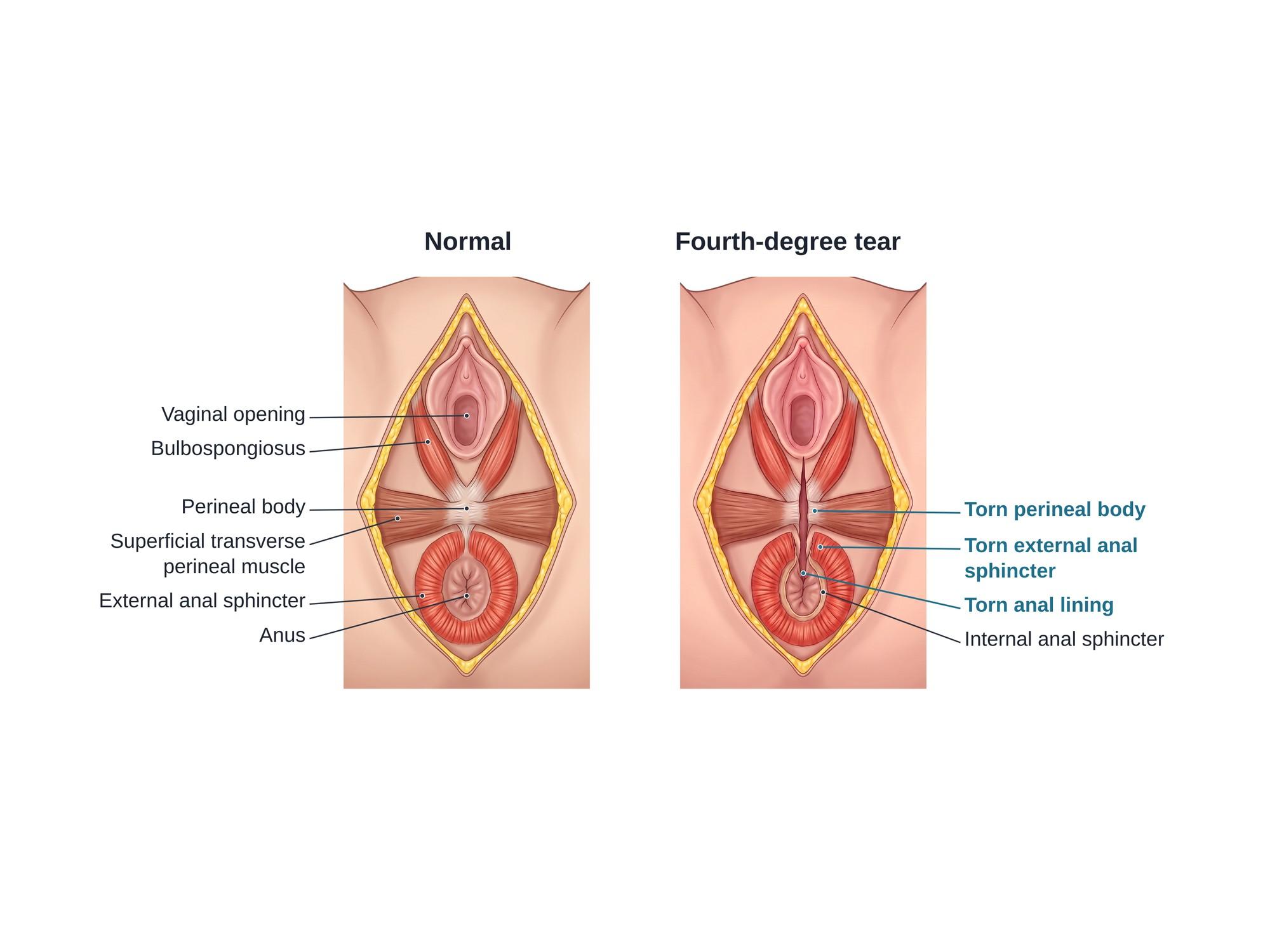
A perineal tear is a tear of the skin and muscle between the vaginal opening and the anus during a vaginal birth. This area, the perineum, holds the perineal body, a small knot of muscle and connective tissue where several pelvic floor muscles meet. Just behind it lies the anal sphincter, the ring of muscle that keeps the bowel closed (see female pelvis anatomy). Perineal trauma is very common, affecting about 9 in 10 women after a vaginal birth (Okeahialam et al., 2024). Most tears are minor. The serious ones reach the anal sphincter and are called obstetric anal sphincter injuries (OASI). The illustration above shows a normal perineum beside a fourth-degree tear.
Degrees
Doctors grade a perineal tear by how deep it goes (Miller and Vadakekut, 2026).
- What is torn
- Skin of the perineum or the lining of the vagina only
- Usual repair
- Often heals alone, or a few stitches
- What is torn
- Skin plus the perineal muscles, but not the anal sphincter
- Usual repair
- Stitched in layers in the delivery room
- What is torn
- Part or all of the anal sphincter
- Usual repair
- Repaired by an experienced doctor, often in the operating room
- What is torn
- The whole anal sphincter plus the lining of the anal canal or rectum
- Usual repair
- Layered repair of the lining and both sphincters in the operating room
Third-degree tears are split into three types. A 3a tear involves less than half the thickness of the external anal sphincter. A 3b tear involves more than half. A 3c tear also tears the internal anal sphincter, the inner smooth muscle ring that keeps the anus closed at rest. If doctors are unsure whether more than half is torn, they should call it 3b so the tear is not underestimated (RCOG, 2015).
Causes
The perineum tears when it is stretched faster or further than it can give as the baby's head and shoulders are born. Second-degree tears are about twice as common in first births, where they occur in about 40% of women (Okeahialam et al., 2024). Anal sphincter tears occur in about 3% of vaginal births. The rate is about 6% in first births and 2% in later births (same source).
Risk factors include:
- A first vaginal birth
- A large baby (higher birth weight)
- Forceps or vacuum delivery (operative vaginal birth)
- A baby facing up (occiput posterior position)
- A midline episiotomy, a straight cut toward the anus to widen the opening
- Induced or sped-up labor and an epidural
- A long pushing stage
- Shoulder dystocia, when a shoulder catches behind the pubic bone (RCOG, 2015) (see shoulder dystocia maneuvers)
- Asian ethnicity, in large studies
A mediolateral episiotomy, a cut angled away from the anus, lowers the risk of a sphincter tear in forceps and vacuum births in first-time mothers.
Symptoms
- Pain, swelling and bruising between the vagina and anus
- Stinging when passing urine
- Pain when sitting or walking in the first weeks
- Bleeding at the time of birth
- With a sphincter tear: urgency or trouble holding gas, liquid or solid stool
- With a fourth-degree tear: rarely, stool or gas passing through the vagina if a rectovaginal fistula forms
Diagnosis
- Exam right after birth. The doctor or midwife looks at the vagina and perineum in good light. A rectal exam, with a finger in the anus and the thumb on the perineum, checks whether the sphincter is intact. This step is the key to finding a sphincter tear.
- Grading. The tear is graded from first to fourth degree, including 3a, 3b or 3c, and written in the birth record.
- Endoanal ultrasound. A small probe in the anus shows both sphincter rings in cross section. It can show a gap in the muscle that was missed or did not heal. It is often used at follow-up for women with symptoms.
- Anal manometry. A pressure test that measures how strongly the sphincter squeezes.
Many sphincter tears are missed. In a study of 241 first-time mothers, the rate of anal sphincter injury rose from 11% to about 25% when an experienced doctor re-examined each woman. Midwives had missed 87% of the sphincter tears in their deliveries (Andrews et al., 2006).
Treatment
- First-degree tears that do not bleed and line up well may be left to heal. Others get a few dissolving stitches.
- Second-degree tears are closed in layers with dissolving stitches, often with one continuous stitch, in the delivery room under local anesthetic.
- Third- and fourth-degree tears are repaired by an experienced doctor, usually in the operating room under regional (spinal or epidural) or general anesthesia, with good light (RCOG, 2015). The torn anal lining is closed first. Then the internal sphincter is repaired. The torn ends of the external sphincter are brought together, either end to end or overlapped. The perineal muscles and skin are closed last.
- After a sphincter repair, women usually get antibiotics to lower the risk of infection and stool softeners or laxatives so bowel movements do not strain the repair (RCOG, 2015).
Recovery
- Pain usually eases within the first few weeks for minor tears, and takes longer for deeper ones.
- Ice packs, pain relief, a peri bottle to rinse with water, and sitz baths help.
- Stitches dissolve on their own over a few weeks.
- Pelvic floor physical therapy helps the muscles regain strength, especially after a sphincter tear.
- Women with a third- or fourth-degree tear should be offered a follow-up visit after birth, ideally in a specialist perineal clinic with anal ultrasound and pressure testing (RCOG, 2015).
Complications
- Anal incontinence, trouble controlling gas or stool. About 10% of women develop symptoms within a year of a vaginal birth, and a sphincter tear is a major risk factor (Okeahialam et al., 2024). The risk grows with the grade of the tear. In a network meta-analysis of 2,467 women, anal incontinence affected 22% after 3a tears and 29% after fourth-degree tears (Okeahialam et al., 2023).
- Infection of the wound
- Wound breakdown (see wound dehiscence), where the repair comes apart
- Rectovaginal fistula, an abnormal passage between the rectum and vagina, a rare result of a tear through the rectal lining that is missed or not repaired (RCOG, 2015)
- Pain during sex (dyspareunia) and long-term perineal pain
- Pelvic floor problems later in life, such as urinary incontinence or prolapse
References
- Okeahialam NA, Sultan AH, Thakar R. The prevention of perineal trauma during vaginal birth. American Journal of Obstetrics and Gynecology. 2024;230(3S):S991-S1004.
- Miller C, Vadakekut ES. Obstetric Perineal Lacerations. StatPearls Publishing, 2026.
- Andrews V, Sultan AH, Thakar R, et al. Occult anal sphincter injuries: myth or reality?. BJOG. 2006;113(2):195-200.
- Okeahialam NA, Taithongchai A, Thakar R, et al. The incidence of anal incontinence following obstetric anal sphincter injury graded using the Sultan classification: a network meta-analysis. American Journal of Obstetrics and Gynecology. 2023;228(6):675-688.e13.
- Royal College of Obstetricians and Gynaecologists. The Management of Third- and Fourth-Degree Perineal Tears (Green-top Guideline No. 29). RCOG, 2015.
Related pages
- Female pelvis anatomyThe normal anatomy of the female pelvis.
- Pelvic congestion syndromePelvic congestion syndrome is chronic pelvic pain from enlarged, refluxing pelvic veins. Learn the causes, symptoms and treatment.
- Placental abruptionPlacental abruption is when the placenta pulls away from the uterine wall before birth. Learn the causes, symptoms, concealed vs revealed types and treatment.
- Uterine ruptureUterine rupture is a tear through the full wall of the uterus, most often along an old C-section scar. Learn the symptoms, causes, VBAC risk and treatment.
FAQ
What is a 1st, 2nd, 3rd and 4th degree tear?+
A first-degree tear involves only the skin of the perineum or the lining of the vagina. A second-degree tear also goes into the perineal muscles. A third-degree tear reaches the anal sphincter, the ring of muscle that keeps the bowel closed. A fourth-degree tear goes all the way through the sphincter and into the lining of the anal canal or rectum.
Why does the perineum tear during birth?+
The perineum has to stretch a great deal as the baby's head is born. If it stretches faster or further than the tissue can take, it tears. A first baby, a large baby, a fast birth, forceps or vacuum delivery, a baby facing up (occiput posterior) and a midline episiotomy all raise the risk.
How common is a perineal tear?+
Very common. About 9 in 10 women have some perineal trauma after a vaginal birth. Most are first- or second-degree tears. Tears of the anal sphincter happen in about 3% of vaginal births, and in about 6% of first births.
How long does it take to recover from a 3rd-degree tear?+
Most women find the pain eases over the first few weeks, once the stitches dissolve and the skin heals. The sphincter muscle takes longer to regain strength. Pelvic floor physical therapy and a follow-up visit after birth, ideally in a specialist perineal clinic, are common. Some women have bowel symptoms that last longer.
How many stitches does a 2nd-degree tear need?+
There is no set number. Second-degree tears are usually closed with one long continuous dissolving stitch in layers, the vaginal lining, the muscle and then the skin, rather than many separate stitches. The stitches dissolve on their own over a few weeks.
Can a perineal tear be missed?+
Yes. In one study of 241 first-time mothers, the rate of anal sphincter injury rose from 11% to about 25% when an experienced doctor re-examined each woman right after birth. A careful exam that includes a rectal exam is the best way to find a sphincter tear so it can be repaired the same day.
How do I know if my perineal tear has reopened?+
Warning signs include pain that gets worse instead of better, a gap or open area at the stitches, pus or a bad smell, fever, and new trouble controlling gas or stool. Any of these should be checked by a doctor or midwife promptly.
Can I have another vaginal birth after a fourth-degree tear?+
Often, yes. The choice depends on how well the sphincter healed, any ongoing bowel symptoms and the results of anal ultrasound or pressure tests. Women who still have symptoms or a weak sphincter are often offered a planned cesarean birth.
Need this illustration for a patient or a case?
Describe the injury or upload a scan and get a clear, labeled medical illustration for a consult, a chart or a case exhibit.
Try Natomy →