Placental Abruption: Causes, Symptoms & Treatment
Placental abruption is when the placenta pulls away from the uterine wall before birth. Learn the causes, symptoms, concealed vs revealed types and treatment.
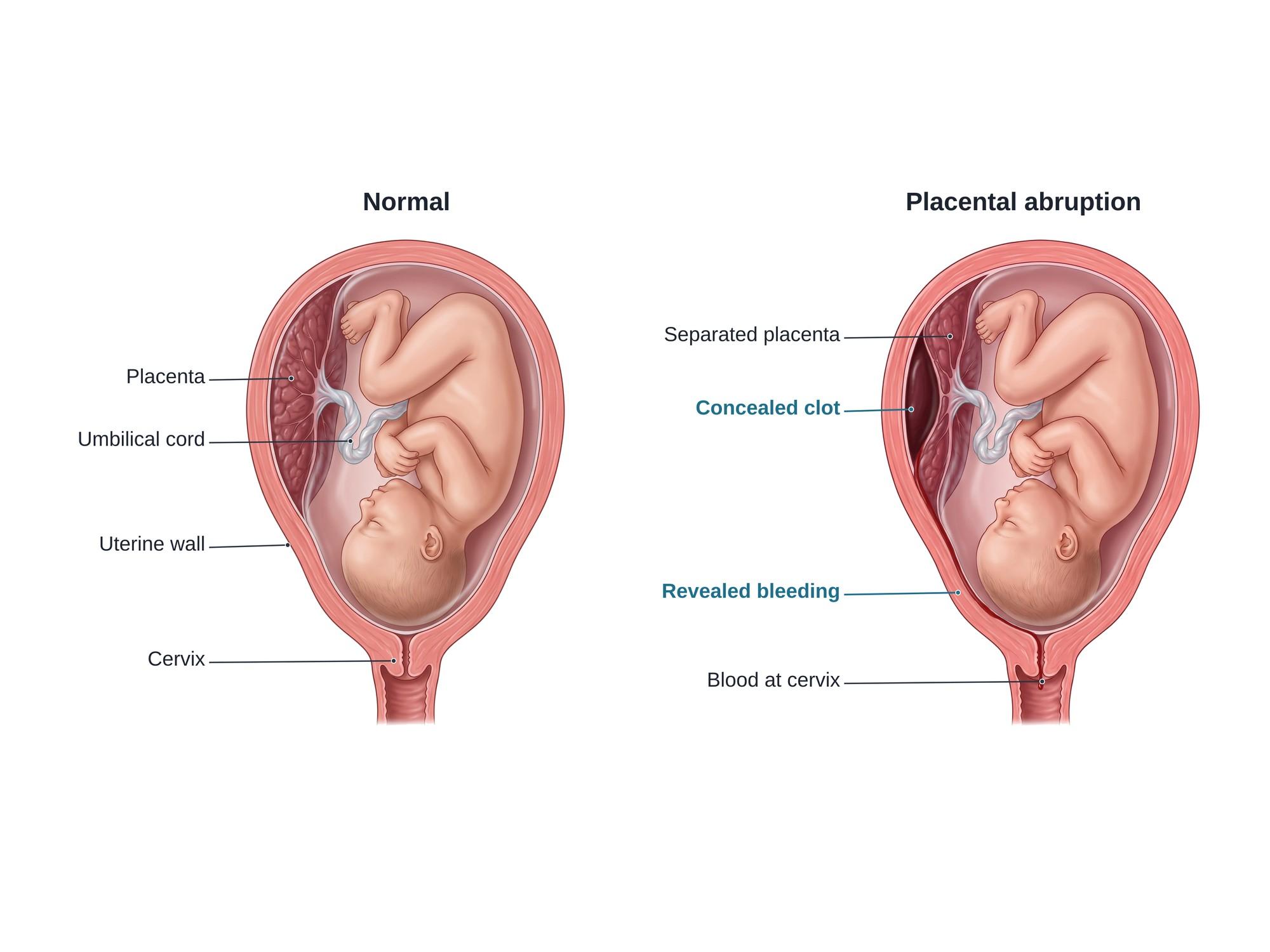
A placental abruption (also called abruptio placentae) is when the placenta separates from the inner wall of the uterus before the baby is born (Sullivan et al., 2025). The placenta is the disc-shaped organ that attaches to the uterine wall and passes oxygen and food from the mother's blood to the baby through the umbilical cord. When part of it pulls away, bleeding fills the gap and the baby loses part of its oxygen supply. The uterus sits in the pelvis and rises into the belly as pregnancy goes on (see female abdomen and pelvis anatomy). It is one of the main causes of bleeding in the second half of pregnancy. In a study of 80.2 million US deliveries, abruption rose from 1.2% of deliveries in 2000 to 1.6% in 2020 (Wright et al., 2026). Nearly half of abruptions happen at term, at 37 weeks or later (Brandt and Ananth, 2023). The illustration above shows a normal placenta beside one that has partly separated.
Types
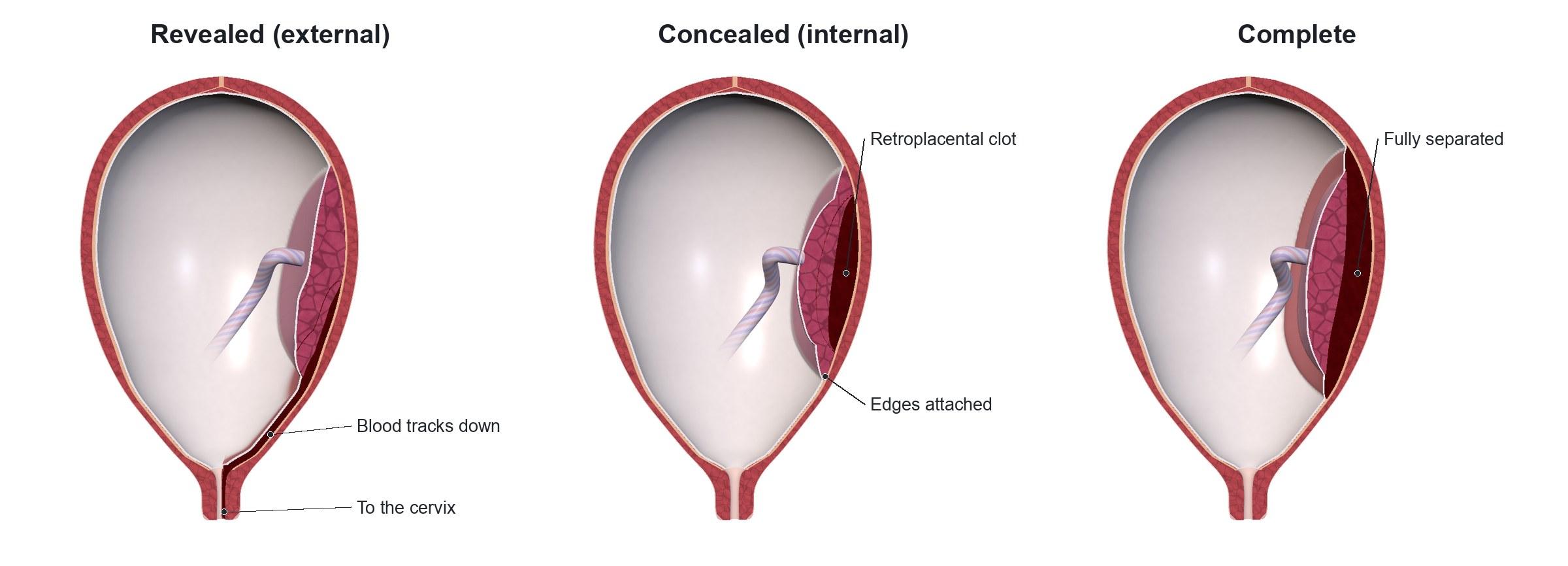
| Type | What happens | What the patient notices |
|---|---|---|
| Revealed (external) | Blood tracks down between the membranes and the uterine wall and leaves through the cervix | Visible vaginal bleeding, often with pain |
| Concealed (internal) | Blood is trapped behind the placenta as a clot (retroplacental clot) | Pain and a hard uterus with little or no bleeding |
| Mixed | Some blood is trapped and some comes out | Some bleeding, often less than the true blood loss |
| Partial | Only part of the placenta separates | Can be mild; the baby may still get enough oxygen |
| Complete | The whole placenta separates | An emergency; the baby's oxygen supply is cut off |
The type matters because the amount of bleeding a doctor can see does not match the real blood loss. A concealed abruption can be severe with no bleeding at all (Brandt and Ananth, 2023). Abruptions can also be acute, with sudden heavy bleeding, or chronic, with repeated light bleeding over weeks.
Causes
Abruption starts with bleeding from the small blood vessels in the decidua, the lining of the uterus where the placenta attaches. Blood collects behind the placenta and peels it off the wall. Two kinds of problems lead to this. Long-term disease of the vessels under the placenta weakens the attachment. A sudden force, such as a blow to the belly, can shear the placenta off.
Risk factors include:
- A prior abruption
- High blood pressure, either chronic hypertension or preeclampsia, a pregnancy disorder with high blood pressure and organ strain
- Smoking. In a review of 1,358,083 pregnancies, smoking raised the odds of abruption about 1.9 times. Up to a quarter of all abruptions were linked to smoking (Brandt and Ananth, 2023).
- Cocaine and other drug use
- Trauma to the belly, such as a car crash, a fall or intimate partner violence
- A sudden drop in pressure in the uterus, after the waters break with a lot of fluid or after the first twin is born
- Twins or more, maternal age 35 or older, and preterm premature rupture of membranes (PPROM), when the waters break early
A 2025 review of 54 studies with 7,267,241 pregnant women found that a prior abruption was the strongest risk factor in the mother's history. Among pregnancy problems, placenta previa carried the highest risk (Chen et al., 2025).
Car crashes. A blow or a sudden stop can create a shearing force between the uterus and the placenta. This force can tear the placenta off the wall.
Symptoms
Placental abruption symptoms can be mild or severe. They depend on how much of the placenta separates and whether the blood can escape.
- Vaginal bleeding, which may be light or heavy, or absent in a concealed abruption
- Belly or back pain, often sudden
- A hard, tender uterus that does not relax
- Contractions that come quickly, one after another
- Less movement from the baby
- Changes in the fetal heart rate, such as slowdowns (decelerations) on the monitor
- Signs of shock in the mother, such as a fast heart rate, low blood pressure, dizziness or confusion
Some people have a silent placental abruption with few or no symptoms. A small abruption may only be found when the placenta is examined after birth.
Diagnosis
Placental abruption is a clinical diagnosis. The team bases it on the symptoms, the exam and the fetal heart rate, after ruling out other causes of bleeding such as placenta previa (Brandt and Ananth, 2023).
- Fetal heart rate monitoring shows how the baby is coping. Repeated decelerations or a long slowdown are warning signs.
- Ultrasound may show a clot behind or at the edge of the placenta. But fresh blood can look like placenta on ultrasound, so a normal scan does not rule it out. In one study of 30 patients with abruption, ultrasound found only 57% of them (Brandt and Ananth, 2023).
- Blood tests check the blood count, blood type and clotting, including fibrinogen, a clotting protein that drops in a severe abruption.
- After a crash or fall, the mother and baby are usually monitored for several hours, even when there are no early signs.
- After birth, the placenta can show a clot on its back surface, which confirms the diagnosis.
Placental abruption vs placenta previa:
| Feature | Placental abruption | Placenta previa |
|---|---|---|
| Where the placenta is | In its normal place, but pulling away from the wall | Low in the uterus, over or near the cervix |
| Bleeding | Dark or red, may be hidden | Bright red |
| Pain | Usually painful | Classically painless |
| Uterus | Hard and tender | Soft and relaxed |
Treatment
Treatment depends on how severe the abruption is, how far along the pregnancy is, and how the mother and baby are doing.
- Stabilizing the mother. The team places large IV lines, gives fluids and blood products, and checks clotting. Severe bleeding may need a massive transfusion.
- Delivery for a significant abruption near term. Most abruptions at 34 weeks or later are managed by delivering the baby. If the baby is in distress, this usually means an emergency cesarean delivery (C-section). If the mother is stable and the baby is doing well, a vaginal birth may be possible.
- Watchful waiting for a small abruption early in pregnancy. When the bleeding is light and both mother and baby are stable, doctors may keep the mother in the hospital and monitor closely. They may give corticosteroids to help the baby's lungs mature before an early birth.
- Rh immune globulin for Rh-negative mothers, to prevent antibodies against the baby's blood.
- Treating complications, such as clotting failure or heavy bleeding after delivery.
There is no proven way to prevent most abruptions. Controlling blood pressure, not smoking and avoiding drugs remove known risk factors. In a car, the usual advice is to wear the lap belt under the belly and the shoulder belt between the breasts.
Recovery
- After a mild abruption, recovery is usually like recovery from any birth.
- After a cesarean, healing takes longer than after a vaginal birth.
- People who lost a lot of blood may need intensive care, more transfusions and a longer stay.
- Babies born early or short of oxygen may need care in the neonatal intensive care unit (NICU).
- A future pregnancy carries a higher risk. In a study of 126,264 US patients, 3.4% of those with an abruption in their first birth had another in their second, compared with 0.7% of those without one (Oyelese et al., 2024).
Complications
For the mother:
- Heavy bleeding and hemorrhagic shock
- Disseminated intravascular coagulation (DIC), a clotting failure where the body uses up its clotting factors and then bleeds. Abruption is the most common cause of DIC in pregnancy (Brandt and Ananth, 2023).
- Blood transfusion. In the US study of 80.2 million deliveries, abruption raised the odds of transfusion about 7 times (Wright et al., 2026).
- Couvelaire uterus, when blood seeps into the uterine muscle, seen at surgery
- Hysterectomy, removal of the uterus, when bleeding cannot be stopped
- Rarely, death
For the baby:
- Lack of oxygen, which can cause brain injury (hypoxic-ischemic encephalopathy) and cerebral palsy
- Preterm birth and its problems
- Poor growth in a chronic abruption
- Stillbirth or death after birth. In a large U.S. study of births in the 1990s, cited in one review, the perinatal death rate was about 120 per 1,000 births with abruption, compared with about 8 per 1,000 without it (Brandt and Ananth, 2023).
A uterine rupture is another labor emergency that causes pain, bleeding and loss of oxygen to the baby. Doctors consider it too, mainly in patients with a prior cesarean scar.
References
- Sullivan M, Skelly CL, Rouse C. Placental Abruption. StatPearls Publishing, 2025.
- Wright GL, Friedman A, Ananth CV, et al. Placental Abruption: Temporal Trends, Risk Factors, and Associated Adverse Maternal Outcomes. American Journal of Perinatology. 2026;43(6):855-861.
- Brandt JS, Ananth CV. Placental abruption at near-term and term gestations: pathophysiology, epidemiology, diagnosis, and management. American Journal of Obstetrics and Gynecology. 2023;228(5S):S1313-S1329.
- Chen D, Gao X, Yang T, et al. Independent risk factors for placental abruption: a systematic review and meta-analysis. BMC Pregnancy and Childbirth. 2025;25(1):351.
- Oyelese Y, Peltier M, Donovan B, et al. Placental abruption: Incidence and risk of recurrence in subsequent pregnancies. Journal of Obstetrics and Gynaecology Research. 2024;50(5):821-827.
Related pages
- Female pelvis anatomyThe normal anatomy of the female pelvis.
- Pelvic congestion syndromePelvic congestion syndrome is chronic pelvic pain from enlarged, refluxing pelvic veins. Learn the causes, symptoms and treatment.
- Perineal tearA perineal tear is a tear of the skin and muscle between the vagina and anus during birth. Learn the four degrees, causes, repair, recovery and risks.
- Uterine ruptureUterine rupture is a tear through the full wall of the uterus, most often along an old C-section scar. Learn the symptoms, causes, VBAC risk and treatment.
FAQ
What causes placental abruption?+
Most cases come from bleeding in the blood vessels between the placenta and the uterine wall. Long-term problems in those vessels, such as high blood pressure and preeclampsia, set the stage. A sudden force can also shear the placenta off the wall, such as a car crash, a fall or a blow to the belly. Smoking, cocaine use and a past abruption raise the risk too.
What are the first signs of placental abruption?+
The classic signs are vaginal bleeding and belly or back pain. The uterus may feel hard and tender, and contractions may come one after another. The baby may move less, and the fetal heart rate monitor may show signs of distress. With a concealed abruption, there may be little or no bleeding even when the abruption is severe.
What happens in a concealed placental abruption?+
In a concealed abruption, the blood stays trapped behind the placenta instead of flowing out through the cervix. The mother may have pain and a hard, tender uterus but little visible bleeding. Because the bleeding is hidden, blood loss is easy to underestimate. A complete concealed abruption can cut off the baby's oxygen and cause clotting problems in the mother.
Can a car accident cause placental abruption?+
Yes. The sudden force of a crash can shear the placenta away from the uterine wall. Signs may not show right away, so a pregnant person should be checked by a doctor after any crash.
Can induction cause placental abruption?+
A sudden drop in pressure inside the uterus can trigger an abruption, for example when the bag of waters is broken (amniotomy) with a lot of fluid, or right after the first twin is born. Doctors watch for this during labor.
Can the baby survive a placental abruption?+
Yes, most babies survive, especially with a small abruption or a fast delivery. The risk depends on how much of the placenta separates and how early in pregnancy it happens. In one review, about 120 of every 1,000 babies born after an abruption died around the time of birth, compared with about 8 per 1,000 without one. Much of that risk comes from being born early.
Can placental abruption happen again?+
Yes. In a large US study, 3.4% of people who had an abruption in their first birth had another in their second, compared with 0.7% of those who did not. Doctors watch the next pregnancy more closely and often plan an earlier delivery.
What is the difference between placental abruption and placenta previa?+
In placental abruption, a normally placed placenta pulls away from the wall, usually with pain and a hard uterus. In placenta previa, the placenta sits low and covers or nears the cervix. Previa classically causes painless, bright red bleeding. Both are causes of bleeding late in pregnancy.
Need this illustration for a patient or a case?
Describe the injury or upload a scan and get a clear, labeled medical illustration for a consult, a chart or a case exhibit.
Try Natomy →