Uterine Rupture: Symptoms, Causes, Risks & Treatment
Uterine rupture is a tear through the full wall of the uterus, most often along an old C-section scar. Learn the symptoms, causes, VBAC risk and treatment.
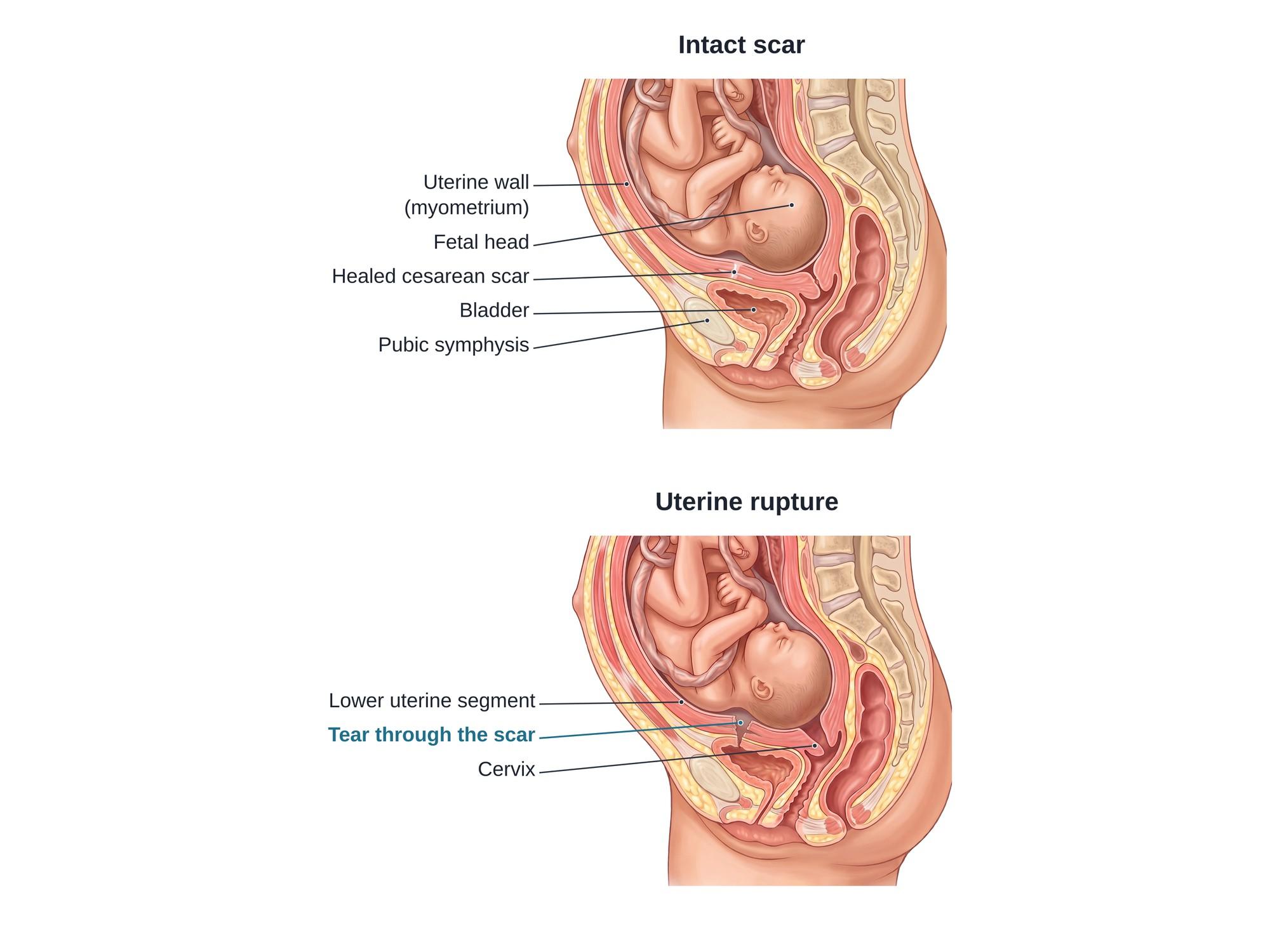
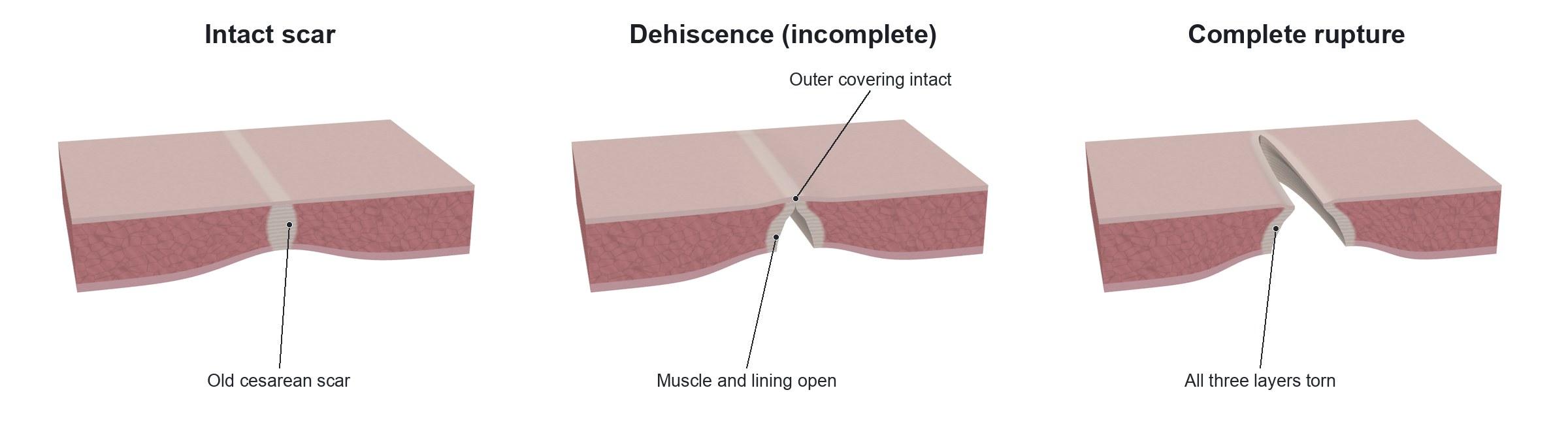
A uterine rupture is a tear through the full thickness of the wall of the uterus, the muscular organ that holds the baby during pregnancy. A full rupture splits all three layers: the inner lining (endometrium), the thick muscle layer (myometrium) and the thin outer covering (perimetrium) (Togioka and Tonismae, 2023). Most ruptures happen during labor, along an old cesarean scar in the lower uterine segment, the thinner lower part of the uterus just above the cervix and right behind the bladder (see female abdomen and pelvis anatomy). It is rare. In a study of 209,112 deliveries at one Shanghai hospital, complete or partial uterine rupture occurred in about 2 per 10,000 births. Only 37% of these were complete ruptures, and 93% were in a uterus with a scar (Wan et al., 2022). It is an emergency for both the mother and the baby. The illustration above shows an intact cesarean scar beside a scar that has torn through.
Types
| Type | What it means | Why it matters |
|---|---|---|
| Complete rupture | A tear through all three layers of the wall, open to the belly | The baby, placenta or cord can move out of the uterus; needs emergency surgery |
| Dehiscence (incomplete) | The scar separates, but the outer covering stays intact | Often found by chance at a repeat cesarean; usually no symptoms |
| Scar rupture | A tear along an old cesarean or other surgical scar | The most common kind |
| Unscarred rupture | A tear in a uterus with no prior surgery | Rare; linked to obstructed labor, trauma or strong labor drugs |
Where the scar is also matters. A low transverse scar runs side to side across the lower uterine segment, the usual cesarean cut today. A classical scar runs up and down the thick upper part of the uterus, and it carries a much higher risk of rupture in labor. In the Wan study, 59% of ruptures were in the front of the lower uterine segment, where most cesarean scars lie (Wan et al., 2022).
Causes
A uterine rupture happens when the force of labor is more than a weak spot in the wall can hold. The weak spot is most often a scar.
Risk factors include:
- A prior cesarean, the main cause. The risk is highest during a trial of labor after cesarean (TOLAC), an attempt at vaginal birth after cesarean (VBAC).
- A classical or T-shaped uterine incision, which goes into the thick upper uterus.
- Induction or augmentation of labor, using medicines such as oxytocin, a hormone that makes contractions stronger, or prostaglandins, which soften the cervix.
- A short time between pregnancies since the last cesarean.
- More than one prior cesarean.
- Other uterine surgery, such as myomectomy, the removal of fibroids.
- Obstructed labor, when the baby cannot come down through the pelvis.
- Trauma, such as a car crash or a fall onto the belly.
- Placenta accreta, where the placenta grows into the uterine wall.
Labor drugs raise the risk in TOLAC. In a review of 14 studies with 48,457 women laboring after one cesarean, rupture occurred in 1.4% when oxytocin was used and in 0.5% when it was not. It also occurred in 2.2% of induced labors and 0.7% of labors that started on their own (Zhang et al., 2021).
Symptoms
Uterine rupture symptoms can come on fast. Not every patient has all of them.
- A sudden change in the fetal heart rate, such as a long slowdown (prolonged deceleration or bradycardia), often the first and most common sign
- Sudden, severe belly pain, or pain that does not ease between contractions
- Pain at the site of the old scar
- Vaginal bleeding
- Contractions that slow down or stop
- The baby's head moving back up in the pelvis (loss of fetal station)
- A fast heart rate, low blood pressure or signs of shock in the mother
- Blood in the urine, when the tear reaches the bladder
An epidural can hide the pain, so heart rate changes on the monitor are often the main clue. In the Wan study, changes in the fetal heart rate were the most reliable sign of rupture (Wan et al., 2022).
Diagnosis
- During labor. Uterine rupture is a clinical diagnosis. The team suspects it from a sudden change in the fetal heart rate, new pain, bleeding or a drop in the mother's blood pressure. There is no time for a scan in most cases.
- Confirmed at surgery. The diagnosis is confirmed during the emergency cesarean or laparotomy, when the surgeon sees the tear in the wall.
- Ultrasound. In a stable patient, ultrasound may show fluid in the belly, a baby or part of the baby outside the uterus, or a gap in the wall. Before labor, ultrasound can also measure how thin the lower uterine segment is over an old scar.
- CT or MRI. These are used only in stable patients, such as after trauma or when a rupture outside labor is suspected.
Treatment
Uterine rupture is treated with emergency surgery.
- Delivery. The baby is delivered right away by emergency cesarean through a cut in the belly (laparotomy). Speed matters, since the baby may lose its oxygen supply within minutes.
- Stopping the bleeding. The team gives fluids and blood products and controls bleeding from the torn wall. See exploratory laparotomy for how the abdomen is opened and checked.
- Repair or hysterectomy. When the tear is clean and bleeding is controlled, the surgeon sews the uterine wall closed in layers. When the tear is large or bleeding cannot be stopped, the uterus is removed (hysterectomy).
- Checking nearby organs. The bladder, ureters and blood vessels next to the uterus are checked and repaired when injured.
Preventing it. Women with a prior cesarean are counseled about the risks of TOLAC and a repeat cesarean. TOLAC should take place where the team can do an emergency cesarean quickly, with continuous fetal heart rate monitoring and careful use of oxytocin.
Recovery
- After a cesarean with uterine repair, most women stay in the hospital for several days.
- Women who needed many blood transfusions or a hysterectomy may need intensive care and a longer stay.
- Full healing of the belly and uterus takes about 6 weeks or more.
- After a repaired rupture, a future pregnancy carries a high risk of rupture again. A planned cesarean before labor is usually advised.
- After a hysterectomy, the woman cannot carry another pregnancy.
- Babies who were short of oxygen may need care in the neonatal intensive care unit (NICU), sometimes with cooling therapy to protect the brain.
Complications
For the mother:
- Heavy bleeding (hemorrhage) and the need for blood transfusion
- Hysterectomy and loss of fertility
- Bladder injury, since the lower uterine segment lies right against the bladder
- Infection
- Rarely, death. In a WHO survey of 37,366 women with a prior cesarean in 29 countries, rupture occurred in 0.5%, and women with a rupture had about 4 times the odds of dying (Motomura et al., 2017).
For the baby:
- Lack of oxygen and brain injury (hypoxic-ischemic encephalopathy), which can lead to cerebral palsy
- Death. In the same WHO survey, the odds of perinatal death were about 33 times higher after a rupture (Motomura et al., 2017).
In the large NICHD study of 17,898 women in labor after a cesarean, 124 (0.7%) had a symptomatic rupture. Seven babies born at term had hypoxic-ischemic encephalopathy after a rupture, including 2 who died (Landon et al., 2004).
References
- Togioka BM, Tonismae T. Uterine Rupture. StatPearls Publishing, 2023.
- Wan S, Yang M, Pei J, et al. Pregnancy outcomes and associated factors for uterine rupture: an 8 years population-based retrospective study. BMC Pregnancy and Childbirth. 2022;22(1):91.
- Zhang H, Liu H, Luo S, et al. Oxytocin use in trial of labor after cesarean and its relationship with risk of uterine rupture in women with one previous cesarean section: a meta-analysis of observational studies. BMC Pregnancy and Childbirth. 2021;21(1):11.
- Motomura K, Ganchimeg T, Nagata C, et al. Incidence and outcomes of uterine rupture among women with prior caesarean section: WHO Multicountry Survey on Maternal and Newborn Health. Scientific Reports. 2017;7:44093.
- Landon MB, Hauth JC, Leveno KJ, et al. Maternal and perinatal outcomes associated with a trial of labor after prior cesarean delivery. New England Journal of Medicine. 2004;351(25):2581-2589.
Related pages
- Female pelvis anatomyThe normal anatomy of the female pelvis.
- Pelvic congestion syndromePelvic congestion syndrome is chronic pelvic pain from enlarged, refluxing pelvic veins. Learn the causes, symptoms and treatment.
- Perineal tearA perineal tear is a tear of the skin and muscle between the vagina and anus during birth. Learn the four degrees, causes, repair, recovery and risks.
- Placental abruptionPlacental abruption is when the placenta pulls away from the uterine wall before birth. Learn the causes, symptoms, concealed vs revealed types and treatment.
FAQ
What are the first signs of uterine rupture?+
The most common early sign is a sudden change in the baby's heart rate on the monitor, such as a long slowdown (prolonged deceleration or bradycardia). The mother may also have sudden belly pain, pain between contractions, vaginal bleeding, a fast heart rate or low blood pressure. Contractions may stop, and the baby's head may move back up in the pelvis.
What does uterine rupture feel like?+
Many women describe a sudden, sharp or tearing pain in the lower belly. Pain can keep going between contractions. But an epidural can hide the pain, and some ruptures cause little pain at all, which is why heart rate monitoring of the baby matters so much.
How common is uterine rupture?+
It is rare. In a study of more than 209,000 deliveries, complete or partial rupture happened in about 2 of every 10,000 births. The risk is higher with a scar on the uterus. In a large US study of women who labored after a cesarean, about 0.7% had a uterine rupture.
What is the risk of uterine rupture after one C-section?+
For a woman with one prior low transverse cesarean who goes into labor, the risk is usually quoted below 1%. In one large US study, it was about 0.7%. Inducing or speeding up labor with oxytocin raises the risk, and a classical (vertical) incision in the upper uterus raises it much more.
Can you have a uterine rupture without a previous C-section?+
Yes, but it is very rare. Ruptures of an unscarred uterus are linked to obstructed labor, trauma such as a car crash, many prior births, strong labor drugs, and abnormal placenta attachment. Surgery on the uterus, such as removal of fibroids (myomectomy), also leaves a scar that can rupture.
Can the baby survive a uterine rupture?+
Most babies survive when the team recognizes the rupture and delivers quickly, often within minutes. The risk comes from loss of oxygen when the placenta separates or the baby moves out of the uterus. Brain injury from low oxygen, called hypoxic-ischemic encephalopathy, and death can happen when delivery is delayed.
Can you get pregnant again after a uterine rupture?+
Often yes, if the uterus was repaired and not removed. A future pregnancy carries a high risk of another rupture, so doctors usually advise a planned cesarean before labor starts. Doctors also often advise waiting a while before getting pregnant again, so the repair can heal.
Is uterine rupture the same as uterine dehiscence?+
No. A uterine rupture goes through all three layers of the uterine wall. A dehiscence is a partial separation of the scar that does not go through every layer. A dehiscence is often found by chance at a repeat cesarean and usually causes no symptoms.
Need this illustration for a patient or a case?
Describe the injury or upload a scan and get a clear, labeled medical illustration for a consult, a chart or a case exhibit.
Try Natomy →