Wound Dehiscence: Types, Causes & Treatment
Wound dehiscence is when a surgical incision splits open. Learn what dehiscence means, partial vs full-thickness types, causes, treatment and risks.
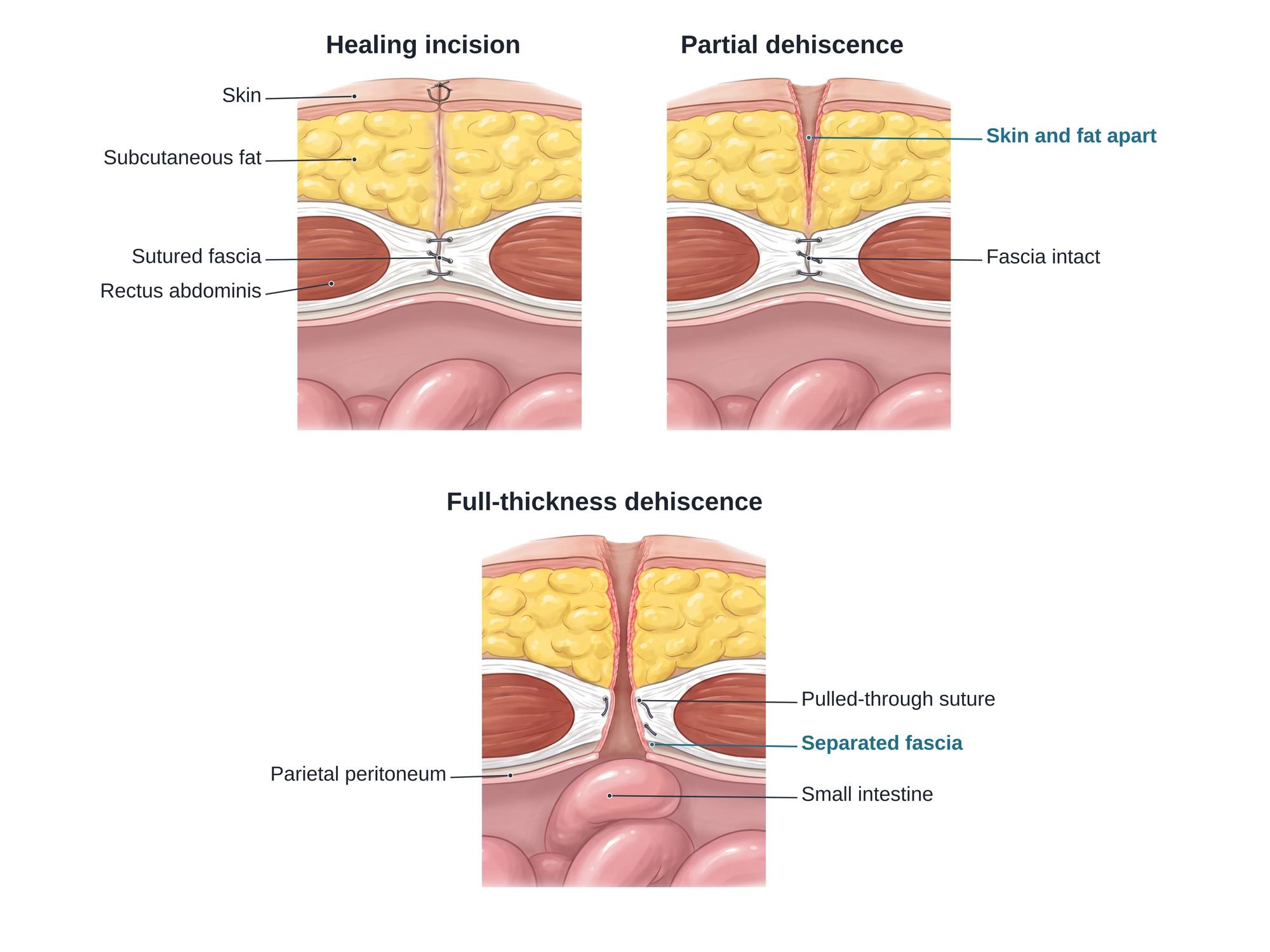
Wound dehiscence is when a closed surgical incision splits open. The word dehiscence means "bursting open." It happens most often after abdominal surgery, usually in the first one to two weeks. An abdominal incision is closed in layers. The skin and subcutaneous fat (the fat under the skin) are on top. Under them is the fascia, a tough sheet of connective tissue that holds the abdominal wall together. In a midline incision, this is the linea alba, the strip of fascia between the two rectus abdominis muscles. In a partial dehiscence, only the skin and fat open. In a full-thickness, or fascial, dehiscence, the fascia also gives way. In a Danish study of 14,169 patients who had open colon cancer surgery, 3.9% developed abdominal wound dehiscence (Jensen et al., 2022). The figure above shows a healing incision beside both types. For the organs under the wall, see the abdominal organs.
Types
| Type | What opens | How serious |
|---|---|---|
| Partial (superficial) dehiscence | Skin and subcutaneous fat; the fascia stays closed | Common; usually treated with wound care |
| Full-thickness (fascial) dehiscence | Skin, fat, fascia and often the peritoneum | Serious; usually needs surgery |
| Evisceration | Full-thickness opening with bowel or other organs pushed out through the wound | Surgical emergency |
A full-thickness dehiscence of an abdominal incision is also called a burst abdomen. Evisceration is the most severe form. The bowel comes out through the opening. Some fascial dehiscences stay hidden under closed skin. These may show up later as an incisional hernia.
Causes
A wound opens when the force on it is greater than the strength of the closure. That can happen because the tissue is weak, the stitches fail, or pressure inside the abdomen rises.
- Wound infection. Infection weakens the tissue and is one of the strongest risk factors.
- Raised abdominal pressure. Coughing, vomiting, straining, a swollen bowel (ileus) or fluid in the abdomen (ascites) all strain the closure.
- Technical factors. Stitches that are too far apart, too tight or too close to the edge can cut through the fascia. A knot can also slip or break.
- Fluid under the wound. A seroma or hematoma can push the edges apart.
- Patient factors. Obesity, older age, smoking, diabetes, poor nutrition, anemia, steroid use, cancer and chemotherapy all slow healing.
- Emergency surgery. Operations done in a rush on sick patients, such as an exploratory laparotomy after trauma, carry a higher risk.
A Swedish registry study of 30,050 open colorectal cancer operations found several independent risk factors for reoperation due to dehiscence. These included age over 70, male sex, a BMI over 30, chronic obstructive pulmonary disease (COPD) and generalized inflammatory disease (Söderbäck et al., 2019).
Symptoms
- A sudden gush of thin, pink fluid from the incision, a warning sign of a fascial dehiscence
- A feeling that something "popped" or gave way, often with a cough or strain
- Wound edges that pull apart, with a visible gap
- Redness, warmth, swelling or pus if the wound is infected
- Pain at the incision that gets worse instead of better
- Bowel or fatty tissue (omentum) visible in the wound, in evisceration
Diagnosis
Wound dehiscence is diagnosed at the bedside. The doctor looks at the wound and gently probes it with a sterile swab. This shows how deep the opening goes and whether the fascia is intact. A swab may be sent to the lab if the wound looks infected. If the skin is closed but a fascial dehiscence is suspected, a CT scan can show the gap in the abdominal wall. It can also show fluid collections or an abscess under the wound.
Treatment
Partial dehiscence is usually treated without surgery:
- Wound cleaning. Dead or infected tissue is removed (debridement).
- Dressings. The wound is packed with moist dressings and left to heal from the bottom up.
- Negative pressure wound therapy. A sealed foam dressing attached to a gentle vacuum can speed healing of larger wounds.
- Antibiotics if there is infection.
- Delayed closure. Once the wound is clean, the surgeon may stitch it closed again.
Full-thickness dehiscence is a surgical problem. The exposed bowel is covered with sterile, saline-soaked dressings. The patient goes back to the operating room. The surgeon cleans the wound and closes the fascia again. A mesh may be added to reinforce the repair. When the abdomen is too swollen or infected to close, a temporary open-abdomen dressing is used until it can be closed later.
Mesh can lower the risk of a later hernia. In a 2021 meta-analysis, an incisional hernia formed after 31% (67 of 218) of plain suture repairs, compared with 11% (19 of 171) of synthetic mesh repairs (Denys et al., 2021).
Prevention
Good closure technique is the main defense. Surgeons close the fascia with a continuous, slowly absorbable stitch using many small bites close to the edge. In high-risk patients, a mesh may be placed when the abdomen is first closed. In a randomized trial of high-risk emergency laparotomy patients, fascial dehiscence occurred in 14% (7 of 52) with sutures alone and in none of the 63 patients who also got an onlay mesh (Lima et al., 2020). Other steps include treating infection early, controlling blood sugar, stopping smoking, improving nutrition and splinting the wound with a pillow when coughing.
Recovery
Recovery depends on the type. A partial dehiscence often heals in several weeks with dressings. A large open wound can take months. After a fascial repair, patients usually stay in the hospital longer. They should avoid heavy lifting for several weeks. An abdominal binder may give support. The final scar is often wider than the first one and can be raised, like a hypertrophic scar.
Complications
Fascial dehiscence is a serious event. In a Danish cohort of 543 emergency midline laparotomies, a burst abdomen occurred in 4.4% of patients. Those patients had more complications and longer, harder hospital stays (Kvist et al., 2024). In the colon cancer study above, 5-year survival was 42% with dehiscence, compared with 53% without it (Jensen et al., 2022).
- Evisceration of the bowel through the wound
- Wound infection and abscess
- Incisional hernia, a bulge of bowel through the weak scar
- Enterocutaneous fistula, an abnormal channel from the bowel to the skin
- Repeat dehiscence after the repair
- Death, mainly in older and very sick patients
References
- Jensen KK, Oma E, van Ramshorst GH, et al. Abdominal wound dehiscence is dangerous: a nationwide study of 14,169 patients undergoing elective open resection for colonic cancer. Hernia. 2022;26(1):75-86.
- Söderbäck H, Gunnarsson U, Martling A, et al. Incidence of wound dehiscence after colorectal cancer surgery: results from a national population-based register for colorectal cancer. International Journal of Colorectal Disease. 2019;34(10):1757-1762.
- Denys A, Monbailliu T, Allaeys M, et al. Management of abdominal wound dehiscence: update of the literature and meta-analysis. Hernia. 2021;25(2):449-462.
- Lima HVG, Rasslan R, Novo FCF, et al. Prevention of fascial dehiscence with onlay prophylactic mesh in emergency laparotomy: a randomized clinical trial. Journal of the American College of Surgeons. 2020;230(1):76-87.
- Kvist M, Jensen TK, Snitkjær C, et al. The clinical consequences of burst abdomen after emergency midline laparotomy: a prospective, observational cohort study. Hernia. 2024;28(5):1861-1870.
FAQ
What does dehiscence mean?+
Dehiscence means splitting or bursting open. In medicine it usually describes a surgical wound whose edges come apart after they were closed. The word is also used for other closed tissues that reopen, such as a suture line inside the body.
What is partial wound dehiscence?+
Partial, or superficial, dehiscence is when the skin and the fat under it open but the deep fascia stays closed. It is the less dangerous form. It is usually treated with wound care and heals from the bottom up over weeks.
How is a burst abdomen managed?+
A burst abdomen is a full-thickness dehiscence of an abdominal incision. The bowel is covered with sterile, moist dressings and the patient goes back to the operating room. The surgeon cleans the wound and closes the fascia again, often with mesh, or uses a temporary closure if the abdomen is swollen or infected.
What are two common causes of postoperative wound evisceration?+
Two common causes are infection of the wound and raised pressure inside the abdomen, such as from coughing, vomiting or a swollen bowel. Both put strain on a weak fascial closure. Obesity, poor nutrition and steroid use add to the risk.
Can wound dehiscence heal on its own?+
A small partial dehiscence often heals on its own with dressings and time. This is called healing by secondary intention, and it can take several weeks. A full-thickness dehiscence of the fascia does not heal safely on its own and needs a surgeon.
Can a scar reopen after months?+
A well-healed skin scar rarely splits open. Months later, a weak spot in the fascia under the scar is more likely to bulge as an incisional hernia. A scar that opens late should be checked for infection, a retained stitch or a hernia.
How long does wound dehiscence take to heal?+
Healing time depends on the depth and size of the wound and on the patient's health. A small superficial opening may close in a few weeks. A large open wound or a repaired fascial dehiscence can take months to heal fully.
Is wound dehiscence a medical emergency?+
A small skin opening is not usually an emergency, but the surgeon should see it soon. A sudden gush of pink fluid, a wide opening, or bowel visible in the wound is an emergency. Cover the wound with a clean, moist dressing and get help right away.
Need this illustration for a patient or a case?
Describe the injury or upload a scan and get a clear, labeled medical illustration for a consult, a chart or a case exhibit.
Try Natomy →