Kyphoplasty: Procedure, Recovery & Risks
Kyphoplasty fills a compression-fractured vertebra with bone cement after a balloon makes space. See the kyphoplasty procedure illustrated step by step.
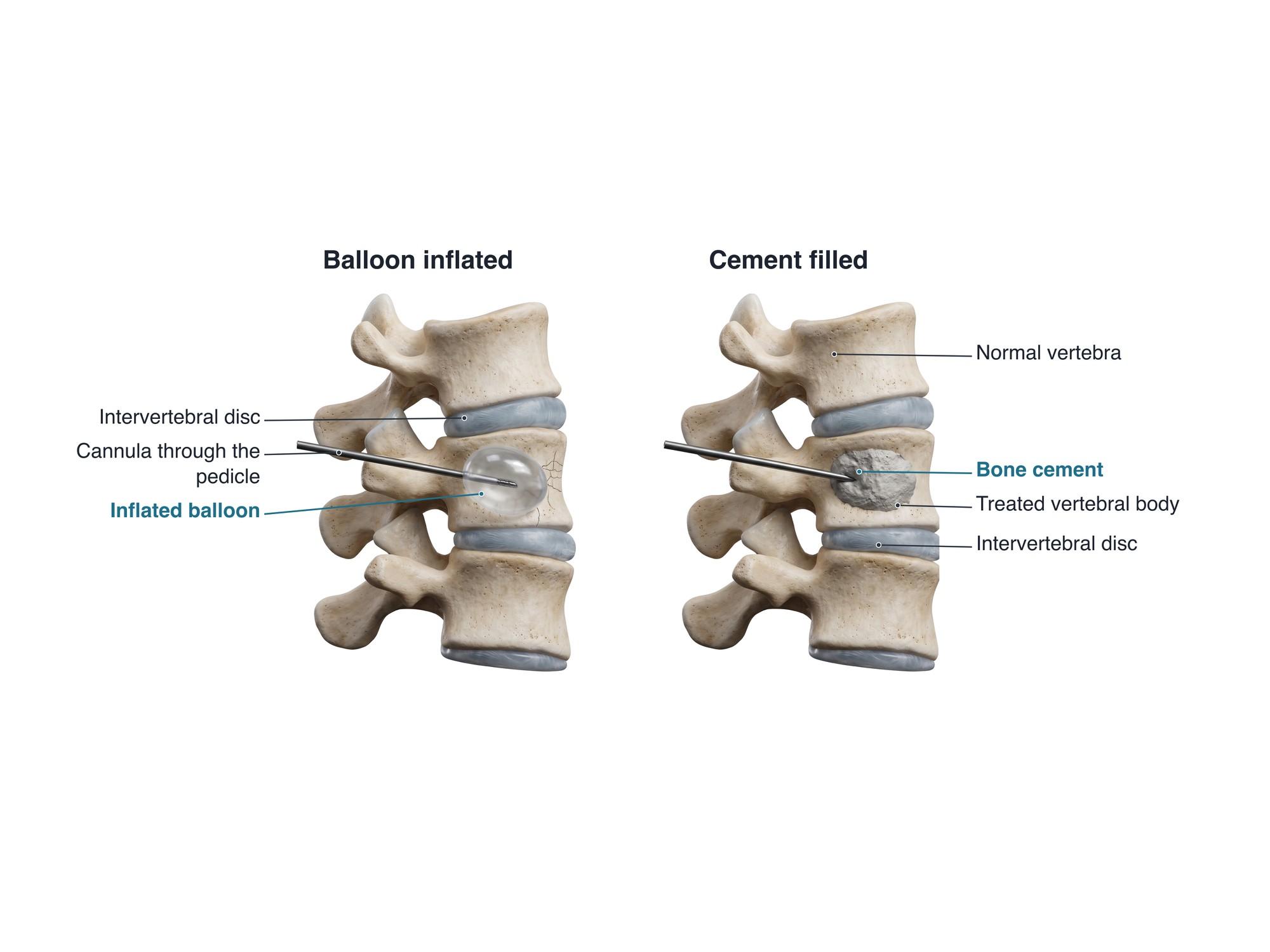
Kyphoplasty is a minimally invasive procedure that treats a painful compression fracture, a collapse of the vertebral body (the solid block at the front of each vertebra). Through a needle in the back, a small balloon is inflated inside the broken bone to make a space. The space is then filled with bone cement, which hardens in minutes and stabilizes the fracture. It is also called balloon kyphoplasty or vertebral augmentation. The illustration above shows the balloon inflated inside a fractured vertebra, then the same vertebra filled with cement.
Why it is done
Kyphoplasty is used for a compression fracture that stays very painful despite rest, pain medicine and sometimes a brace. Most of these fractures are caused by osteoporosis, which makes bone thin and weak. Others come from cancer that has spread to the spine, multiple myeloma, or trauma such as a fall.
The goals are to:
- Relieve pain quickly
- Stabilize the broken vertebra so it does not collapse further
- Restore some of the lost height and reduce the forward bend of the spine (kyphosis)
- Get the patient walking sooner
It works best when the fracture is recent, usually within a few weeks to months. MRI can show whether the fracture is still healing (bone marrow swelling). Kyphoplasty is not used for burst fractures with bone pushed into the spinal canal, or when an infection is present.
How the surgery is done
Kyphoplasty usually takes about an hour per vertebra. The patient lies face down. Live X-ray (fluoroscopy) guides every step.
- Anesthesia. Light sedation with numbing medicine, or general anesthesia.
- Needle access. A small skin nick is made over the back. A hollow tube called a cannula is guided through the pedicle, the bony bridge that joins the back of the vertebra to the vertebral body. Often one is placed on each side.
- Balloon inflation. A deflated balloon is passed through the cannula into the vertebral body. It is slowly inflated with contrast fluid. The balloon pushes the collapsed bone apart and leaves a cavity, as shown in the left panel above.
- Cement injection. The balloon is removed. Thick bone cement (usually polymethyl methacrylate, PMMA) is injected into the cavity under low pressure, as shown in the right panel.
- Closing. The cement hardens in about 10 to 20 minutes. The cannula is removed, and the small incision is closed with a stitch or skin glue.
Vertebroplasty is a related procedure. It injects cement straight into the bone without a balloon.
Recovery
- Most patients go home the same day or the next morning.
- Many feel less pain within 24 to 48 hours.
- Walking starts right away. Most return to normal daily activity in about 1 to 2 weeks.
- Heavy lifting and bending are avoided for about 6 weeks.
- Physical therapy for posture and back strength helps prevent new fractures.
- A bone density test and osteoporosis treatment are important, because one osteoporotic fracture raises the risk of the next.
Risks
Serious complications are uncommon. They include:
- Cement leakage outside the vertebra, into the disc, nearby veins, or rarely the spinal canal. Most leaks cause no symptoms. A leak near a nerve can cause pain or weakness.
- Cement embolism, where cement travels through veins to the lungs, rare
- New fractures of nearby vertebrae, mostly from the underlying osteoporosis
- Infection or bleeding at the needle site
- Nerve injury from the needle, rare
- Reactions to sedation or anesthesia
How kyphoplasty is shown in a personal injury case
Kyphoplasty often follows compression fractures from car crashes, falls from ladders, and falls in nursing homes. It turns a fracture claim into a surgical one, which affects medical costs and damages. The defense may argue the fracture was old or due to osteoporosis. An illustration of the plaintiff's own fractured vertebra, before and after kyphoplasty, shows the jury which level broke and how it was repaired. It also explains the cement visible on later imaging. For how these images are used at trial, see demonstrative evidence and medical legal illustration. For the normal anatomy, see thoracic spine anatomy and lumbar spine anatomy.
Related pages
FAQ
How long does it take to recover from kyphoplasty?+
Most people go home the same day or the next morning. Many notice less pain within a day or two. Light activity such as walking starts right away, and most people return to normal daily activity within about 1 to 2 weeks. Heavy lifting is usually avoided for about 6 weeks.
Does kyphoplasty really work?+
For a painful osteoporotic compression fracture that has not improved with rest and medicine, most patients report faster pain relief than with non-surgical care alone. Results are best when the fracture is recent and MRI shows active healing (bone marrow swelling). Studies on long-term benefit are mixed, so careful patient selection matters.
What is the difference between vertebroplasty and kyphoplasty?+
Both inject bone cement into a fractured vertebra through a needle. In kyphoplasty, a balloon is first inflated inside the bone to make a cavity and sometimes restore some height. The cement then fills that cavity under lower pressure. Vertebroplasty injects cement directly into the bone without a balloon.
Is kyphoplasty permanent?+
The cement hardens within minutes and stays in the vertebra for life. The treated vertebra does not collapse further. Kyphoplasty does not treat osteoporosis, though, so other vertebrae can still fracture later.
Is kyphoplasty safe for elderly patients?+
Kyphoplasty is done mostly in older adults with osteoporosis. It is a minimally invasive procedure, often under light sedation, with a low rate of serious complications. Heart and lung health, blood thinners, and infection are reviewed before it is done.
What exercises help after kyphoplasty?+
Walking is encouraged from the first day. Physical therapy then focuses on posture and on strengthening the back extensor muscles, which support the spine and lower the risk of new fractures. Twisting, bending forward to lift, and high-impact exercise are avoided until the surgeon clears them.
What is the best sleeping position after a compression fracture or kyphoplasty?+
Most people are comfortable on their back with a pillow under the knees, or on their side with a pillow between the knees. Getting out of bed by rolling to the side and pushing up with the arms (log rolling) avoids twisting the spine.
Are there long-term restrictions after kyphoplasty?+
Most people have no permanent restrictions. Doctors usually advise avoiding heavy lifting and repeated forward bending, and treating the underlying osteoporosis to prevent new fractures.
Need a surgical illustration for consent or a case?
Describe the operation and get a clear, labeled medical illustration for patient consent, teaching or a case exhibit.
Try Natomy →