Distal Radius Fracture Surgery: Plate, Recovery & Risks
Distal radius fracture surgery fixes a broken wrist with a plate and screws. See the volar locking plate beside the original fracture, plus recovery time.
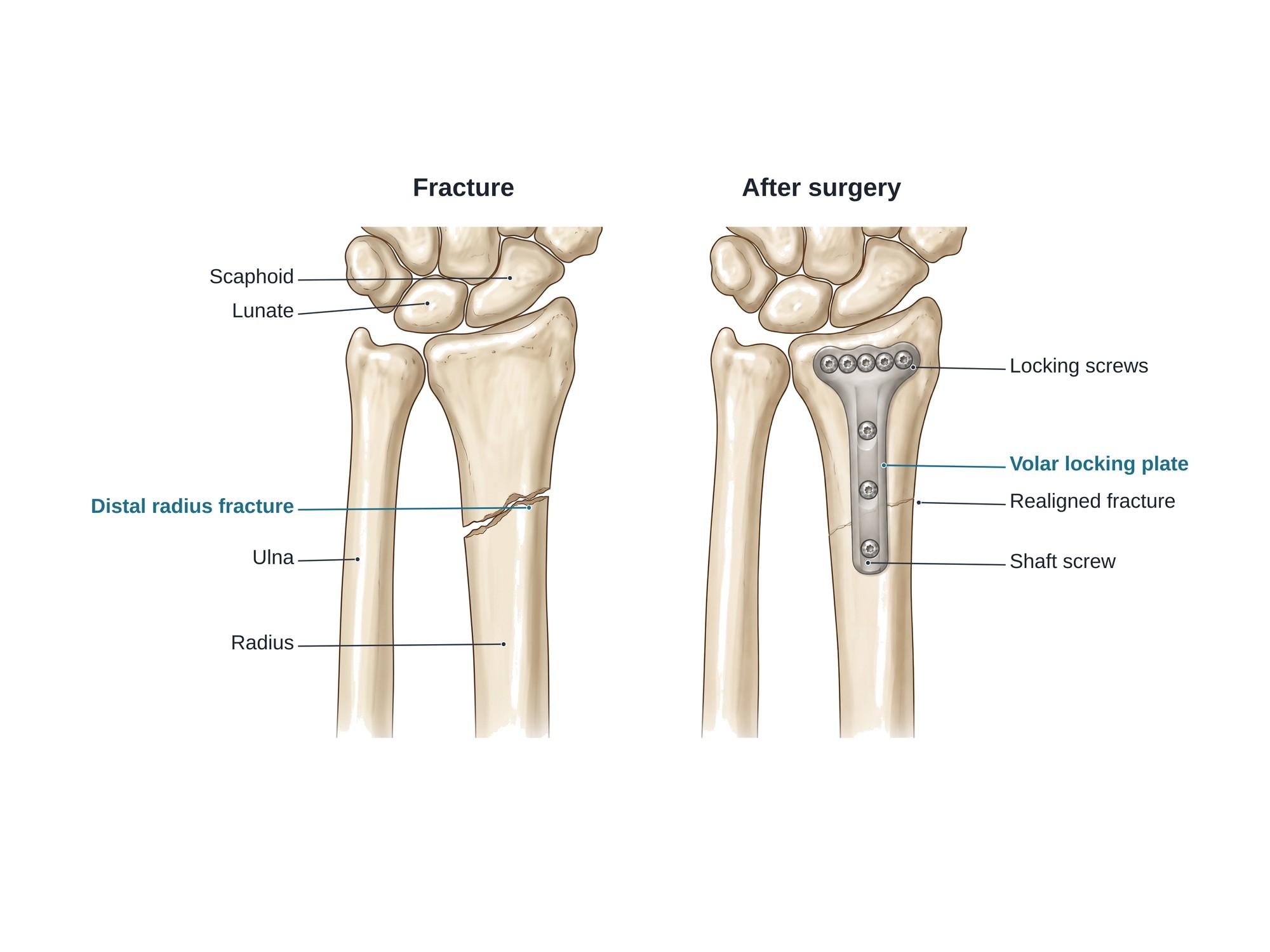
Distal radius fracture surgery fixes a broken wrist by putting the pieces of bone back in line and holding them with metal. The distal radius is the wide lower end of the radius, the forearm bone on the thumb side. The most common surgery is open reduction and internal fixation (ORIF) with a volar locking plate. "Open reduction" means the surgeon opens the skin to line up the bone. "Internal fixation" means metal inside the body holds it. "Volar" means the palm side. The illustration above shows a distal radius fracture, then the same wrist held with a plate and screws.
Why it is done
A distal radius fracture is one of the most common broken bones. It usually happens in a fall on an outstretched hand, a car crash, or a sports injury. Many of these fractures heal well in a splint and then a cast. Surgery is done when a cast cannot hold the bone in a good position. Common reasons are:
- Displacement. The broken end has shifted, tilted or shortened the radius. A displaced fracture toward the back of the hand is a Colles fracture.
- Instability. The fracture slips again after it is set (closed reduction).
- A joint step. The break runs into the wrist joint and leaves an uneven surface. Uneven joint surfaces wear out faster.
- Comminution. The bone is broken into several pieces.
- Open fracture. The bone has broken through the skin.
- Nerve pressure. Numbness in the thumb, index and middle fingers can mean pressure on the median nerve.
For a broken wrist, treatment ranges from a splint, to a cast, to surgery. The choice depends on the fracture pattern, the patient's age and activity, and their hand dominance.
How the surgery is done
Volar plating usually takes about 1 to 2 hours. It is often done as outpatient surgery. Anesthesia is general, or a nerve block that numbs the arm.
- Incision. A cut about 6 to 8 cm long is made on the palm side of the wrist, along the thumb side of the forearm.
- Exposure. The surgeon moves tendons and the radial artery aside. A thin muscle over the radius, the pronator quadratus, is lifted off the bone.
- Reduction. The fracture pieces are lined up with the shaft. Live X-ray (fluoroscopy) checks the length, tilt and joint surface.
- Plate. A volar locking plate is placed on the front of the radius. Its wide head sits just below the joint surface.
- Screws. Locking screws go through the head of the plate into the broken end. They thread into the plate and form a fixed frame, which holds even soft bone. More screws fix the plate to the radius shaft.
- Checks and closing. The surgeon checks the wrist on X-ray, often repairs the pronator quadratus over the plate, and closes the skin.
Other options include an external fixator (a frame outside the skin), pins (K-wires), or a plate on the back of the wrist. Volar plating is the most common choice in adults.
Hardware
- Volar locking plate. A thin T-shaped plate of titanium or stainless steel shaped to fit the front of the distal radius.
- Distal locking screws. A row of screws under the joint surface. They support the broken end like the legs of a table.
- Shaft screws. Screws through the long part of the plate into the radius shaft.
See ORIF surgery for the same idea on an ankle.
Recovery
- A splint is worn for about 1 to 2 weeks after surgery. Many patients then switch to a removable brace.
- Finger motion starts right away to limit swelling and stiffness.
- Hand therapy usually starts within 2 weeks. It works on wrist motion, then grip strength.
- The bone usually heals in about 6 to 8 weeks.
- Heavy lifting and contact sports usually wait about 3 months.
- Strength and motion keep improving for 6 to 12 months. Older patients may take longer.
After surgery with a plate and screws, many people regain good use of the hand. Some keep mild stiffness or a weaker grip.
Risks
- Stiffness of the wrist and fingers, the most common problem.
- Tendon irritation or rupture. A screw tip that pokes out the back of the radius can wear on an extensor tendon. A plate set too close to the joint can rub a flexor tendon on the palm side.
- Median nerve problems, such as new or worse carpal tunnel symptoms.
- Complex regional pain syndrome (CRPS), a pain condition with swelling, color change and stiffness out of proportion to the injury.
- Loss of position, where the fracture shifts before it heals.
- Infection and wound problems.
- Arthritis of the wrist over years, more likely when the fracture entered the joint.
- Hardware removal, a second surgery if the plate or screws cause pain.
How distal radius fracture surgery is shown in a personal injury case
A broken wrist from a fall or a car crash often looks minor at first. Surgery changes that picture. It adds an operation, permanent hardware, weeks out of work, and months of hand therapy. It can also bring lasting stiffness, weak grip and later arthritis, which matter for a plaintiff's job and daily life. X-rays show the plate as a bright shape that a jury cannot easily read. A side by side illustration of the plaintiff's own fracture and the plate that now holds it shows what was broken and what was done to fix it. For how these images are used at trial, see demonstrative evidence and medical legal illustration. For the normal bones and joints of the wrist, see hand and wrist anatomy. A nearby wrist injury that is easy to miss is the scaphoid fracture.
Related pages
FAQ
When does a broken wrist need surgery?+
Surgery is usually advised when the fracture is unstable, slips after it is set, or leaves the radius too short or too tilted. A step in the joint surface, many fragments, an open fracture, or nerve symptoms also point toward surgery. Many simple fractures heal well in a cast.
How long does it take to recover from wrist surgery?+
The bone usually heals in about 6 to 8 weeks. Most people use the hand for light tasks within a few weeks. Strength and motion keep improving for 6 to 12 months, so full recovery often takes most of a year.
How much time off work after a broken wrist?+
Desk workers often return within 1 to 2 weeks, typing with care. Jobs that need lifting, gripping or using tools usually take 6 to 12 weeks, and sometimes longer. The surgeon and therapist set the timing based on healing and grip strength.
Do the plate and screws stay in my wrist forever?+
Usually, yes. The plate is meant to stay for life. It is removed only if it rubs on a tendon, causes ongoing pain, or gets infected. Removal is a smaller second surgery done after the bone has healed.
What are the side effects of a metal plate in the wrist?+
Most people do not feel the plate. Some notice stiffness, a sore spot, or cold sensitivity. Less often, a screw tip irritates a tendon on the back of the wrist, or the plate rubs a tendon on the palm side. These problems may lead to plate removal.
What is the difference between a Colles fracture and a Smith fracture?+
Both are fractures of the distal radius. In a Colles fracture the broken end tilts toward the back of the hand, usually from a fall on an outstretched hand. In a Smith fracture it tilts toward the palm. Both can be fixed with a volar plate when surgery is needed.
What is a radial styloid fracture?+
The radial styloid is the bony point on the thumb side of the wrist. A fracture through it is also called a chauffeur's fracture. It often enters the joint and may be fixed with screws or a plate to keep the joint surface smooth.
What are the long-term effects of a broken wrist?+
Many people recover well. Some keep stiffness, weaker grip, or aching with weather or heavy use. A joint surface that heals uneven can lead to wrist arthritis over years. Older patients and fractures that enter the joint are more likely to have lasting problems.
Need a surgical illustration for consent or a case?
Describe the operation and get a clear, labeled medical illustration for patient consent, teaching or a case exhibit.
Try Natomy →