Calcaneus Fracture (Broken Heel): X-ray & Recovery
A calcaneus fracture is a break of the heel bone, usually from a fall from a height. See a tongue-type fracture on X-ray, with causes and recovery.
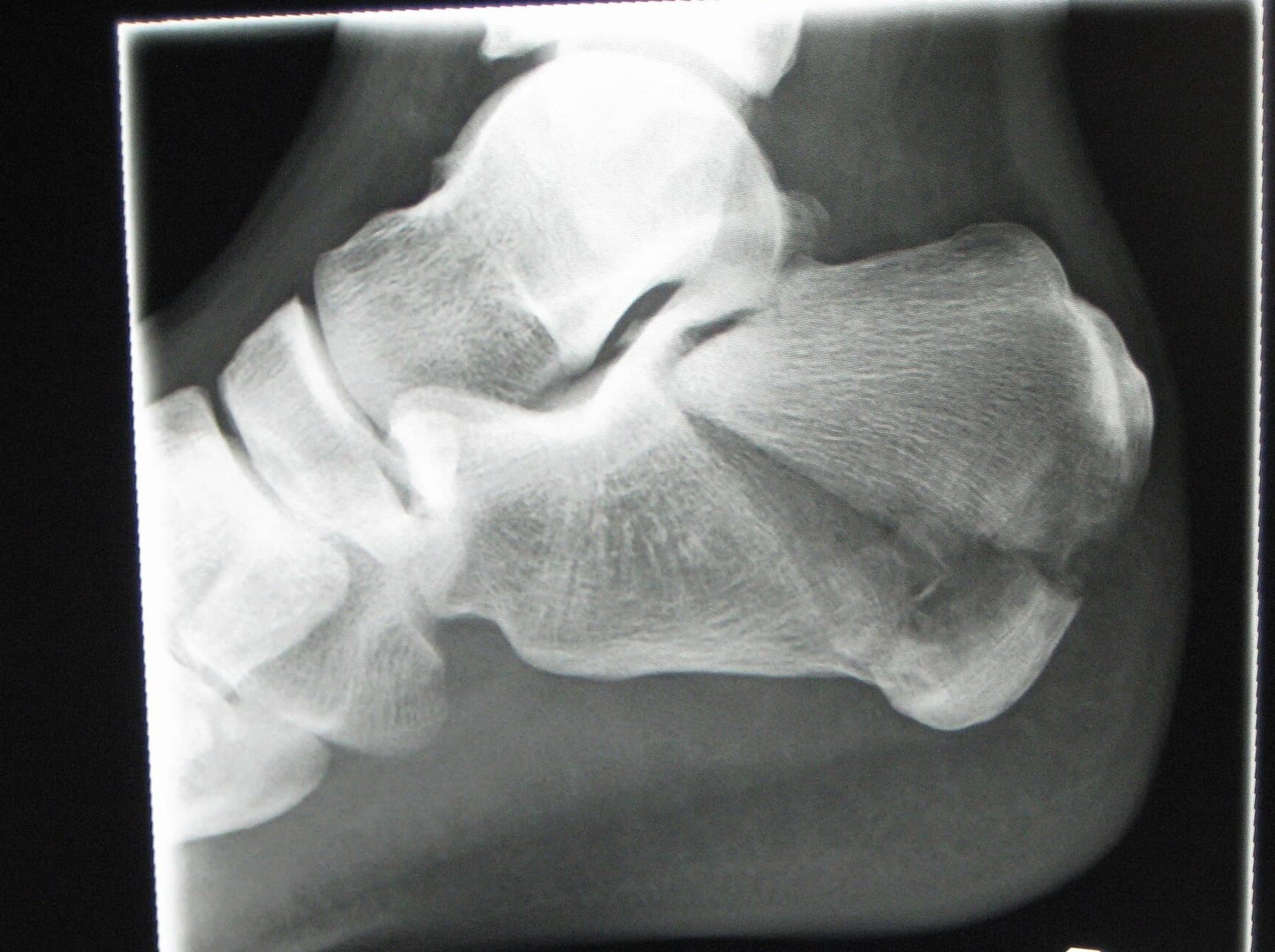
A calcaneus fracture is a break of the heel bone, the largest bone of the foot. It usually comes from a fall from a height or a jump, landing on the heels, and it often involves the subtalar joint beneath the ankle, which makes it one of the more disabling foot injuries. The X-ray above shows a calcaneus fracture in a right foot after a fall of about 8 feet off a roof.
The calcaneus
The calcaneus forms the heel. Its top carries the posterior facet of the subtalar joint, on which the talus sits, and its back is the tuberosity where the Achilles tendon attaches. In front, it meets the cuboid. The calcaneus is built mostly of spongy bone with a thin shell, so it tends to crush and break into several pieces. For the normal bones of the foot, see foot bones anatomy.
Types of calcaneus fracture
- Intra-articular: about three quarters of calcaneus fractures, extending into the subtalar joint. Divided into tongue-type, where the main fracture line exits at the back of the heel (as on this page), and joint-depression, where it exits just behind the joint and the joint surface sinks.
- Extra-articular: fractures that spare the joint, such as tuberosity avulsions and fractures of the front process.
- Stress fractures: in runners and military recruits; see stress fracture.
Calcaneus fracture on X-ray
A side view, a front view of the ankle and an axial (heel) view are taken, and CT is standard for planning treatment. On the X-ray above, a fracture runs from just in front of the posterior facet, back and down through the body of the calcaneus to the back of the heel. It splits off the upper back part of the bone as a tongue fragment that carries the subtalar joint surface under the talus, and that fragment has sunk and tilted, flattening the top of the heel: a displaced tongue-type fracture.
| Finding | Why it matters |
|---|---|
| Bohler's angle (normally about 20 to 40 degrees) | A flattened angle means the heel has collapsed |
| Angle of Gissane | Increases when the joint surface is depressed |
| Subtalar joint involvement | The main driver of long-term arthritis |
| Heel width and height | Widening causes shoe-wear problems and tendon impingement |
| Tongue fragment pressing on the skin | Can need urgent surgery |
Because a fall onto the heels sends force up the skeleton, doctors also check the other heel and the lumbar spine: about 1 in 10 people with a calcaneus fracture also have a spinal compression fracture. See compression fracture.
How a calcaneus fracture happens
The typical injury is a fall from a ladder, roof or scaffold, landing on the heels, which drives the talus down into the calcaneus. Car crashes, when the foot is jammed against the floor or pedals, and jumps from a height cause the same fracture. It is common in construction and industrial workers.
Symptoms
- Severe heel pain and inability to bear weight
- Swelling and bruising that can spread to the sole and arch
- A wider or flatter heel
- Blistering of the skin from severe swelling
- Pain in the lower back if the spine was also injured
Treatment
- Non-surgical: elevation, a splint or boot, and no weight bearing for about 6 to 12 weeks, for non-displaced fractures or patients at high risk of wound problems.
- ORIF: a plate and screws through an incision on the outer heel, to restore the joint surface and the heel's height and width.
- Minimally invasive fixation: screws through small incisions, increasingly used to lower wound complications.
- Urgent reduction: for tongue-type fragments that press on the skin.
- Subtalar fusion: for severely shattered joints, either early or later for arthritis.
Recovery time
Weight bearing is usually restricted for about 6 to 12 weeks, followed by months of physical therapy. Most people take 6 to 12 months to reach their final level of function, and many have some lasting heel or ankle pain, especially on uneven ground.
Complications
- Subtalar arthritis
- Wound breakdown and infection, especially after open surgery, in smokers and in diabetics
- Heel widening with tendon impingement and shoe-wear problems
- Compartment syndrome of the foot
- Chronic pain and stiffness
How a calcaneus fracture is shown in a personal injury and workplace case
Calcaneus fractures are classic construction and workplace injuries: falls from ladders, roofs and scaffolding, often in claims about missing fall protection. They are also common in car crashes with footwell intrusion. Many people never return to heavy or ladder work. Jurors struggle to read an X-ray like the one above. An illustration drawn from the patient's own X-ray or CT shows how the talus crushed the heel bone and why the joint is likely to become arthritic. For how these images are used at trial, see demonstrative evidence and medical legal illustration.
Related pages
- Foot anatomyThe normal bones, joints and soft tissues of the foot.
- Jones fractureA Jones fracture is a break of the fifth metatarsal where its base meets the shaft, an area that heals slowly. See one on X-ray beside a labeled illustration.
- Stress fractureA stress fracture is a small crack from repeated loading, often invisible on X-ray for weeks. See one on MRI beside a labeled illustration.
FAQ
How does a calcaneus fracture happen?+
Most come from a fall from a height or a jump, landing on the heels, so the talus is driven down into the calcaneus like a wedge. Car crashes where the foot is jammed against the pedals cause the same injury. Because it often happens on both sides, a fall from a height can break both heels.
How long does a broken heel take to heal?+
Most calcaneus fractures need about 6 to 12 weeks without putting weight on the foot, whether or not surgery is done, then a gradual return to walking. Swelling, stiffness and pain on uneven ground often last 6 to 12 months, and some people have lasting symptoms.
Does a broken heel need surgery?+
Not always. Non-displaced fractures and many fractures in people at high risk of wound problems, such as smokers and people with diabetes, are treated without surgery. Displaced fractures that involve the subtalar joint are often fixed with screws or a plate to restore the heel's height and shape.
What is Bohler's angle?+
An angle measured on a side X-ray of the heel that reflects the height of the back of the calcaneus. It is normally about 20 to 40 degrees. A calcaneus fracture that collapses the heel flattens this angle, and a lower angle generally means a more severe fracture.
What is a tongue-type calcaneus fracture?+
A fracture in which the main fracture line exits at the back of the heel, so the upper back part of the calcaneus, carrying the subtalar joint surface, breaks off as a tongue-shaped piece. The Achilles tendon can pull this piece upward and press it against the skin, which can be an emergency.
Can you walk on a broken heel?+
Usually not, because the heel takes the full weight of the body. After treatment, walking is restricted for weeks to let the bone heal in good position.
What are the long-term effects of a calcaneus fracture?+
Subtalar arthritis, a widened or flattened heel that makes shoes uncomfortable, chronic heel and ankle pain, stiffness on uneven ground, and tendon irritation on the outer side of the foot. Some people later need a subtalar fusion.
Need an illustration of a patient's own X-ray?
Upload an X-ray, CT or MRI and turn it into a clear, labeled medical illustration for a consult, a chart or a case exhibit.
Try Natomy →