Exploratory Laparotomy: Surgery, Steps & Recovery
Exploratory laparotomy opens the abdomen through a midline incision to find and repair injuries or disease. See the incision and the organs it exposes.
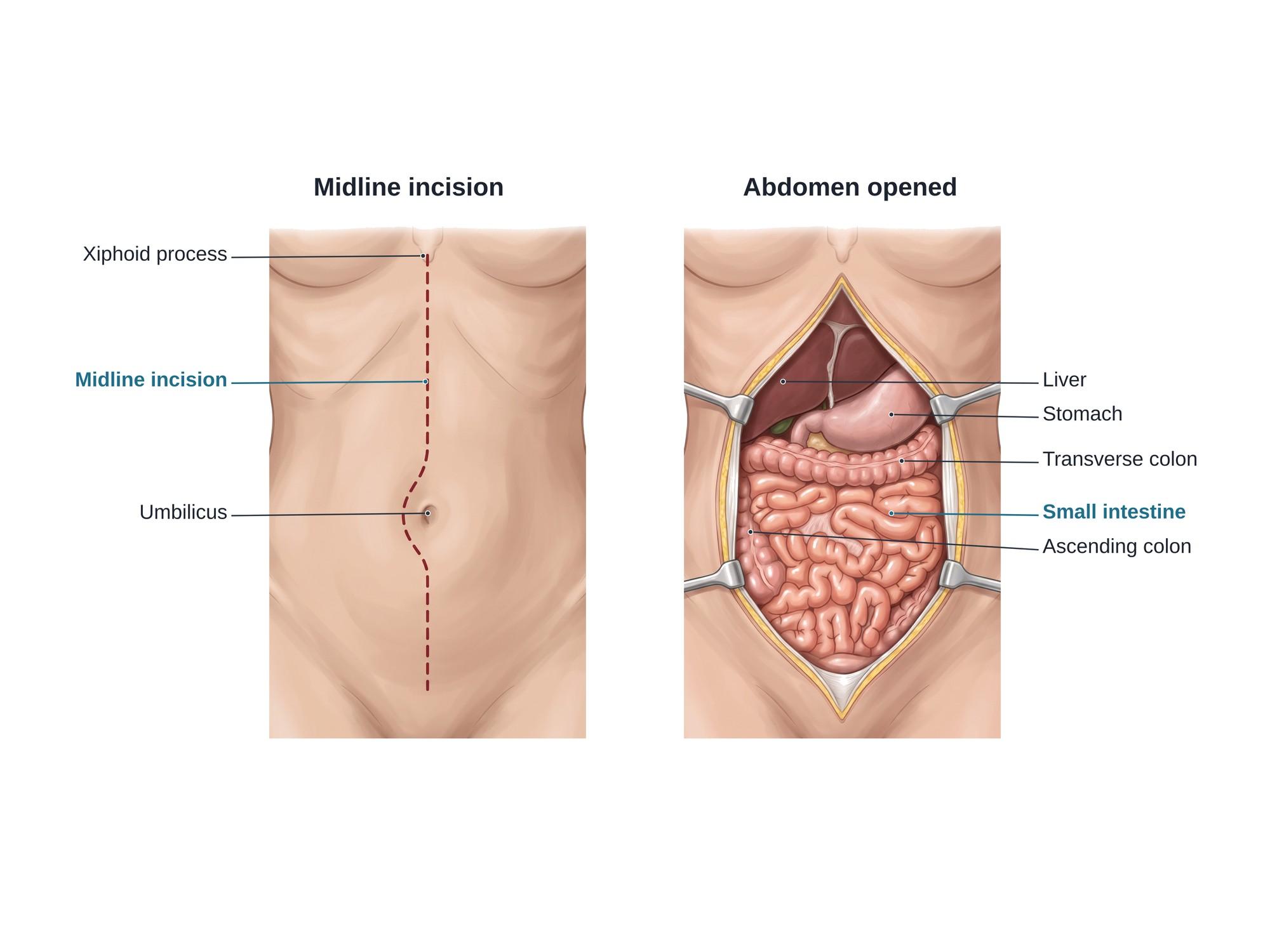
Exploratory laparotomy, often called an ex lap, is open surgery to look inside the abdomen. The surgeon makes a long incision down the middle of the belly, opens the abdominal cavity, and checks every organ. Any injury or disease found is repaired in the same operation. It is the standard emergency operation for internal bleeding and organ injury after blunt or penetrating trauma, such as a car crash, a fall or a stab wound. The illustration above shows the midline incision and the organs it exposes.
Why it is done
- Trauma with internal bleeding, a ruptured spleen, a torn liver, or a hole in the bowel
- Unstable blood pressure after injury, with signs of blood in the abdomen
- Peritonitis, which is infection or inflammation of the lining of the abdomen, often from a perforated bowel or ulcer
- Bowel obstruction that does not settle, or bowel that has lost its blood supply
- Unexplained abdominal pain or findings when scans cannot give an answer
In an unstable trauma patient, the surgeon may operate without a CT scan. A quick bedside ultrasound check for free fluid, called a FAST exam, often guides that choice. For the organs involved, see abdominal organ anatomy.
How the surgery is done
- Anesthesia and preparation. The patient is under general anesthesia. The whole abdomen and chest are cleaned and draped. A catheter drains the bladder.
- Midline incision. The surgeon cuts from just below the xiphoid process (the tip of the breastbone) to just above the pubic bone. The cut skirts the umbilicus.
- Opening the abdominal wall. The surgeon divides the linea alba, the tough band of tissue down the midline. Then the peritoneum, the thin lining of the abdomen, is opened.
- Retractors. Metal retractors hold the wound edges apart so the whole cavity can be seen.
- Controlling bleeding. In trauma, the surgeon first packs each quarter of the abdomen with surgical pads to slow bleeding.
- Systematic exploration. The surgeon checks each organ in order: liver, gallbladder, spleen, stomach, duodenum, pancreas, small intestine, colon, kidneys, major vessels and pelvic organs. The small intestine is run by hand along its full length.
- Repair. Injuries are fixed as they are found. A torn bowel may be sewn closed or a section removed. A badly ruptured spleen may be taken out (splenectomy).
- Washout and closure. The abdomen is rinsed with warm saline. The linea alba is closed with strong sutures, then the skin is closed.
In a very sick trauma patient, the surgeon may do only what stops bleeding and contamination. This is called damage control surgery. The abdomen may be left closed only with a temporary dressing. The patient goes to intensive care to warm up and stabilize. A second operation a day or two later finishes the repairs and closes the abdomen.
Recovery
- Hospital stay: usually 5 to 10 days, longer after major trauma or damage control surgery.
- First days: pain control, early walking, breathing exercises, and a slow return to eating as the bowel wakes up.
- First 6 to 8 weeks: no heavy lifting or hard exercise while the abdominal wall heals.
- 2 to 3 months: most people feel close to normal, though tiredness can last longer.
A pause in bowel movement after surgery, called an ileus, is common. It usually passes within a few days.
Risks
- Wound infection, more likely after a bowel injury or contamination
- Wound breakdown, where the deep layer of the incision opens
- Incisional hernia, a bulge through the scar, sometimes needing a later repair
- Adhesions, bands of scar tissue inside the abdomen that can cause pain or bowel blockage years later
- Abscess, a pocket of infection inside the abdomen
- Ileus, a slow return of bowel function
- Blood clots in the legs or lungs
- Missed injury, which is why the exploration follows a set order
How exploratory laparotomy is shown in a personal injury case
An exploratory laparotomy often follows the car crashes, falls and assaults behind a personal injury claim. The long scar is lasting evidence of how serious the internal injuries were. A clean illustration like the one above shows a jury where the incision runs and which organs the surgeon had to check and repair. It can be paired with an illustration of the specific injury, such as a ruptured spleen and splenectomy. Later problems, such as an incisional hernia or bowel blockage from adhesions, can be shown the same way to support future care costs. For how these images are used at trial, see demonstrative evidence and medical legal illustration.
Related pages
FAQ
Why is an exploratory laparotomy done?+
To find and fix a problem inside the abdomen when it cannot be safely sorted out another way. Common reasons are internal bleeding or organ injury after a car crash, fall or stab wound, a perforated bowel, a blocked bowel, or severe abdominal infection. In an unstable trauma patient it is often done right away, before detailed scans.
What is the difference between exploratory laparotomy and laparoscopy?+
A laparotomy uses one long open incision so the surgeon can see and reach every part of the abdomen by hand. A laparoscopy uses a camera and instruments through small cuts. Laparoscopy means less pain and a faster recovery, but laparotomy is faster and safer when a patient is bleeding heavily or the injuries are extensive.
How long does it take to recover from an exploratory laparotomy?+
Most people stay in the hospital about 5 to 10 days, longer after major trauma. Light activity at home is usually possible within a few weeks. Heavy lifting is usually avoided for about 6 to 8 weeks while the abdominal wall heals. Full energy can take 2 to 3 months or more.
Is an exploratory laparotomy major surgery?+
Yes. It is done under general anesthesia, through a large incision, and often in an emergency. It usually takes 1 to 4 hours depending on what is found and repaired.
What is the survival rate after an exploratory laparotomy?+
It depends on why the surgery was needed, not on the incision itself. A planned laparotomy in a stable patient carries a low risk of death. After severe trauma, heavy blood loss or widespread infection, the risk is much higher, because of the injuries that made the surgery necessary.
What does the scar look like?+
A vertical line down the middle of the belly, usually from just below the breastbone to just above the pubic bone, often curving around the belly button. Shorter incisions are used when the surgeon knows which part of the abdomen to explore.
Can the incision cause problems later?+
Yes. The most common long-term problem is an incisional hernia, a bulge where the abdominal wall did not heal fully. Scar tissue inside the abdomen (adhesions) can also cause pain or bowel blockage years later.
What happens if the surgeon finds nothing wrong?+
This is called a negative laparotomy. The surgeon checks every organ, finds no injury that needs repair, and closes the abdomen. Recovery is usually shorter, but the patient still has the incision and its risks.
Need a surgical illustration for consent or a case?
Describe the operation and get a clear, labeled medical illustration for patient consent, teaching or a case exhibit.
Try Natomy →