Burn Degrees: First, Second, Third & Fourth
Burn degrees describe how deep a burn goes, from first degree (epidermis only) to fourth degree (into muscle or bone). Signs, healing time, treatment and scarring.
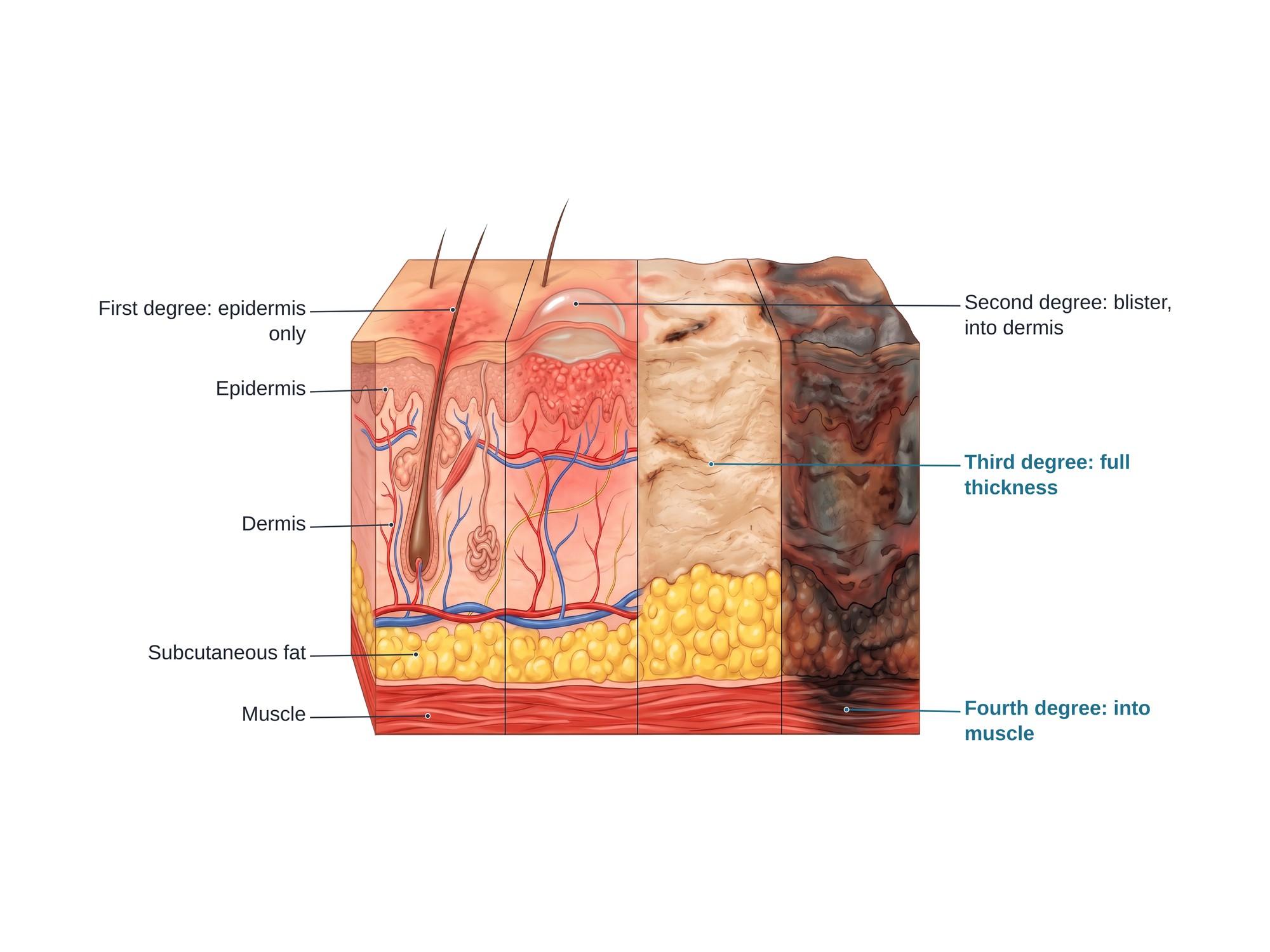
Burn degrees describe how deep a burn goes into the skin and the tissue below it. A first-degree burn damages only the epidermis, the thin outer layer. A second-degree burn reaches into the dermis, the thick layer below, and usually blisters. A third-degree burn destroys the full thickness of the skin. A fourth-degree burn goes past the skin and fat into muscle, tendon or bone. Doctors also use the terms superficial, partial thickness and full thickness for the same depths. Depth sets the treatment, the healing time and the chance of a scar. Burns are common: about 15 million new burns occurred worldwide in 2021 (Shao et al., 2026). The illustration above shows all four degrees side by side in one block of skin.
The anatomy
Skin has two layers. The epidermis is the thin outer layer of cells. It has no blood vessels. Under it lies the dermis, a tough layer of collagen with blood vessels, nerve endings, hair follicles, oil glands and sweat glands. Below the skin is the subcutaneous fat, and under that are muscle, tendon and bone.
The hair follicles and glands matter most for healing. Their linings hold skin cells that can grow back over a wound. A burn that leaves most of them alive can heal on its own. A burn that destroys them can only heal slowly from its edges, so it usually needs a skin graft.
Degrees
Second-degree burns are split in two. A superficial partial-thickness burn reaches only the upper dermis. A deep partial-thickness burn reaches the lower dermis and kills more of the follicles and glands.
- Layers damaged
- Epidermis only
- What it looks like
- Red, dry, painful, no blisters
- Usual healing
- A few days, no scar
- Layers damaged
- Epidermis and part of the dermis
- What it looks like
- Blisters, wet pink or red base, very painful
- Usual healing
- 10 to 14 days if superficial, 3 to 6 weeks if deep
- Layers damaged
- Full thickness of the skin
- What it looks like
- White, tan or brown, dry, leathery, may be numb
- Usual healing
- Needs a skin graft except when very small
- Layers damaged
- Skin and fat, plus muscle, tendon or bone
- What it looks like
- Black or charred, may expose deep tissue
- Usual healing
- Surgery, often several operations
The healing times for second-degree burns come from a 2023 review (Żwierełło et al., 2023). That review also notes that the idea of grading burns by depth is old: in 1839, Dupuytren described six degrees of burn depth. His six-degree system is still used in some countries, but most burn centers use the four degrees above.
Causes
Most burns come from heat, but other forces can burn the skin too.
- Flames and fires, including house fires, car fires and explosions
- Scalds from hot water, coffee, cooking oil or steam
- Contact with hot objects such as stoves, irons, exhaust pipes and machinery
- Chemicals, such as acids, drain cleaners and cement
- Electricity, which can burn deep tissue under skin that looks only lightly hurt
- Radiation, including sunburn
- Friction, as in road rash or a treadmill burn
- Extreme cold (frostbite), which damages tissue in a similar pattern
In the United States, emergency rooms treated an average of 206,856 burns a year from 2014 to 2023, based on a national injury database. About 67% happened at home, and about 21% were in children under 5 (Soulakis et al., 2026).
The same heat source can cause different degrees. The depth depends on how hot it was, how long it touched the skin, and how thick the skin is in that spot. Thin skin, such as on the inner arm or in young children and older adults, burns deeper.
Symptoms
- First degree: redness, warmth and soreness, like a sunburn. The skin turns white when pressed and pinks up again.
- Second degree: blisters, a wet pink or red base, swelling and sharp pain. Deep second-degree burns may look paler and blotchy and hurt less.
- Third degree: dry, stiff, waxy white, tan or brown skin, called eschar. The center may be numb because the nerve endings are destroyed.
- Fourth degree: black, charred tissue, sometimes with exposed muscle, tendon or bone.
Many burns have more than one depth. A scald may be second degree at the edges and third degree in the center, where the liquid stayed longest.
Diagnosis
Diagnosis is made by examining the burn. The doctor looks at color, blisters and moisture. They press on the skin to check if color returns (capillary refill) and test feeling with a light touch or pinprick. Judging depth early is hard, even for burn surgeons. A burn that looks shallow at first can deepen over several days, so it is checked again (Gravino, 2026). Some burn centers use laser Doppler imaging, which measures blood flow in the dermis, to judge depth more accurately (Żwierełło et al., 2023).
The doctor also estimates the total body surface area (TBSA) burned. In adults this is done with the rule of nines, and in children with the Lund and Browder chart (Gravino, 2026). Burn size, depth, the person's age and the body parts involved decide whether the patient goes to a burn center.
Treatment
First-degree burns need 20 minutes of cool running water (Gravino, 2026), a soothing moisturizer and pain relief.
Second-degree burns are cleaned, and large or broken blisters are usually removed. The wound is covered with a dressing that keeps it moist and clean. Deep second-degree burns that will not heal within about 3 weeks are often treated with surgery, because slow healing leads to thick scars.
Third and fourth degree burns need surgery. The dead tissue is cut away (excision, also called debridement), and the wound is closed with a skin graft taken from unburned skin. When there is not enough donor skin, skin substitutes or donor skin can cover the wound for a time. Fourth-degree burns may also need flaps of muscle or skin, or amputation of a part that cannot be saved.
Large burns affect the whole body. Without IV fluids, burns over about 15 to 20% of the body can lead to burn shock from fluid loss, so patients get IV fluids based on their weight and burn size (Żwierełło et al., 2023). A burn that circles a limb or the chest can form a tight band of eschar that cuts off blood flow or breathing. It is treated with an urgent cut through the eschar (escharotomy). When pressure builds inside the muscles too, a fasciotomy may be needed to treat compartment syndrome.
Recovery
Shallow burns heal from the hair follicles and glands left in the dermis, so they heal quickly and evenly. Deep burns heal from the edges, or after a graft. Healing time is closely linked to scarring. In a study of 337 children with scald burns, none of the burns that healed in under 10 days formed a raised scar. About 20% of those that healed in 15 to 21 days did, and 92% of those that took more than 30 days did (Cubison et al., 2006).
After a deep burn or a graft, recovery often includes pressure garments, silicone sheets, scar massage, splints and physical or occupational therapy. Scars keep changing for a year or more. Healed burn skin is sensitive to the sun and may stay darker or lighter than the skin around it.
Complications
- Infection of the burn wound, which can spread to the blood (sepsis)
- Hypertrophic scars, thick raised scars that stay within the burn (hypertrophic scar)
- Contractures, tight scars across a joint that limit movement and may need surgery to release
- Pigment changes, with darker or lighter skin
- Itching and nerve pain in healed skin
- Loss of a limb or digit after fourth-degree or electrical burns
- Breathing problems after an inhalation injury
- Emotional effects, such as anxiety, depression and post-traumatic stress, especially after visible scars
How burns are shown in a personal injury case
Burns are common in house fire, car crash, workplace, product defect and scald claims. A burn's degree drives the medical bills, the number of surgeries and the scarring, so it is often the key fact in a damages case. Photos show the surface, but they do not show how deep the damage goes or why a graft was needed. A medical illustration can show which skin layers were destroyed, why the burn could not heal on its own, and why the scar formed. Friction burns from a crash are covered on the abrasion and road rash pages. For how these images are used at trial, see demonstrative evidence and medical legal illustration.
References
- Shao JL, Zhu YQ, Xie MS, et al. Assessing the Global Burns Burden in the Context of the WHO Prevention and Care Strategy: Insights From the Global Burden of Disease Study 2021. Nursing & Health Sciences. 2026;28(2):e70329.
- Żwierełło W, Piorun K, Skórka-Majewicz M, et al. Burns: Classification, Pathophysiology, and Treatment: A Review. International Journal of Molecular Sciences. 2023;24(4):3749.
- Soulakis ND, Hensing C, Shaffer A, et al. Epidemiology of emergency department visits for burn injuries in the United States, 2014-2023. Burns. 2026;52(1):107802.
- Gravino D. Modern Burn Surgery: Operative Decisions From Acute Excision to Long-Term Reconstruction. Cureus. 2026;18(10):e117564.
- Cubison TC, Pape SA, Parkhouse N. Evidence for the link between healing time and the development of hypertrophic scars (HTS) in paediatric burns due to scald injury. Burns. 2006;32(8):992-999.
FAQ
How do you tell the degree of a burn?+
Look at the color, moisture, blisters and feeling. A first-degree burn is red, dry and painful, with no blisters. A second-degree burn blisters, looks wet and pink or red, and hurts a lot. A third-degree burn looks white, tan, brown or leathery, is dry, and may feel numb. A fourth-degree burn goes into muscle or bone and looks black or charred. Depth can change over the first few days, so doctors often check again.
Which type of burn is the most painful?+
Second-degree burns are usually the most painful. The burn exposes the nerve endings in the dermis but does not destroy them. Third and fourth degree burns destroy those nerves, so the center can feel numb, although the edges around them often hurt.
What is the rule of nines for burns?+
The rule of nines is a quick way to estimate how much of an adult's body is burned. It divides the adult body into regions that each count for a set share of the skin. In children, whose heads are larger for their size, doctors use the Lund and Browder chart instead.
What are the types of burns?+
Burns are grouped by depth (first to fourth degree) and by cause. Causes include heat from flames, hot liquids (scalds) and hot objects, as well as chemicals, electricity, radiation, friction and extreme cold. Breathing in smoke or hot gas can also burn the airway, called an inhalation injury.
How long does a second-degree burn take to heal?+
A superficial second-degree burn usually heals in 10 to 14 days with a low risk of scarring. A deep second-degree burn takes about 3 to 6 weeks to heal on its own and often scars, so many are treated with surgery and a skin graft.
Does a third-degree burn need surgery?+
Usually, yes. A third-degree burn destroys the whole thickness of the skin, including the hair follicles and glands that new skin grows from. Except for very small burns, the dead tissue is removed and the wound is closed with a skin graft.
Is there such a thing as a fifth or sixth degree burn?+
Some systems use up to six degrees, and one from 1839 is still used in parts of the world. Most burn doctors stop at fourth degree, which covers any burn that reaches muscle, tendon or bone. Terms like fifth and sixth degree are sometimes used to stress how deep the damage goes.
When should a burn be seen by a doctor?+
Get care for any burn larger than the palm, any blistering burn on the face, hands, feet, genitals or over a joint, any third or fourth degree burn, and any chemical, electrical or inhalation burn. Burns in young children and older adults also need care sooner.
Need this illustration for a patient or a case?
Describe the injury or upload a scan and get a clear, labeled medical illustration for a consult, a chart or a case exhibit.
Try Natomy →