Hip Labral Tear: Symptoms, Causes & Treatment
A hip labral tear is a tear in the cartilage rim of the hip socket. Learn the symptoms, causes, types, MRI diagnosis, treatment and recovery.
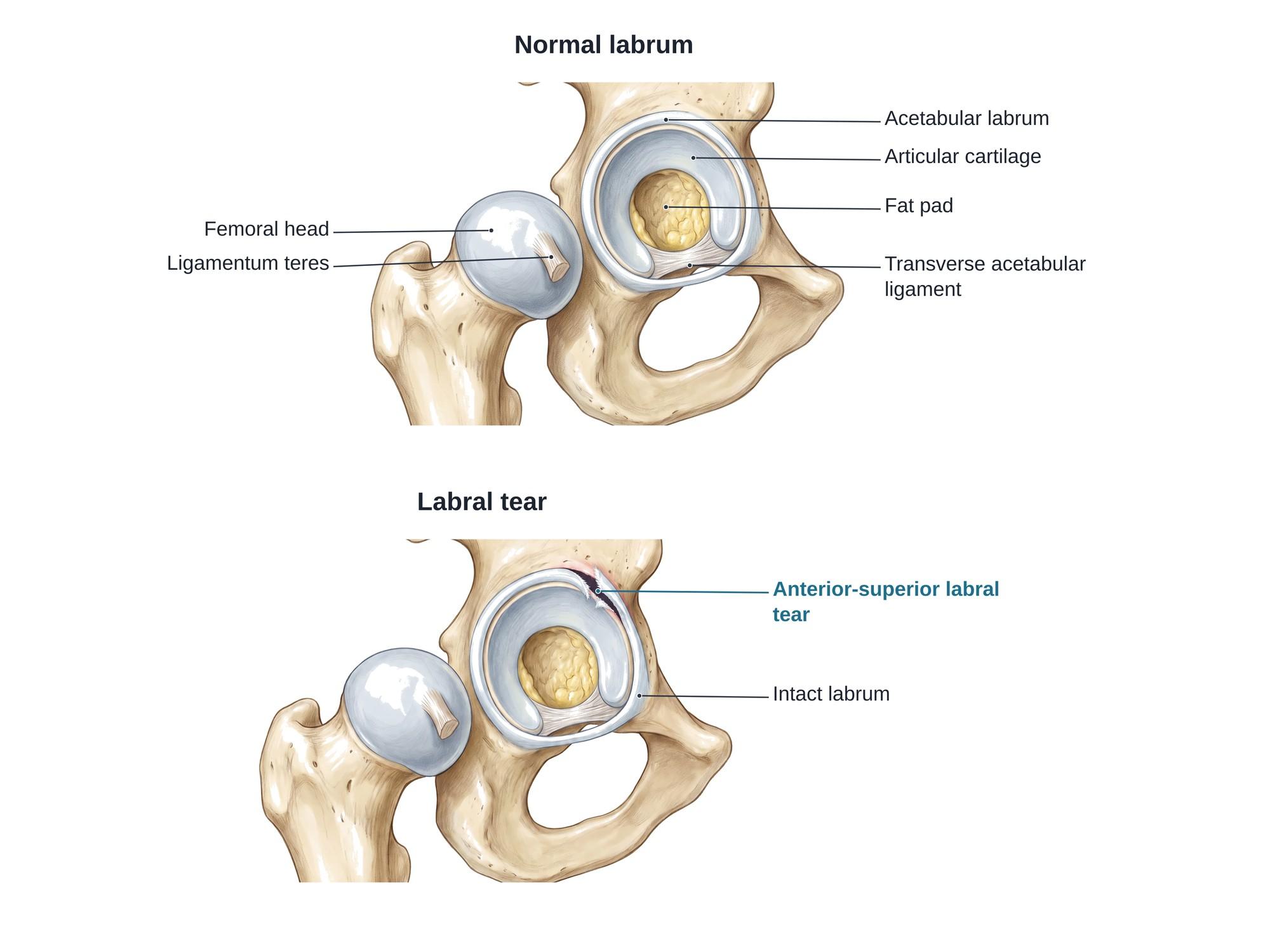
A hip labral tear is a tear in the acetabular labrum, the ring of tough cartilage (fibrocartilage) that lines the rim of the hip socket. The hip is a ball-and-socket joint: the round head of the thighbone (femoral head) sits in a cup in the pelvis (the acetabulum). The labrum deepens the cup, seals in joint fluid and helps keep the ball in place (see hip anatomy). A tear causes groin or hip pain, often with clicking or catching. Most tears are in the front of the labrum. In one arthroscopic series of 261 labral tears, 86% were in the front part of the socket (Groh and Herrera, 2009). The illustration above shows a normal labrum beside a torn one.
Types
Surgeons describe a tear by where it is and by its shape.
By location, tears are anterior (front), superior (top) or posterior (back). Front and front-top tears are by far the most common in the United States. Back tears are more often caused by a hard blow that drives the thighbone backward.
By shape, surgeons use the Lage arthroscopic classification (Groh and Herrera, 2009):
| Type | What the tear looks like | Notes |
|---|---|---|
| Radial flap | A flap torn from the free inner edge of the labrum | One of the two most common shapes |
| Radial fibrillated | A frayed, hairy free edge | Common |
| Longitudinal peripheral | A split along the base where the labrum meets the socket rim | Can run a long way around the rim |
| Unstable | No set pattern, but loose enough to catch in the joint | Causes clicking and locking |
Tears are also described by where they split. Some separate the labrum from the cartilage of the socket (a chondrolabral tear). Others split inside the labrum itself (an intrasubstance tear).
Causes
Doctors group the causes of labral tears into five main kinds (Groh and Herrera, 2009):
- Femoroacetabular impingement (FAI). An extra bump of bone on the femoral neck (cam) or an overhanging socket rim (pincer) pinches the labrum each time the hip bends. It is a major cause of hip pain in young, active adults. In a review of 43 studies, labral tears were found in about 94% of hips with FAI (Savoye-Laurens et al., 2023).
- Hip dysplasia. A shallow socket covers too little of the ball, so the labrum carries extra load. The same review found labral tears in about 79% of hips with dysplasia.
- Trauma. A fall, a car or motorcycle crash, or a hip dislocation can tear the labrum in one event.
- Loose joint (capsular laxity). A hip that moves too far, as in some athletes and people with collagen disorders, stresses the labrum.
- Wear (degeneration). The labrum frays with age, often alongside arthritis.
Repeated twisting and pivoting on a loaded hip also raises the risk. Soccer, hockey, golf, ballet and running are all linked to labral tears.
Symptoms
Hip labral tear symptoms often start slowly, without one clear injury. After trauma they can start at once. Common signs include:
- A deep ache in the groin or the front of the hip, less often on the side of the hip or in the buttock
- Clicking, catching or locking in the hip (mechanical symptoms)
- A feeling that the hip briefly gives way
- Pain that is worse with sitting for a long time, twisting, pivoting or running
- Stiffness and less range of motion, especially in rotation
- Pain at night
Some people with a labral tear have no pain at all. Others have pain that comes and goes for months.
Diagnosis
Labral tears are often missed at first, because many other problems cause groin pain. Studies show an average of more than 2 years from the first symptoms to the diagnosis (Groh and Herrera, 2009).
- Exam. The most useful test is the anterior impingement test (also called FADIR). The doctor bends the hip and knee to 90 degrees, then turns the leg inward and across the body. Pain in the groin is a positive test.
- X-rays look for the bone shapes behind most tears: a cam bump, a pincer rim or a shallow socket. They also check for arthritis. X-rays do not show the labrum itself.
- MRI or MR arthrogram. For an MR arthrogram, contrast dye is injected into the joint before the scan. The dye seeps into the tear and outlines it. This is the best imaging test for the labrum. A standard MRI can miss small tears.
- Numbing injection. A local anesthetic injected into the joint can show whether the pain really comes from inside the hip.
- Hip arthroscopy, a look inside the joint with a small camera, is the most certain way to see a tear.
Imaging findings must match the symptoms. In a review of imaging studies, labral tears showed up in 62% of people with hip pain and in 54% of people with no hip pain at all (Heerey et al., 2018).
Treatment
Labral tear hip treatment usually starts without surgery.
Nonsurgical treatment:
- Rest from the activities that cause pain, such as deep squats and pivoting sports
- Anti-inflammatory medicine (NSAIDs) for pain
- Physical therapy to strengthen the hip, buttock and core muscles and improve how the hip moves
- A steroid injection into the joint, which may also confirm where the pain comes from
A 2023 review looked at 26 studies (1,153 patients) with hip pain not caused by arthritis, including FAI, dysplasia and labral tears. In the studies that reported a response rate, about 54% did well with nonsurgical treatment (Probst et al., 2023).
Surgery is considered when pain, catching or locking continue after a few months of nonsurgical care. Most surgery is done by hip arthroscopy, through two or three small keyhole incisions:
- Labral repair: the torn labrum is stitched back onto the rim with small bone anchors. This is preferred when the tissue is healthy enough.
- Debridement: loose, frayed tissue is trimmed away.
- Labral reconstruction: a badly damaged labrum is replaced with a tissue graft.
- Bone reshaping: a cam bump or pincer rim is shaved down at the same time, so the labrum is not pinched again.
Repair is now favored over trimming, because trimming the labrum is linked to a higher risk of later hip replacement (Migliorini et al., 2022). People with advanced arthritis usually do poorly with arthroscopy. For them, a hip replacement may be the better choice.
Recovery
Labral tear hip recovery time depends on the treatment:
- Without surgery: many people improve over a few months of physical therapy, though some need longer.
- After arthroscopic repair: crutches for the first few weeks, with limits on how far the hip can bend at first. Physical therapy starts soon after surgery. Most people return to desk work in a few weeks. Return to sport usually takes several months, and full recovery can take up to a year.
During recovery, avoid moves that pinch the front of the hip: deep squats, deep lunges and pulling the knee hard toward the chest. A physical therapist sets the pace for each stage.
Complications
- Ongoing pain or clicking, with or without surgery
- Osteoarthritis. A torn labrum seals the joint less well, so the cartilage carries more stress. Tears that come with FAI or dysplasia may speed up arthritis.
- Surgical risks: numbness from nerves stretched by traction or nicked at the small incisions, stiffness, blood clots, infection and, rarely, hip instability
- Repeat surgery. In a review of 9,357 operations for FAI, 5% needed revision surgery and 3.8% went on to hip replacement after a median follow-up of about 2.5 years (Migliorini et al., 2022).
How a hip labral tear is shown in a personal injury case
Hip labral tears follow car and motorcycle crashes, slip-and-fall injuries and work accidents. In a front-on crash, the knee can strike the dashboard and drive the thighbone back into the socket. This can tear the back of the labrum, sometimes with a hip dislocation (see subluxation and dislocation) or a fracture of the socket rim. The defense often argues that the tear was already there. Because about half of people with no hip pain have a labral tear on MRI, this argument needs a careful answer. The timing of symptoms, a tear in an unusual place such as the back of the labrum, and fresh findings like joint fluid or a bone bruise all help. An illustration of the plaintiff's own hip, normal labrum beside the torn one, shows the jury where the tear is and why the hip catches. For how these images are used at trial, see demonstrative evidence and medical legal illustration.
Other leg injuries from the same kinds of accidents include an ACL tear and a hip fracture.
References
- Groh MM, Herrera J. A comprehensive review of hip labral tears. Current Reviews in Musculoskeletal Medicine. 2009;2(2):105-117.
- Savoye-Laurens T, Verdier N, Wettstein M, et al. Labral tears in hip dysplasia and femoroacetabular impingement: A systematic review. Orthopaedics & Traumatology: Surgery & Research. 2023;109(4):103539.
- Heerey JJ, Kemp JL, Mosler AB, et al. What is the prevalence of imaging-defined intra-articular hip pathologies in people with and without pain? A systematic review and meta-analysis. British Journal of Sports Medicine. 2018;52(9):581-593.
- Probst DT, Sookochoff MF, Harris-Hayes M, et al. What is the Rate of Response to Nonoperative Treatment for Hip-Related Pain? A Systematic Review With Meta-analysis. Journal of Orthopaedic & Sports Physical Therapy. 2023;53(5):286-306.
- Migliorini F, Maffulli N, Baroncini A, et al. Revision Surgery and Progression to Total Hip Arthroplasty After Surgical Correction of Femoroacetabular Impingement: A Systematic Review. American Journal of Sports Medicine. 2022;50(4):1146-1156.
Related pages
FAQ
Can a labral tear in the hip heal on its own?+
Usually not completely. The labrum has a poor blood supply, especially at the front, so a torn labrum rarely grows back together. Many people still feel much better without surgery. In a 2023 review, about 54% of people with this kind of hip pain did well with nonsurgical care such as physical therapy.
What does a torn hip labrum feel like?+
Most people feel a deep ache in the groin or the front of the hip. Some feel it on the side of the hip or in the buttock. The hip may click, catch or lock, or briefly give way. Sitting for a long time, twisting, pivoting and running often make it worse.
What happens if a hip labral tear goes untreated?+
Some tears stay quiet for years. Others keep causing pain, clicking and catching. A torn labrum seals the joint less well, so the cartilage takes more stress. Over time this may speed up wear of the joint (osteoarthritis), especially when a bone shape problem such as impingement is also present.
Is it worth fixing a hip labral tear?+
It depends on the pain, the activity level and the shape of the hip. Most doctors start with rest, medicine and physical therapy for at least a few months. Surgery is considered when pain and catching continue. Repairing the labrum, rather than trimming it away, is now preferred when the tissue allows.
Will a hip labral tear show up on an MRI?+
Often, yes, but not always. A standard MRI can miss small tears. An MR arthrogram, where dye is injected into the joint first, shows the labrum better. Many people with no hip pain also have labral tears on MRI, so the result has to match the symptoms and the exam.
How long does it take to recover from a hip labral tear?+
Without surgery, many people improve over a few months of physical therapy. After arthroscopic surgery, most people use crutches for a few weeks. Return to sport usually takes several months, and full recovery can take up to a year.
What exercises should you avoid with a hip labral tear?+
Avoid moves that pinch the front of the hip: deep squats, deep lunges, bringing the knee hard toward the chest, and twisting on a planted leg. High-impact running can also flare the pain. A physical therapist can choose safe strength exercises for the hip and core.
Can a car accident cause a hip labral tear?+
Yes. In a crash, the knee can hit the dashboard and drive the thighbone back into the socket. This can tear the back of the labrum, sometimes with a hip dislocation or a fracture of the socket rim. Falls onto the side of the hip and hard twisting injuries can also tear it.
Need this illustration for a patient or a case?
Describe the injury or upload a scan and get a clear, labeled medical illustration for a consult, a chart or a case exhibit.
Try Natomy →