Hamstring Tear: Grades, Recovery Time & Treatment
A hamstring tear is a strain or rupture of the muscles at the back of the thigh. Learn the grades, symptoms, torn hamstring recovery time and treatment.
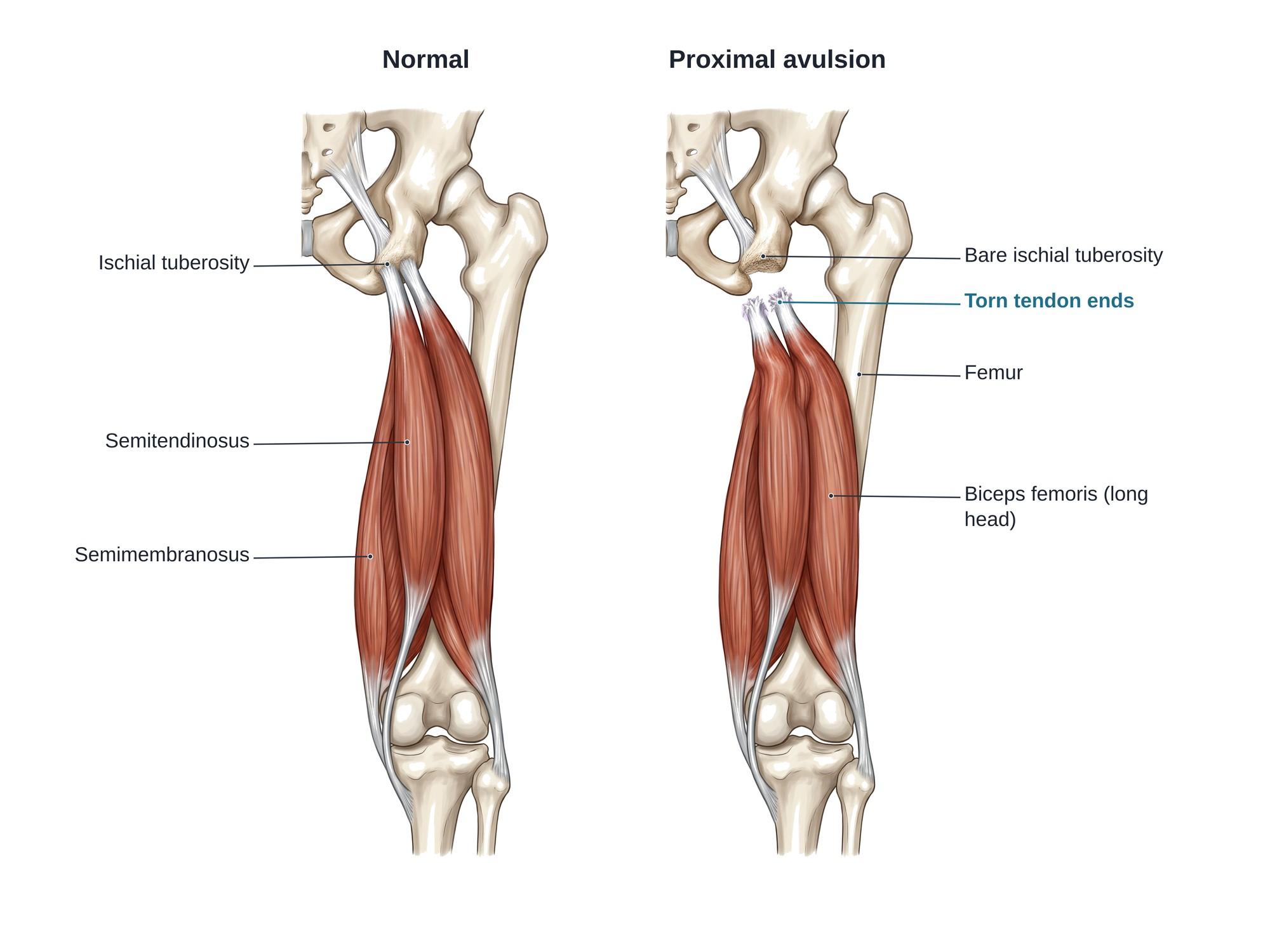
A hamstring tear is a strain or rupture of one or more of the three hamstring muscles at the back of the thigh. These are the biceps femoris, the semitendinosus and the semimembranosus. They start on the ischial tuberosity, the sit bone at the bottom of the pelvis, and end just below the knee (see hip anatomy). They extend the hip and bend the knee. Most tears are mild strains from sprinting. The most serious type, a proximal avulsion, tears the tendons off the bone. Hamstring injuries make up 10% of all injuries in field team sports, and 13% of players get one over a 9-month season (Maniar et al., 2023).
Grades
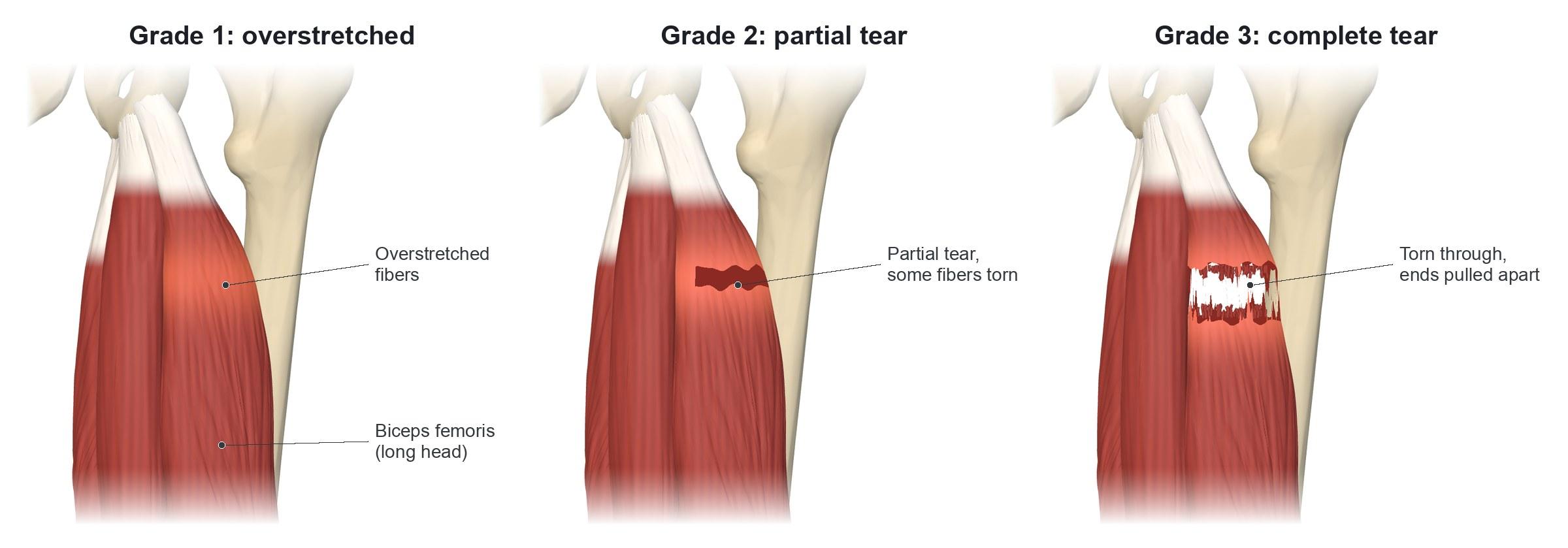
A hamstring tear is a type of strain, an injury to a muscle or tendon (see sprain vs strain). Doctors grade it by how much is torn. The recovery times below are averages from professional football players and from surgical repairs, not fixed rules.
- What is torn
- Overstretched fibers, little tearing
- Typical signs
- Tightness, mild pain, normal walking
- Typical recovery
- About 2 to 3 weeks
- What is torn
- Partial tear of the muscle or tendon
- Typical signs
- Sharp pain, bruising, weakness, limp
- Typical recovery
- About 3 weeks
- What is torn
- Complete tear or tendon pulled off the bone
- Typical signs
- Pop, severe pain, large bruise, gap
- Typical recovery
- About 10 weeks, or about 6.5 months after tendon repair
Many sports doctors also use the British Athletics Muscle Injury Classification. It grades the tear on MRI and notes whether it reaches the tendon, since tendon tears take longer to heal.
Proximal hamstring avulsion
In a proximal avulsion, the hamstring tendons tear off the ischial tuberosity, as shown in the figure above. The semitendinosus and the long head of biceps femoris share one tendon here, the conjoint tendon. The semimembranosus has its own tendon just beside it. One, two or all three tendons can tear. Once free, the muscles pull the torn ends down into the thigh. It is a form of avulsion injury, and the bare bone is where a surgeon reattaches them.
Proximal avulsions often happen in middle-aged adults, not only in athletes. In a review of 1,530 surgical repairs, the average patient was 45 years old (Hillier-Smith and Paton, 2022).
Causes
The hamstrings tear when they are stretched hard while they contract. This happens in two main ways:
- Sprinting. The muscle tears as it slows the swinging leg just before the foot lands. This usually hits the long head of biceps femoris, at the junction of muscle and tendon.
- Overstretching. The hip bends far forward while the knee stays straight, as in a high kick, a dance split or water skiing. This often injures the semimembranosus tendon near the pelvis.
Slip-and-fall injuries are a classic cause of proximal avulsion. A foot slides forward on a wet floor or ice, and the leg is forced into a split with the knee straight. The same thing happens in waterskiing falls and when a person tries to catch a fall on stairs.
Hamstring injuries are rising in elite sport. In men's professional soccer, they made up 24% of all injuries in the 2021/22 season, double the 12% share in 2001/02 (Ekstrand et al., 2023). Risk factors include:
- An earlier hamstring injury
- Older age
- Weak hamstrings, especially in slow lengthening (eccentric) strength
- Fatigue, and sudden jumps in sprint training
Symptoms
- Sudden sharp pain at the back of the thigh, often mid-sprint
- A pop or tearing feeling, especially with a tendon tear
- Bruising at the back of the thigh, which can spread down to the knee over a few days
- Pain when bending the knee or straightening the leg
- Weakness and a limp
- Pain when sitting on the sit bone, a clue to a proximal tear
- A gap or lump in the thigh with a complete tear
- Numbness or tingling down the leg, if the nearby sciatic nerve is irritated (see lower limb nerves)
Diagnosis
The doctor asks how the injury happened and examines the back of the thigh. They press along the muscle to find the sore spot and feel for a gap near the sit bone. They test knee bending strength and how far the straight leg lifts.
Mild strains rarely need imaging. MRI is used when a tendon tear is suspected. It shows which muscles and tendons are torn, whether the tendons have pulled off the bone, and how far the ends have pulled down (the retraction). That distance helps decide on surgery. Ultrasound can show a tear in the muscle and is quick and low cost. X-rays do not show the muscle. In teenagers, they can show a piece of bone pulled off with the tendon.
Treatment
Torn hamstring treatment depends on the grade and on where the tear is.
Nonsurgical treatment is used for almost all grade 1 and 2 tears and many partial tendon tears:
- Protect the leg in the first days: relative rest, ice, compression and crutches if needed
- Early gentle movement as pain allows, which helps the muscle heal in line
- Progressive strengthening with a physical therapist, including eccentric exercises
- Running drills that build up to full-speed sprints before return to sport
Surgery is used mainly for proximal avulsions. The surgeon makes a cut in the crease below the buttock, finds the torn tendons and reattaches them to the ischial tuberosity with suture anchors. In one French cohort, surgery was offered for complete tears and for partial tears pulled down more than 2 cm (Lefèvre et al., 2024). Outcomes are good. In the review of 1,530 repairs, 93% of patients were satisfied, and hamstring strength returned to 87% of the other leg (Hillier-Smith and Paton, 2022).
Timing matters. Over weeks, the torn tendons scar down and pull further away, which makes repair harder. In a study of 740 repairs, surgery more than 32 days after the injury was linked to about 2.5 times the risk of the tendon tearing again (Lefèvre et al., 2024).
Recovery
Torn hamstring recovery time depends on the grade. In a study of 516 hamstring injuries in professional football players, graded on MRI, average time out was 17 days for grade 1, 22 days for grade 2 and 73 days for grade 3 (Ekstrand et al., 2012). Tears that reach the tendon take longer.
After proximal avulsion surgery, the leg is protected at first, and some surgeons add a brace that keeps the knee bent. Rehab protocols vary from surgeon to surgeon. In the review of 1,530 repairs, 85% of patients returned to sport, after about 6.5 months on average (Hillier-Smith and Paton, 2022).
Prevention helps after recovery. Programs that include the Nordic hamstring exercise, a slow lowering of the body forward from a kneeling position, cut hamstring injury rates by about half (risk ratio 0.49) in a review of 8,459 athletes (van Dyk et al., 2019).
Complications
- Re-injury, the most common problem, usually from returning to sprinting too soon
- Lasting weakness or tightness at the back of the thigh
- Scar tissue around the sciatic nerve after a proximal tear, causing buttock pain and sciatica-like symptoms
- Missed avulsion. A tendon torn off the bone can be mistaken for a simple strain. Late repair is harder and less reliable.
- Sciatic nerve problems after surgery. In the 1,530-repair review, 3.5% had sciatic nerve dysfunction afterward (Hillier-Smith and Paton, 2022).
- Re-rupture after repair. In the French study of 740 repairs, 4.6% of tendons tore again, most within the first 6 months (Lefèvre et al., 2024).
References
- Maniar N, Carmichael DS, Hickey JT, et al. Incidence and prevalence of hamstring injuries in field-based team sports: a systematic review and meta-analysis of 5952 injuries from over 7 million exposure hours. British Journal of Sports Medicine. 2023;57(2):109-116.
- Hillier-Smith R, Paton B. Outcomes following surgical management of proximal hamstring tendon avulsions: a systematic review and meta-analysis. Bone and Joint Open. 2022;3(5):415-422.
- Ekstrand J, Bengtsson H, Waldén M, et al. Hamstring injury rates have increased during recent seasons and now constitute 24% of all injuries in men's professional football: the UEFA Elite Club Injury Study from 2001/02 to 2021/22. British Journal of Sports Medicine. 2023;57(5):292-298.
- Lefèvre N, Moussa MK, El Otmani L, et al. Surgical Treatment of Proximal Hamstring Avulsion Injuries Compared With Nonsurgical Treatment: A Matched Comparative Study With a Mean Follow-up of >4 Years From the Proximal Hamstring Avulsion Surgery Cohort Study. American Journal of Sports Medicine. 2024;52(11):2718-2727.
- Lefèvre N, Freiha K, Moussa MK, et al. Risk Factors for Rerupture After Proximal Hamstring Avulsion Injury Including the Optimal Timing for Surgery. American Journal of Sports Medicine. 2024;52(5):1173-1182.
- van Dyk N, Behan FP, Whiteley R. Including the Nordic hamstring exercise in injury prevention programmes halves the rate of hamstring injuries: a systematic review and meta-analysis of 8459 athletes. British Journal of Sports Medicine. 2019;53(21):1362-1370.
- Ekstrand J, Healy JC, Waldén M, et al. Hamstring muscle injuries in professional football: the correlation of MRI findings with return to play. British Journal of Sports Medicine. 2012;46(2):112-117.
Related pages
FAQ
How long does a hamstring tear take to heal?+
It depends on the grade. In professional football players, a mild strain kept players out for about 2 to 3 weeks on average, and a partial tear for about 3 weeks. A tendon torn off the bone that needs surgery takes much longer: in a review of 1,530 repairs, people returned to sport after about 6.5 months on average.
How do you heal a torn hamstring muscle?+
Most tears heal without surgery. The first days focus on protecting the leg, with ice, compression and crutches if walking hurts. Then a physical therapist guides gentle movement and, step by step, strengthening, including slow lengthening (eccentric) exercises. Running and sprinting come back last.
What is a grade 2 hamstring strain?+
A grade 2 strain is a partial tear of the muscle or tendon. Some fibers are torn, but the muscle is still in one piece. It causes clear pain, bruising, weakness and a limp, and usually needs several weeks of rehab before running.
Can you walk if you tear a hamstring?+
Usually yes, though often with a stiff, short-stepping limp. People with a mild strain walk almost normally. Even a tendon torn off the bone may still allow walking, which is one reason that injury is sometimes missed. Weakness when bending the knee and pain when sitting are clues to a more serious tear.
Is heat good for a hamstring tear?+
Not in the first few days. Heat increases blood flow and can add to swelling and bleeding in the fresh tear. Ice and compression are usually advised early.
What is the difference between a pulled and a torn hamstring?+
They are the same injury at different grades. A pulled hamstring usually means a mild strain, where fibers are overstretched with little tearing. A torn hamstring usually means a partial or complete tear. Doctors use grades 1 to 3 to describe how much is torn.
Does a torn hamstring need surgery?+
Most do not. Surgery is mainly for tendons torn off the ischial tuberosity (proximal avulsion), especially when two or three tendons are torn and pulled down by more than about 2 cm. Repair works best when it is done within a few weeks of the injury.
Can a hamstring tear happen again?+
Yes. Hamstring strains often recur, most often when a person returns to sprinting before the muscle has regained full strength. Programs that include the Nordic hamstring exercise roughly halve the rate of hamstring injuries.
Need this illustration for a patient or a case?
Describe the injury or upload a scan and get a clear, labeled medical illustration for a consult, a chart or a case exhibit.
Try Natomy →