Zavanelli Maneuver: Steps, Success Rate & Risks
The Zavanelli maneuver pushes the baby's head back into the birth canal for a cesarean when shoulder dystocia fails. Learn the steps, success rates and risks.
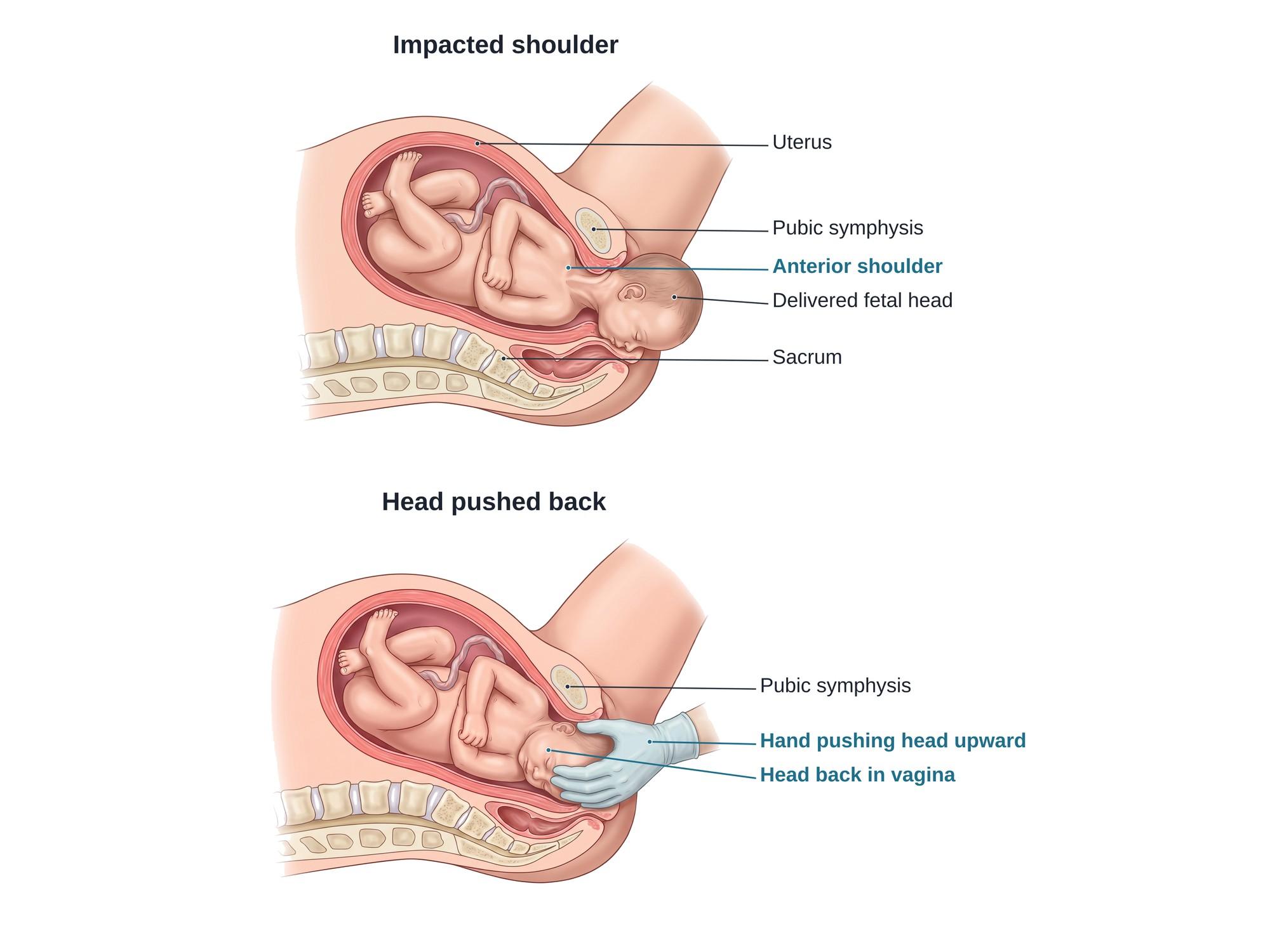
The Zavanelli maneuver, also called cephalic replacement, is a last-resort step for severe shoulder dystocia. In shoulder dystocia, the baby's head is born, but the front (anterior) shoulder is caught behind the mother's pubic bone, the pubic symphysis. The shoulders should turn to fit the widest angle of the pelvis, a ring of bone with the sacrum at the back, but here they stay front to back (see female abdomen and pelvis). When every standard maneuver has failed, the doctor turns the head back, flexes it and pushes it back up into the birth canal. The baby is then delivered by emergency cesarean section. In a 1999 review of 103 reported attempts, the overall success rate was 92% (Sandberg, 1999). The illustration above shows the stuck shoulder, then the head being pushed back.
Why it is done
Shoulder dystocia happens in a small share of births. In a US study of 132,098 term vaginal births, 2,018 had shoulder dystocia, or 1.5% (Hoffman et al., 2011). Most cases resolve with the standard shoulder dystocia maneuvers. These include the McRoberts maneuver, suprapubic pressure, the Rubin and Woods screw maneuvers and delivery of the posterior arm.
Rarely, none of these work. The baby's chest is squeezed in the birth canal, and the cord may be compressed. Oxygen to the brain drops with every minute. At that point the team has three main options:
- Zavanelli maneuver: put the head back and deliver by cesarean
- Abdominal rescue: open the uterus by cesarean and push the shoulder free from above, then finish the birth through the vagina
- Symphysiotomy: cut the cartilage of the pubic symphysis to widen the pelvis
The Zavanelli maneuver was first reported in 1985 by Dr. Edward Sandberg, who named it for Dr. William Zavanelli, the obstetrician who first performed it (Sandberg, 1985).
How the Zavanelli maneuver is done
The maneuver reverses the normal movements of birth (the cardinal movements). It is done in the delivery room, with the operating room and anesthesia team called at once.
- Call for the cesarean team. The obstetrician, anesthesia, the newborn team and operating room staff are called. The time is recorded.
- Relax the uterus. A drug that relaxes the uterine muscle (a tocolytic, such as terbutaline or nitroglycerin) is given. General anesthesia may also be used. A relaxed uterus makes room for the baby to move back.
- Reverse the head's turn. After the head is born, it normally turns to the side (restitution). The clinician turns it back so the back of the head faces the pubic bone (occiput anterior).
- Flex the head. The head is bent so the chin moves toward the chest. This presents the smallest part of the head to the birth canal.
- Push the head back up. With the palm and fingers cupped over the top of the head, the clinician applies firm, steady upward pressure. The head slides back into the vagina, as shown in the lower panel above.
- Deliver by cesarean. The mother is taken for an emergency cesarean section. The baby is lifted out through the uterus.
- Abdominal rescue if needed. If the head will not go back, the surgeon can open the uterus and free the shoulder from above.
The baby's heart rate is checked as soon as possible. Many babies are already short of oxygen by this point, so the newborn team is ready to resuscitate.
Success rates
The maneuver is rare, so the data come from reported cases, not trials. The largest review collected 103 attempts from 30 publications. The head was successfully replaced in 84 of 92 head-first cases (Sandberg, 1999). An earlier registry found that 53 of 59 replaced infants were delivered by cesarean (O'Leary, 1993). A 2021 review pooled 110 shoulder dystocia cases and gave a step-by-step guide (Dharmasena et al., 2021). It noted that many clinicians have no formal training in the maneuver, which can delay it.
A successful replacement does not guarantee a healthy baby. The outcome often depends on how long the shoulder was stuck before the head went back.
Recovery
For the baby, recovery depends on how long oxygen was low. Some babies go home healthy. Others need care in the neonatal intensive care unit (NICU). A baby who went without enough oxygen may need cooling therapy for hypoxic-ischemic encephalopathy (HIE), brain injury from low oxygen. The newborn team also checks for a brachial plexus injury such as Erb's palsy. This is a stretch of the nerves from the neck to the arm, from the C5 and C6 roots of the cervical spine. Fractures of the collarbone or upper arm bone usually heal in a few weeks.
For the mother, recovery is like any emergency cesarean, plus healing of any tears. Most women stay in the hospital for a few days. A future pregnancy needs early planning, often with a planned cesarean.
Risks
Baby:
- Brain injury or death from prolonged low oxygen (often from the delay before the maneuver)
- Brachial plexus injury (Erb's palsy), from the original shoulder dystocia or the maneuvers before it
- Fracture of the collarbone or humerus
- Rarely, injury to the neck or spinal cord
Mother:
- Tears of the cervix, vagina or uterus, and uterine rupture
- Heavy bleeding (postpartum hemorrhage)
- Infection
- The usual risks of an emergency cesarean
In the 1999 review, 7 women had tissue tearing injuries, and no maternal deaths were linked to the maneuver (Sandberg, 1999).
Shoulder dystocia and birth injury
Shoulder dystocia is a leading cause of birth trauma. In one review of 285 shoulder dystocia births, 25% of babies had an injury. Brachial plexus palsy occurred in 17% (Gherman et al., 1998). Most of these nerve injuries heal, but some are permanent. When the Zavanelli maneuver is needed, the case is usually one of the most severe.
How the Zavanelli maneuver is shown in a personal injury case
Cases that reach the Zavanelli maneuver often lead to birth injury lawsuits. The child may have HIE, cerebral palsy or a permanent brachial plexus injury. Common claims are that the provider pulled too hard on the head, used fundal pressure, moved too slowly through the standard maneuvers, or delayed the Zavanelli maneuver. Another claim is a failure to offer a planned cesarean for a very large baby. The defense often argues that the delay came from a true emergency and that the forces of labor caused the injury.
The record is central. Experts look for the time the head delivered, each maneuver tried and in what order, when the cesarean team was called, and the time from head to birth. The baby's cord blood gases and Apgar scores help show how long oxygen was low. An illustration like the one above helps a jury see where the shoulder was stuck and how the head was pushed back. For how these images are used at trial, see demonstrative evidence and medical legal illustration.
References
- Sandberg EC. The Zavanelli maneuver: 12 years of recorded experience. Obstetrics & Gynecology. 1999;93(2):312-317.
- Hoffman MK, Bailit JL, Branch DW, et al. A comparison of obstetric maneuvers for the acute management of shoulder dystocia. Obstetrics & Gynecology. 2011;117(6):1272-1278.
- Sandberg EC. The Zavanelli maneuver: a potentially revolutionary method for the resolution of shoulder dystocia. American Journal of Obstetrics and Gynecology. 1985;152(4):479-484.
- O'Leary JA. Cephalic replacement for shoulder dystocia: present status and future role of the Zavanelli maneuver. Obstetrics & Gynecology. 1993;82(5):847-850.
- Dharmasena D, Berg L, Hay A, et al. The Zavanelli manoeuvre revisited: a review of the literature and a guide to performing cephalic replacement for severe shoulder dystocia. European Journal of Obstetrics & Gynecology and Reproductive Biology. 2021;266:63-73.
- Gherman RB, Ouzounian JG, Goodwin TM. Obstetric maneuvers for shoulder dystocia and associated fetal morbidity. American Journal of Obstetrics and Gynecology. 1998;178(6):1126-1130.
FAQ
What is the Zavanelli maneuver?+
It is a last-resort step for severe shoulder dystocia. The doctor turns the baby's head back, bends it toward the chest and pushes it back up into the birth canal. The baby is then delivered by emergency cesarean.
When is the Zavanelli maneuver used?+
It is used when the shoulder stays stuck after the standard maneuvers have failed. These include McRoberts, suprapubic pressure, the internal rotation maneuvers and delivery of the posterior arm. It is rare, and most obstetricians never perform one.
Which maneuver is used first to relieve shoulder dystocia?+
The McRoberts maneuver and suprapubic pressure come first. If they fail, the clinician tries internal maneuvers such as the Rubin and Woods screw maneuvers, or delivers the posterior arm. The Zavanelli maneuver comes only after these.
How successful is the Zavanelli maneuver?+
In a 1999 review of 92 reported head-first cases, the head was successfully replaced in 84. Results depend on how long the shoulder was stuck before the maneuver began.
Is shoulder dystocia a cause of traumatic birth?+
Yes. Shoulder dystocia is one of the main causes of birth trauma. The most common injuries are a brachial plexus injury such as Erb's palsy and a broken collarbone or upper arm bone. A long delay can also cause brain injury from low oxygen.
What is the Woods screw maneuver?+
The clinician places fingers on the front of the baby's posterior shoulder and turns the baby like a screw. This moves the shoulders into a wider angle of the pelvis. It is one of the internal maneuvers tried before the Zavanelli maneuver.
Is the Zavanelli maneuver dangerous for the mother?+
It can be. Risks include tears of the uterus, cervix or vagina, uterine rupture and heavy bleeding. The mother also needs an emergency cesarean. These risks are accepted because the baby is in danger.
What is the difference between the Zavanelli maneuver and symphysiotomy?+
In the Zavanelli maneuver, the head goes back in and the baby is born by cesarean. In a symphysiotomy, the cartilage of the pubic symphysis is cut to widen the pelvis so the baby can be born vaginally. Both are rare last steps.
Need a surgical illustration for consent or a case?
Describe the operation and get a clear, labeled medical illustration for patient consent, teaching or a case exhibit.
Try Natomy →