Trigger Finger Surgery: Release, Recovery & Risks
Trigger finger surgery cuts the tight A1 pulley so a caught flexor tendon glides freely again. Learn how the procedure is done, recovery time and risks.
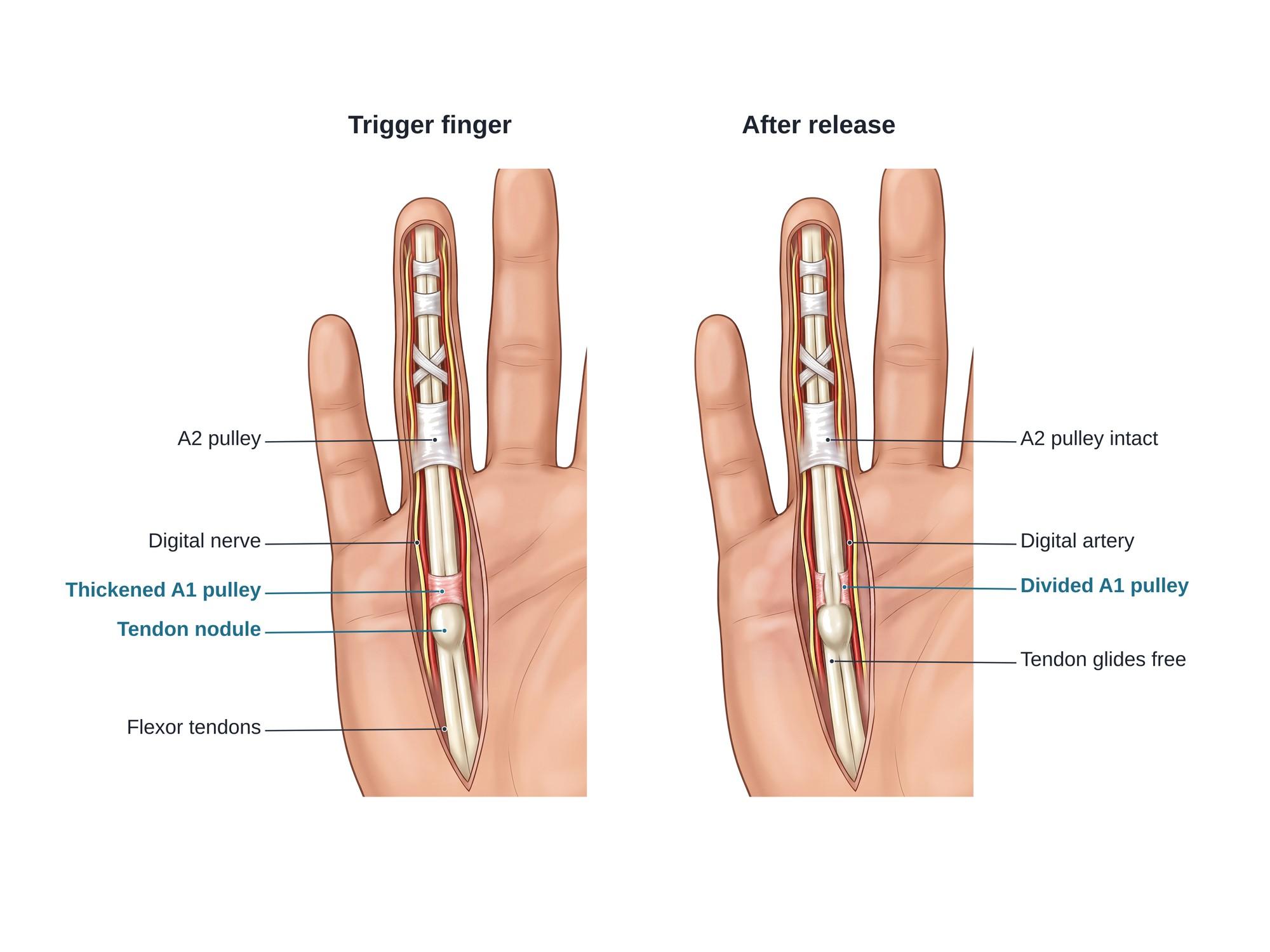
Trigger finger release is surgery that cuts the A1 pulley so a caught flexor tendon can glide freely again. The flexor tendons bend the finger. They run in a tunnel of tough bands called pulleys that hold them close to the bone. The A1 pulley is the first of these bands, in the palm at the base of the finger. In trigger finger (stenosing tenosynovitis, a narrowing of the tendon sheath), this pulley thickens and the tendon swells into a nodule. The nodule catches on the pulley, so the finger clicks, sticks or locks bent. The ring finger and the thumb are affected most often (Jeanmonod et al., 2024). In a Swedish study of 30,357 adults, 3.2% were diagnosed with trigger finger over about 20 years, and diabetes doubled the risk (Löfgren et al., 2021).
Why it is done
Trigger finger release is done when the finger keeps catching or locking despite simpler care. First steps are usually rest, a splint and a corticosteroid injection (a steroid shot into the tendon sheath). In a pooled analysis of 6 randomized trials with 368 patients, a steroid injection worked in about 64% of people (Pathak et al., 2022). Surgery is usually offered when:
- The finger still locks after one or two injections
- The finger is stuck bent and has to be pushed straight with the other hand
- The finger is locked and cannot be straightened at all
- Pain at the base of the finger makes it hard to grip or work
- The person has diabetes
Trigger finger is also common after carpal tunnel surgery. A review of 10 studies found that about 8% of patients developed it after carpal tunnel release (Lo et al., 2023). A similar tendon sheath problem at the wrist is De Quervain tenosynovitis, which is treated by releasing a different tunnel.
How the surgery is done
There are two main ways to release the A1 pulley. Both are outpatient procedures.
Open trigger finger release
- The palm is numbed with local anesthetic. Many surgeons use WALANT (wide-awake local anesthesia with no tourniquet), so the patient stays awake.
- The surgeon makes a cut about 1 to 2 centimeters long in the palm, over the A1 pulley at the base of the finger.
- The fat is gently spread apart. This protects the digital nerves and arteries, which run along each side of the tendon sheath.
- The A1 pulley is cut along its full length, in line with the tendon.
- The A2 pulley, the next band along the finger, is left intact. Cutting it would let the tendon pull away from the bone (bowstringing).
- The patient bends and straightens the finger to show that the catching is gone.
- The skin is closed with a few stitches, and a light dressing goes on.
Percutaneous trigger finger release
- The palm is numbed with local anesthetic.
- A needle or small blade is passed through the skin over the A1 pulley, sometimes guided by ultrasound.
- The pulley is cut from the outside without opening the skin.
- The patient moves the finger to confirm it glides freely.
A review of 14 randomized trials with 996 patients found no long-term difference between open and percutaneous release in repeat surgery, complications or pain (Huang et al., 2026). People went back to work about 13 days sooner after percutaneous release. In the thumb, the surgeon takes extra care to protect the radial digital nerve, which gives feeling to the thumb and lies close to its A1 pulley.
Either way, the cut edges of the pulley spread apart, as in the right panel above. The nodule usually shrinks over time once the tendon is no longer squeezed.
Hardware
Trigger finger release uses no hardware. No plates, screws or implants are placed. The pulley is not repaired. Only the skin is stitched after an open release.
Recovery
- Same day: bend and straighten the finger often. Keep the hand raised to limit swelling.
- First week: light tasks such as eating, dressing and typing are usually fine. Keep the wound clean and dry.
- Follow-up visit: stitches come out after an open release.
- Next few weeks: swelling and soreness settle, and heavy gripping and manual work resume step by step.
- Hand therapy: some people need exercises or a splint, most often when the finger was locked bent for months before surgery.
- Long term: a tender scar or a firm lump under it can last a few months. If the middle joint was stiff before surgery, it may not fully straighten.
Risks
In a study of 3,428 patients after open A1 pulley release, 16% had a complication (Koopman et al., 2022). Most were mild and treated with hand therapy, a splint, pain medicine, antibiotics or an injection. About 2% needed further major surgery. Three or more steroid injections before surgery, or one within 3 months of it, raised the risk. Possible problems include:
- Tender or thick scar, and a lump in the palm while the scar heals
- Stiffness, or a finger that stays slightly bent at the middle joint
- Infection or slow wound healing
- Incomplete release, where part of the pulley is left and the finger still catches
- Injury to a digital nerve, causing numbness on one side of the finger (uncommon)
- Bowstringing, if the A2 pulley is damaged (rare)
- Complex regional pain syndrome (CRPS), a rare condition with lasting pain, swelling and stiffness
References
- Jeanmonod R, Tiwari V, Waseem M. Trigger Finger. StatPearls Publishing, 2024.
- Löfgren JP, Zimmerman M, Dahlin LB, et al. Diabetes mellitus as a risk factor for trigger finger: a longitudinal cohort study over more than 20 years. Frontiers in Clinical Diabetes and Healthcare. 2021;2:708721.
- Pathak SK, Salunke AA, Menon PH, et al. Corticosteroid injection for the treatment of trigger finger: a meta-analysis of randomised control trials. Journal of Hand Surgery (Asian-Pacific Volume). 2022;27(1):89-97.
- Lo YC, Lin CH, Huang SW, et al. High incidence of trigger finger after carpal tunnel release: a systematic review and meta-analysis. International Journal of Surgery. 2023;109(8):2427-2434.
- Huang KC, Chu YY, Lin YT, et al. Comparative effectiveness of open versus percutaneous release for trigger fingers: a systematic review and meta-analysis of randomized controlled trials. Journal of Orthopaedic Science. 2026;31(4):789-798.
- Koopman JE, Zweedijk BE, Hundepool CA, et al. Prevalence and risk factors for postoperative complications following open A1 pulley release for a trigger finger or thumb. Journal of Hand Surgery (American Volume). 2022;47(9):823-833.
Related pages
- Hand and wrist anatomyThe normal anatomy of the hand and wrist.
- Carpal tunnel releaseCarpal tunnel release cuts the transverse carpal ligament to take pressure off the median nerve. Learn why it is done, how it is done, recovery and risks.
- Distal radius fracture surgeryDistal radius fracture surgery fixes a broken wrist with a plate and screws. See the volar locking plate beside the original fracture, plus recovery time.
FAQ
Does trigger finger go away without surgery?+
Sometimes. Mild trigger finger can settle with rest, a splint or a steroid injection. A steroid injection works in about 64% of people in pooled trials, but symptoms can come back. When the finger keeps locking after one or two injections, surgery is the usual next step and fixes it in most people.
How long does trigger finger surgery take?+
The operation itself is short. It is done as outpatient surgery under local anesthetic, often with the patient awake. Most people go home the same day.
How long is recovery from trigger finger surgery?+
Most people move the finger the same day and use the hand for light tasks within a few days. Stitches come out at a follow-up visit. Soreness, swelling and stiffness settle over the next few weeks, though the scar can stay tender for a few months.
What should you not do after trigger finger surgery?+
For the first one to two weeks, avoid heavy gripping, lifting and soaking the hand, and keep the wound clean and dry until the stitches are out. Do not keep the finger still, though. Gentle bending and straightening right away helps prevent stiffness.
Why is my finger still bent after trigger finger surgery?+
The finger can stay slightly bent at the middle joint, especially if it was locked for a long time before surgery. The joint and its soft tissues tighten up. Stretching exercises or a splint from a hand therapist usually help over a few weeks to months.
Is there a lump in the palm after trigger finger surgery?+
A firm, tender lump under the scar is common for a few weeks. It is usually healing scar tissue and swelling, and it softens with massage and time. A lump that grows, gets red or drains should be checked for infection.
Can trigger finger come back after surgery?+
In the same finger it is unlikely once the pulley is fully cut, because the pulley stays open. A part of the pulley left uncut can make the finger keep catching. Trigger finger can still start in a different finger, especially in people with diabetes.
Is open or percutaneous trigger finger release better?+
A review of 14 randomized trials found no long-term difference between them in repeat surgery, complications or pain. Percutaneous release gave a faster early recovery and return to work. Open release lets the surgeon see the nerves and the pulley directly. Percutaneous release uses a needle instead of a cut, so there is no stitched wound.
Need a surgical illustration for consent or a case?
Describe the operation and get a clear, labeled medical illustration for patient consent, teaching or a case exhibit.
Try Natomy →