De Quervain Tenosynovitis: Symptoms, Splint & Treatment
De Quervain tenosynovitis is painful swelling of the thumb tendon sheath at the wrist. Learn the causes, symptoms, Finkelstein test, splint and treatment.
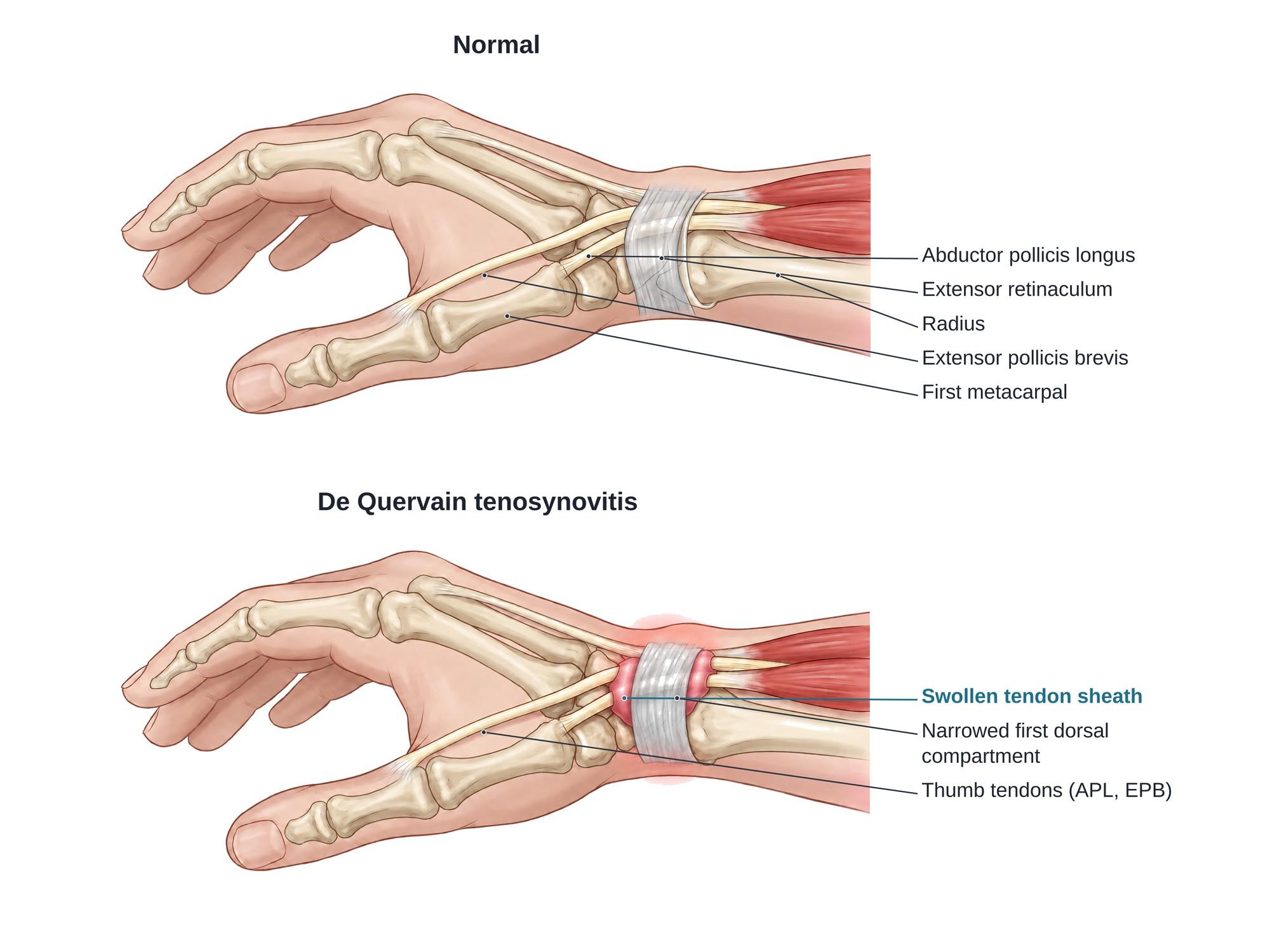
De Quervain tenosynovitis is painful swelling of the tendon sheath on the thumb side of the wrist. Tenosynovitis means irritation of the slick lining, or sheath, around a tendon. Two thumb tendons are involved: the abductor pollicis longus (APL), which pulls the thumb away from the hand, and the extensor pollicis brevis (EPB), which straightens the thumb's base. They run together through a narrow tunnel over the end of the radius, called the first dorsal compartment. A tough band of tissue, the extensor retinaculum, forms the roof of this tunnel (see hand and wrist anatomy). When the sheath and the roof thicken, the tendons are squeezed, and thumb and wrist motion hurts. The condition is named after Fritz de Quervain, a Swiss surgeon who described it in 1895. It is far more common in women. In a United States insurance database of 33,420 patients, 78% were women, and women were 2.6 times as likely to be diagnosed as men (Hassan et al., 2022). The illustration above shows a normal first dorsal compartment above one with a swollen sheath.
Causes
The problem starts with friction where the two tendons bend around the bony bump at the end of the radius, the radial styloid. Over time the sheath and the retinaculum get thicker. Under the microscope this often looks more like wear and thickening than true inflammation, and experts still debate which matters most (Fakoya et al., 2023).
Common triggers and risk factors:
- Repetitive thumb and wrist motion, such as pinching, gripping, wringing and lifting with the thumb spread
- New parents, from lifting a baby under the arms again and again (often called "mommy thumb")
- Pregnancy and the months after birth, from fluid and hormone changes
- Age 40 to 59, the peak age for diagnosis (Hassan et al., 2022)
- Diabetes, rheumatoid arthritis, lupus and hypothyroidism, an underactive thyroid (Hassan et al., 2022)
- A direct blow to the thumb side of the wrist, in some cases
- A divided tunnel. In many people a thin wall of tissue, a septum, splits the compartment into two smaller tunnels. This crowds the tendons more and can make treatment harder (Larsen et al., 2021).
Work matters too. A meta-analysis found about 2.9 times the odds of de Quervain tenosynovitis with repetitive, forceful or awkward manual work. The same review found the evidence too weak to prove that work alone causes it (Stahl et al., 2013).
Symptoms
- Pain on the thumb side of the wrist, sometimes spreading up the forearm or into the thumb
- Pain that gets worse when gripping, pinching or turning the wrist, such as opening a jar
- Swelling over the radial styloid, sometimes with a small bump
- A catching or snapping feeling as the thumb moves
- Weak grip because of pain
- Numbness on the back of the thumb at times, when the swelling irritates the nearby superficial branch of the radial nerve, a small skin nerve
Diagnosis
Most cases are diagnosed with a history and a hand exam.
- Tenderness right over the first dorsal compartment, at the radial styloid.
- Finkelstein test. The examiner holds the thumb and bends the wrist toward the little finger. Sharp pain over the radial styloid suggests the condition.
- Eichhoff test. The patient makes a fist with the thumb tucked inside, then bends the wrist toward the little finger. Both of these tests can also hurt in wrists without the condition (Fakoya et al., 2023).
- WHAT test (wrist hyperflexion and abduction of the thumb). The wrist is bent forward while the patient pushes the thumb outward against resistance. It was proposed as a more specific test.
- Ultrasound shows a thickened sheath and fluid around the tendons. It can also show a septum that splits the compartment, which helps guide an injection or surgery.
- X-rays are not needed to make the diagnosis. They are used to look for other causes, such as arthritis at the base of the thumb.
Other problems can cause pain in the same area:
| Condition | Where it hurts | Key difference |
|---|---|---|
| Thumb base arthritis | The joint at the base of the first metacarpal | Grinding pain when the thumb base is pressed and turned |
| Scaphoid fracture | The hollow at the base of the thumb (anatomical snuffbox) | Follows a fall on the hand; seen on X-ray or MRI |
| Intersection syndrome | A few inches up the forearm | Pain and creaking where two tendon groups cross |
| Radial nerve irritation | Back of the thumb and wrist | Burning or numbness more than pain with motion |
A broken scaphoid is easy to miss, so see the scaphoid fracture page for its signs. Pain on the other side of the wrist, the little-finger side, points to a different problem, such as a TFCC tear.
Treatment
Nonsurgical treatment helps most people:
- Rest and activity changes, avoiding the pinching, gripping and lifting that hurt
- A thumb spica splint, which holds the wrist and the base of the thumb still while leaving the thumb tip free
- Anti-inflammatory medicine, such as ibuprofen, and ice
- A corticosteroid injection into the first dorsal compartment. This is the main treatment (Larsen et al., 2021). Injections are considered safe late in pregnancy and while breastfeeding.
- Hand therapy, with gentle stretching and strengthening once the pain settles
Injections work for most people. In the national database study, 53% of patients had injections and 12% had surgery. A single injection worked in 72% of patients, and a second injection worked in 66% (Hassan et al., 2022). Guiding the needle with ultrasound helps reach both tendons when a septum is present. In a review of 379 wrists treated with ultrasound-guided injections, 74% had their symptoms fully go away (He et al., 2023). A network meta-analysis of 30 trials with 1,663 patients ranked ultrasound-guided injections highest for pain relief. Adding a thumb splint to an injection gave only a small extra gain in function (Challoumas et al., 2023).
Surgery is used when pain lasts despite splints and injections. It is called a first dorsal compartment release:
- The wrist is numbed, sometimes with the patient awake (WALANT, wide-awake local anesthesia with no tourniquet).
- A small cut is made over the radial styloid.
- The surgeon finds and protects the superficial branch of the radial nerve.
- The roof of the compartment is opened along its length, so the tendons are free.
- The surgeon checks for a septum and opens any second tunnel, so no tendon stays trapped.
- The skin is closed with a few stitches.
A cut along the length of the forearm gives a better view and causes fewer nerve injuries and fewer thick scars than a cut across the wrist (Larsen et al., 2021). The carpal tunnel release is a similar operation that frees the median nerve on the palm side of the wrist.
Recovery
- After a splint and rest: mild cases often improve in a few weeks.
- After an injection: pain usually eases within days to a few weeks. The splint is often kept on for a short time.
- After surgery: a soft dressing or a splint for a short time, then gentle motion. Most people use the hand for light tasks within days and return to full use over several weeks. Heavy gripping may take longer.
- Changing how the hand is used, such as lifting a baby with the palms instead of the thumbs, helps stop it from coming back.
Complications
- Return of symptoms after an injection, which may need a second injection or surgery (Hassan et al., 2022)
- Skin thinning or lightening at the injection site, from the steroid
- Injury to the superficial branch of the radial nerve during surgery, causing numbness or painful tingling on the back of the thumb
- Incomplete release, when a septum is missed and one tendon stays trapped
- Tendon slipping (subluxation), when the freed tendons snap forward over the radial styloid
- A thick or tender scar, more common with a cut across the wrist
- Ongoing pain and weak grip in some people
References
- Hassan K, Sohn A, Shi L, et al. De Quervain tenosynovitis: an evaluation of the epidemiology and utility of multiple injections using a national database. Journal of Hand Surgery (American Volume). 2022;47(3):284.e1-284.e6.
- Fakoya AO, Tarzian M, Sabater EL, et al. De Quervain's disease: a discourse on etiology, diagnosis, and treatment. Cureus. 2023;15(4):e38079.
- Larsen CG, Fitzgerald MJ, Nellans KW, et al. Management of de Quervain tenosynovitis: a critical analysis review. JBJS Reviews. 2021;9(9).
- Stahl S, Vida D, Meisner C, et al. Systematic review and meta-analysis on the work-related cause of de Quervain tenosynovitis: a critical appraisal of its recognition as an occupational disease. Plastic and Reconstructive Surgery. 2013;132(6):1479-1491.
- He KS, He KS, Cheah A, et al. Unblinding de Quervain: a systematic review of ultrasound-guided injection of corticosteroids for treatment of stenosing tenosynovitis of the 1st extensor compartment. Journal of Medical Radiation Sciences. 2023;70(3):319-326.
- Challoumas D, Ramasubbu R, Rooney E, et al. Management of de Quervain tenosynovitis: a systematic review and network meta-analysis. JAMA Network Open. 2023;6(10):e2337001.
Related pages
- Hand and wrist anatomyThe normal anatomy of the hand and wrist.
- Ganglion cystA ganglion cyst is a fluid-filled lump that grows from a wrist joint or tendon sheath. Learn the causes, symptoms, diagnosis and treatment of wrist ganglions.
- Mallet fingerMallet finger is a torn extensor tendon at the fingertip that leaves the tip drooping. Learn the causes, types, splint care, surgery and recovery time.
FAQ
What is the fastest way to treat de Quervain tenosynovitis?+
Rest from the thumb and wrist motions that cause pain, a thumb spica splint and a steroid injection work fastest for most people. In a large insurance study, a single steroid injection worked in about 72% of patients. An injection guided by ultrasound may work even better. Surgery is kept for pain that does not settle.
What should you not do with de Quervain tenosynovitis?+
Avoid the motions that load the thumb tendons: pinching and gripping hard, wringing cloths, lifting a baby under the arms with the thumbs spread, texting or gaming for long stretches, and bending the wrist toward the little finger with the thumb tucked in. Do not push through sharp pain with exercises. Stretching and strengthening come later, once the pain settles.
How long does de Quervain tenosynovitis take to go away?+
Mild cases often settle in a few weeks with rest and a splint. Many people get relief within days to weeks of a steroid injection. Some cases come back and need a second injection or surgery. After surgery, most people return to light hand use within days and to full use over several weeks.
How is de Quervain tenosynovitis diagnosed?+
Most cases are diagnosed in the office. The doctor presses on the thumb side of the wrist and does the Finkelstein test, bending the wrist toward the little finger while holding the thumb. Sharp pain over the wrist bone is the typical result. Ultrasound can show a thickened sheath and an extra divider inside the compartment.
Who gets de Quervain tenosynovitis?+
It is most common in women and in people aged 40 to 59. In a study of more than 33,000 patients, 78% were women. New mothers often get it from lifting and feeding a baby. Diabetes, rheumatoid arthritis, lupus and an underactive thyroid also raise the risk.
Is de Quervain tenosynovitis caused by work?+
Repetitive, forceful hand work is linked with it. A review of the research found about 2.9 times the odds of the condition with that kind of work. The same review found that the studies were not strong enough to prove that work alone causes it. Many cases happen with no clear work cause.
Is de Quervain tenosynovitis the same as arthritis of the thumb?+
No. De Quervain tenosynovitis affects the tendons and their sheath on the side of the wrist. Thumb base arthritis affects the joint between the first metacarpal and the trapezium, a little further toward the thumb. The two can happen together, and a doctor can tell them apart with an exam and an X-ray.
Does de Quervain tenosynovitis need surgery?+
Most people get better without surgery. In a study of more than 33,000 patients, about 12% had surgery. Surgery opens the roof of the tendon tunnel so the tendons can glide again. It works well for most people when splints and injections fail.
Need this illustration for a patient or a case?
Describe the injury or upload a scan and get a clear, labeled medical illustration for a consult, a chart or a case exhibit.
Try Natomy →