Billroth II: Gastrojejunostomy Procedure & Recovery
Billroth II (Billroth 2) removes the lower stomach and joins the remnant to a loop of jejunum. See the anatomy before and after the gastrojejunostomy.
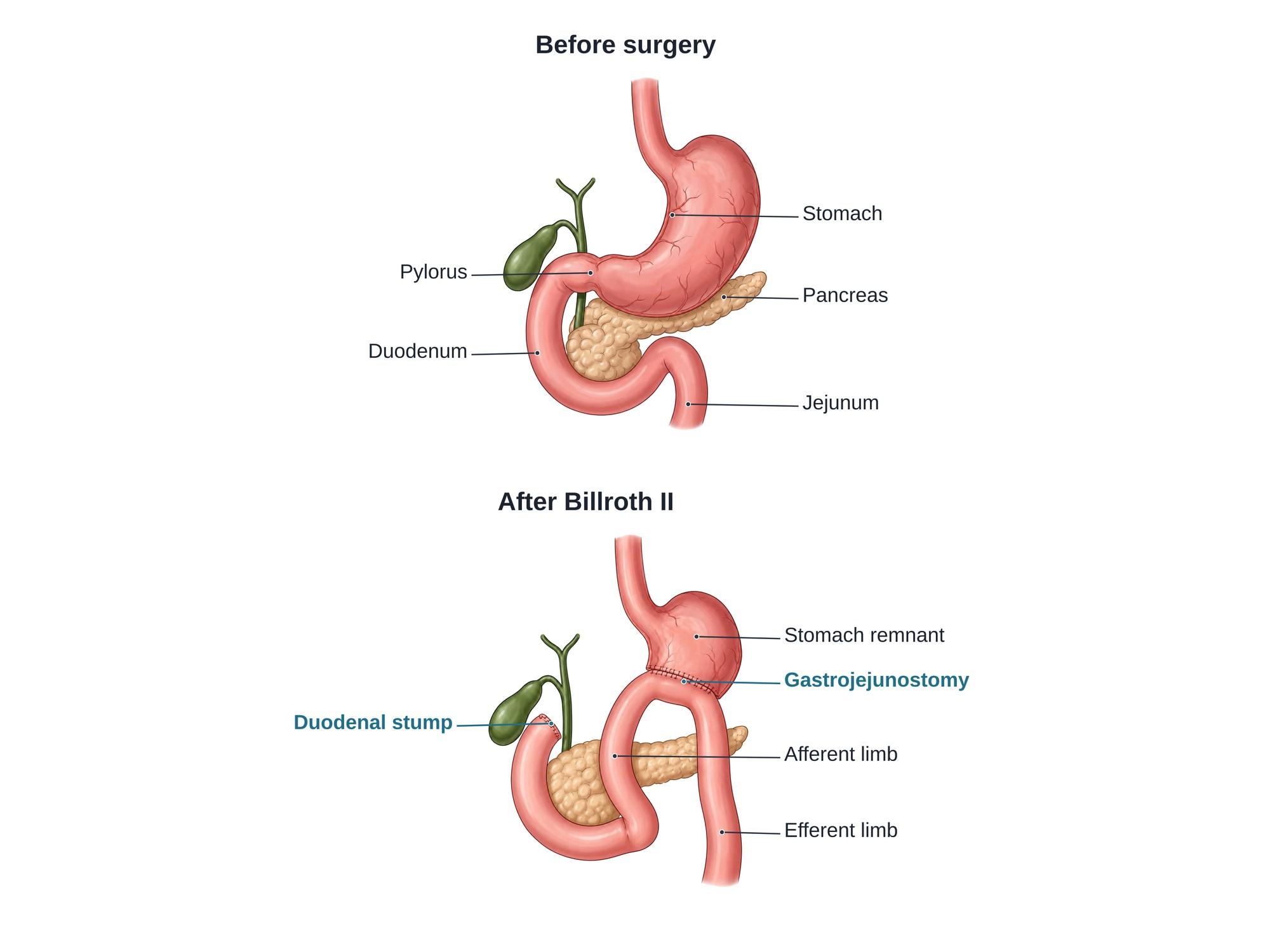
A Billroth II (also written Billroth 2) is surgery that removes the lower part of the stomach and reconnects it to the small intestine. The surgeon removes the antrum (the lower stomach) and the pylorus (the muscle ring that lets food out). The end of the duodenum (the first part of the small intestine) is sewn shut. A loop of jejunum (the next part of the small intestine) is then brought up and joined to the stomach remnant. That join is called a gastrojejunostomy. The illustration above shows the stomach before surgery and the same view after a Billroth II.
Why it is done
- Stomach cancer. Cancer in the lower third of the stomach is now the most common reason. The surgeon removes the tumor with a margin of healthy stomach and the nearby lymph nodes.
- Peptic ulcer disease. Ulcers that bleed, perforate (break through the wall) or scar the stomach outlet shut. Medicines now heal most ulcers, so this is less common than it once was.
- Gastric outlet obstruction. A blocked pylorus or duodenum from scar tissue or a tumor.
- Other tumors near the pylorus, such as some gastrointestinal stromal tumors (GIST).
Billroth II is one of the most widely used reconstructions. In a Korean nationwide survey of 12,751 stomach cancer operations in 2023, it was the most common method after distal gastrectomy, used in 49% of cases (Kim et al., 2025). For the organs around the stomach, see abdominal organs anatomy.
Billroth I vs Billroth II vs Roux-en-Y
After the lower stomach is removed, the surgeon has three main ways to reconnect the gut.
| Reconstruction | What is joined | Main strengths | Main drawbacks |
|---|---|---|---|
| Billroth I | Stomach remnant to the duodenum | Keeps the normal food path; one join | Needs enough stomach left to reach the duodenum without tension |
| Billroth II | Stomach remnant to a loop of jejunum; duodenum closed | Works even when a large part of the stomach is removed | Bile reflux into the stomach, duodenal stump leak, afferent loop syndrome |
| Roux-en-Y | Stomach remnant to a cut limb of jejunum; bile limb joined lower down | Less bile reflux and gastritis | Two joins; longer operation; Roux stasis |
A network meta-analysis of 12 randomized trials with 1,662 patients compared the three. Roux-en-Y had a lower risk of remnant gastritis (inflammation of the stomach remnant) than Billroth II (odds ratio 0.36) (Jiang et al., 2021). The trials found no clear difference in complications, blood loss or hospital stay.
How the surgery is done
A Billroth II can be done open, through an upper midline incision, or laparoscopically through small ports. Robotic surgery is used in some centers. The key steps are the same:
- Anesthesia and access. General anesthesia. The surgeon opens the abdomen or places the laparoscopic ports.
- Mobilizing the stomach. The omentum (the fatty apron on the stomach) and the blood vessels to the lower stomach are divided. For cancer, the lymph nodes around the stomach are removed with it.
- Dividing the duodenum. The duodenum is cut just past the pylorus, usually with a stapler.
- Closing the duodenal stump. The cut end of the duodenum is closed with staples, often reinforced with stitches. This closed end is the duodenal stump. Bile and pancreatic juice still flow into the duodenum from the common bile duct and pancreatic duct.
- Dividing the stomach. The stomach is cut across, and the lower part, including the antrum and pylorus, is removed.
- Bringing up the jejunal loop. A loop of jejunum, about 20 to 40 cm past the duodenojejunal flexure (where the duodenum turns into the jejunum), is brought up to the stomach remnant. It can pass in front of the colon (antecolic) or through the mesentery behind it (retrocolic).
- The gastrojejunostomy. The stomach remnant is sewn or stapled to the side of the jejunal loop. The afferent limb now carries bile and pancreatic juice from the closed duodenum up to the join. The efferent limb carries food and digestive juice away.
- Optional Braun anastomosis. Some surgeons add a small join between the two limbs below the stomach. It lets bile bypass the stomach and lowers reflux.
- Checking and closing. The surgeon checks for leaks and bleeding, may leave a drain near the duodenal stump, and closes.
Recovery
- Hospital stay: about 5 to 10 days after open surgery, often shorter after laparoscopic surgery.
- Eating: liquids first, then soft foods, then small solid meals. Five or six small meals a day work better than three large ones.
- Activity: walking from the first day. No heavy lifting for about 4 to 6 weeks.
- Nutrition: weight loss is common in the first months. Doctors watch vitamin B12, iron, folate, calcium and vitamin D, because the smaller stomach absorbs them less well.
- Endoscopy later: the new layout makes some procedures harder. Reaching the bile duct for an ERCP (a scope test of the bile and pancreatic ducts) means passing the scope up the afferent limb.
Risks
- Duodenal stump leak. The closed end of the duodenum can break down in the first days. In a 15-year cohort of 678 patients who had a gastrectomy with the duodenum closed off, 8% developed a duodenal stump leak (Po Chu et al., 2020). It is serious. In a systematic review of 145 duodenal stump fistulas after cancer surgery, 12% of the patients died (Aurello et al., 2015).
- Anastomotic leak or bleeding at the gastrojejunostomy.
- Afferent loop syndrome. The afferent limb kinks, twists or gets trapped, so bile and pancreatic juice back up. Among 396 patients after laparoscopic distal gastrectomy with Billroth II, 4 (1%) developed an afferent loop obstruction (Kim et al., 2013).
- Bile reflux gastritis. Bile flows back into the stomach remnant and inflames it, causing pain and bile vomiting.
- Dumping syndrome. Food rushes into the jejunum, causing cramps, sweating, a fast heartbeat or diarrhea after meals.
- Marginal ulcer at the join, on the jejunal side.
- Internal hernia, where bowel slips through a gap left by the reconstruction.
- Long-term effects: weight loss, anemia, bone thinning, and a small added risk of cancer in the stomach remnant many years later.
Surgical complications like a stump leak can lead to a medical malpractice review, and a before-and-after medical legal illustration can show a jury where each join sits.
References
- Kim DJ, Song JH, Park JH, et al. Korean Gastric Cancer Association-Led Nationwide Survey on Surgically Treated Gastric Cancers in 2023. Journal of Gastric Cancer. 2025;25(1):115-132.
- Jiang H, Li Y, Wang T. Comparison of Billroth I, Billroth II, and Roux-en-Y reconstructions following distal gastrectomy: A systematic review and network meta-analysis. Cirugia Espanola. 2021;99(6):412-420.
- Po Chu Patricia Y, Ka Fai Kevin W, Fong Yee L, et al. Duodenal stump leakage. Lessons to learn from a large-scale 15-year cohort study. American Journal of Surgery. 2020;220(4):976-981.
- Aurello P, Sirimarco D, Magistri P, et al. Management of duodenal stump fistula after gastrectomy for gastric cancer: Systematic review. World Journal of Gastroenterology. 2015;21(24):7571-7576.
- Kim DJ, Lee JH, Kim W. Afferent loop obstruction following laparoscopic distal gastrectomy with Billroth-II gastrojejunostomy. Journal of the Korean Surgical Society. 2013;84(5):281-286.
Related pages
- Abdomen anatomyThe normal anatomy of the abdomen.
- Exploratory laparotomyExploratory laparotomy opens the abdomen through a midline incision to find and repair injuries or disease. See the incision and the organs it exposes.
- SplenectomySplenectomy is surgery to remove the spleen, often after a rupture from blunt trauma. See the spleen before and after removal, with the tied vessels.
FAQ
What is the difference between Billroth I and Billroth II?+
Both remove the lower part of the stomach. In a Billroth I, the stomach remnant is joined straight to the duodenum, so food follows its normal path. In a Billroth II, the duodenum is closed off and the remnant is joined to a loop of jejunum further down the small intestine. Billroth II is used when the remnant cannot reach the duodenum without tension, or when the duodenum is scarred or diseased.
What is the difference between Billroth II and Roux-en-Y?+
Both join the stomach remnant to the jejunum. In a Billroth II, one loop of jejunum carries both food and bile, so bile can flow back into the stomach. In a Roux-en-Y, the jejunum is cut and the bile limb is joined lower down, which keeps most bile away from the stomach. Roux-en-Y takes longer to do but causes less bile reflux and remnant gastritis.
Why is a Billroth II done?+
Today the most common reason is cancer in the lower stomach. It is also used for ulcers that bleed, perforate or block the stomach outlet when other treatment fails, and for some tumors near the pylorus. Surgeons choose it when a large part of the stomach must be removed.
How long is recovery after a Billroth II?+
Most patients stay in the hospital for about 5 to 10 days after open surgery, and often fewer after laparoscopic surgery. Eating starts with liquids and moves to small, soft meals. Most people return to light activity in 4 to 6 weeks, but eating habits can take a few months to settle.
Can you eat normally after a Billroth II?+
Most people eat well again, but meals change. The smaller stomach fills fast, so 5 to 6 small meals a day work better than 3 large ones. Sugary foods and drinking with meals can bring on dumping syndrome. Many patients also need vitamin B12, iron and calcium checked over time.
What is afferent loop syndrome?+
It is a blockage of the afferent limb, the loop of bowel that carries bile and pancreatic juice from the closed duodenum to the stomach. Fluid backs up and causes pain, bloating and vomiting. It is uncommon, and in one large series about 1 in 100 patients developed it. A sudden, complete blockage is an emergency.
Is Billroth II still done today?+
Yes. It is still one of the most common ways to reconnect the stomach after a distal gastrectomy, especially for stomach cancer. In a 2023 Korean nationwide survey it was the most common method after distal gastrectomy.
What is a duodenal stump leak?+
After a Billroth II, the cut end of the duodenum is closed with staples or stitches. If that closure breaks down, bile and digestive juice leak into the abdomen. It is one of the most serious early complications. Most leaks are treated with drains, nutrition and antibiotics, and some need another operation.
Need a surgical illustration for consent or a case?
Describe the operation and get a clear, labeled medical illustration for patient consent, teaching or a case exhibit.
Try Natomy →