Splenectomy: Spleen Removal Surgery & Recovery
Splenectomy is surgery to remove the spleen, often after a rupture from blunt trauma. See the spleen before and after removal, with the tied vessels.
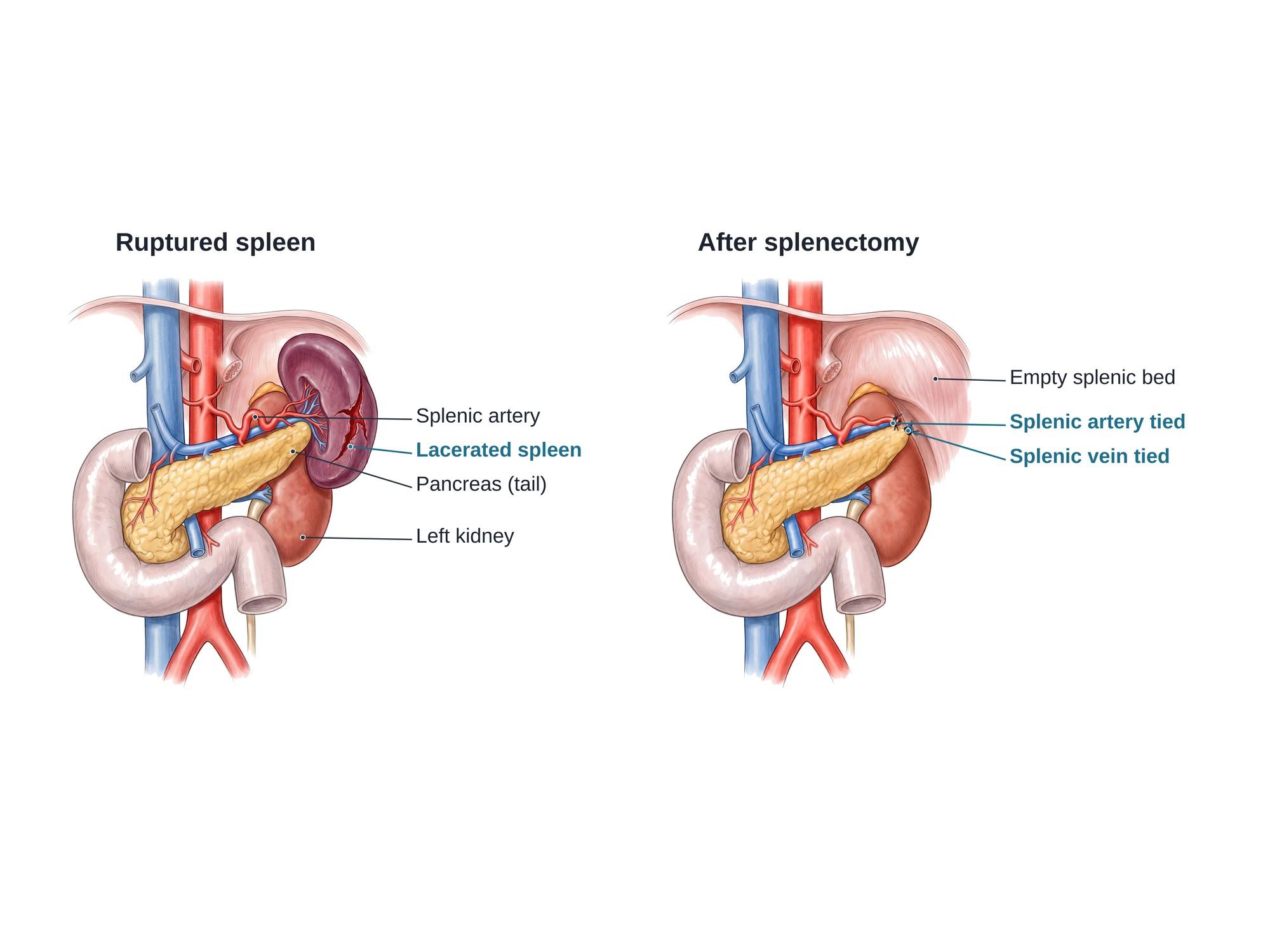
A splenectomy is surgery to remove the spleen, the fist-sized organ under the lower left ribs that filters the blood and helps fight infection. The surgeon frees the spleen from its attachments, ties off the splenic artery and splenic vein at the hilum (the notch where the vessels enter), and lifts the spleen out. In personal injury cases, the usual reason is a ruptured spleen from blunt trauma, such as a car crash or a fall. The illustration above shows a lacerated spleen and the same view after removal.
Why it is done
- Trauma. A spleen torn by blunt force can bleed heavily into the abdomen. Surgery is needed when the patient is unstable, the bleeding does not stop, or the tear is severe.
- Blood disorders. Immune thrombocytopenia (ITP), hereditary spherocytosis and some anemias, where the spleen destroys blood cells too fast.
- An enlarged spleen (splenomegaly) that causes pain, low blood counts or a high risk of rupture.
- Cancer and cysts, such as some lymphomas and leukemias, or large cysts and tumors of the spleen.
- Splenic artery aneurysm or a blocked splenic vein, in some cases.
Not every injured spleen is removed. Doctors grade spleen injuries from I (a small tear) to V (a shattered spleen or torn hilar vessels). Many lower-grade injuries heal with bed rest, repeat scans and observation in the hospital. Others are treated with splenic artery embolization, where a radiologist blocks the bleeding vessel through a catheter. Surgery is the answer when these fail or the patient is in shock. For the surrounding organs, see abdominal organs anatomy.
How the surgery is done
An emergency splenectomy for trauma is usually done through a long midline incision, as part of an exploratory laparotomy. A planned splenectomy is usually laparoscopic, through three or four small cuts with a camera. The key steps are the same:
- Anesthesia and access. General anesthesia. The surgeon opens the abdomen, or places ports and inflates it with gas for laparoscopy.
- Control of bleeding (trauma). In a trauma case, the surgeon first packs the abdomen and finds the source of bleeding. The spleen can be lifted up and pressure put on the hilum.
- Freeing the spleen. The ligaments that hold the spleen to the diaphragm, colon and left kidney are divided.
- Dividing the short gastric vessels. These small vessels run between the top of the spleen and the stomach. They are sealed and cut.
- Tying the hilar vessels. The splenic artery and splenic vein are clamped, tied with sutures or sealed with a stapler at the hilum. The surgeon takes care not to injure the tail of the pancreas, which often reaches into the hilum.
- Removing the spleen. In open surgery it is lifted out whole. In laparoscopy it is placed in a bag and broken up inside the bag, so it can come out through a small cut.
- Checking and closing. The surgeon checks for bleeding and for an injured pancreas tail, looks for small extra spleens (accessory spleens) in planned cases, and closes. A drain is sometimes left in.
Recovery
- Hospital stay: about 1 to 3 days after laparoscopic surgery. After a trauma laparotomy, the stay depends on the other injuries and is often a week or more.
- First 2 weeks: soreness at the incisions, walking every day, no driving while on opioid pain medicine.
- Weeks 2 to 6: gradual return to normal activity. No heavy lifting for about 4 to 6 weeks, longer after a large incision.
- Vaccines: pneumococcal, meningococcal and Hib vaccines, plus a yearly flu shot.
- For life: any fever is taken seriously. Many doctors give patients antibiotics to start at the first sign of a fever, and advise a medical alert card or bracelet.
Blood counts can change after splenectomy. The platelet count often rises for weeks or months, and some patients need aspirin for a time.
Risks
- Bleeding, during or after surgery
- Infection of the wound or a collection of pus under the diaphragm (subphrenic abscess)
- Injury to the pancreas tail, which can leak pancreatic fluid (pancreatic fistula)
- Injury to the stomach or colon next to the spleen
- Blood clots, including clots in the portal and splenic veins and deep vein thrombosis
- Pneumonia and fluid at the base of the left lung, because deep breaths hurt after upper abdominal surgery
- Overwhelming post-splenectomy infection (OPSI), a rare but fast and severe blood infection that can happen years later. Vaccines and early treatment of fevers lower the risk.
How splenectomy is shown in a personal injury case
A ruptured spleen is one of the most common internal injuries after a car crash, and losing the organ is a permanent injury. A before-and-after illustration like the one above helps a jury see where the spleen sits under the left ribs, how blunt force tears it, and what is left after surgery: two tied-off vessels and an empty space. It also supports the future damages. The plaintiff needs vaccines, careful fever plans and lifelong caution about infection. Surgical findings and imaging reports can be drawn as clean illustrations of the specific injury grade. For the trauma operation that often comes first, see exploratory laparotomy. For how these images are used at trial, see demonstrative evidence and medical legal illustration.
Related pages
FAQ
Can you live a normal life without a spleen?+
Yes. Most people live a full, active life after a splenectomy. Other organs, mainly the liver and lymph nodes, take over most of the spleen's work. The one lasting change is a higher risk of serious infection, so vaccines, prompt care for fevers and sometimes antibiotics on hand become part of life.
Is pain common after a splenectomy?+
Yes, for a while. Pain at the incisions and in the left upper abdomen is normal for the first one to two weeks. After laparoscopic surgery, gas used to inflate the abdomen can also cause shoulder pain for a few days. Pain that gets worse, or comes with fever, needs a call to the surgeon.
How long is recovery after spleen removal?+
After laparoscopic splenectomy, most people go home in 1 to 3 days and return to normal activity in about 2 to 4 weeks. After open surgery, often done for trauma, the hospital stay is longer and full recovery usually takes about 4 to 8 weeks. Heavy lifting is limited for several weeks.
What vaccines do you need after a splenectomy?+
Vaccines against pneumococcus, meningococcus and Haemophilus influenzae type b, plus a yearly flu shot. For a planned splenectomy they are given at least two weeks before surgery. After an emergency splenectomy they are usually given about two weeks after the operation, or before the patient goes home.
What does the spleen do for the body?+
The spleen filters the blood. It removes old and damaged red blood cells, stores some platelets and white blood cells, and helps the immune system fight bacteria that have a sugar coating, such as pneumococcus. That last job is why infection risk rises without it.
Does life expectancy change after spleen removal?+
For most people, life expectancy depends far more on the reason for the surgery and their other health than on the missing spleen. The main added risk is a rare but severe blood infection, called overwhelming post-splenectomy infection. Vaccines and fast treatment of fevers lower that risk a great deal.
Why is the spleen removed after a car crash?+
The spleen is soft and full of blood, and it sits under the lower left ribs, where seat belts, steering wheels and side impacts strike. A torn spleen can bleed heavily inside the abdomen. Many injured spleens heal with close watching or with embolization, but surgeons remove it when the bleeding will not stop or the patient is unstable.
Is a splenectomy done laparoscopically or open?+
Planned splenectomies are usually laparoscopic, through a few small cuts with a camera. Emergency splenectomy for trauma is usually open, through a midline incision, because the surgeon needs to control bleeding fast and check the other organs.
Need a surgical illustration for consent or a case?
Describe the operation and get a clear, labeled medical illustration for patient consent, teaching or a case exhibit.
Try Natomy →