Ganglion Cyst: Wrist Causes, Symptoms & Treatment
A ganglion cyst is a fluid-filled lump that grows from a wrist joint or tendon sheath. Learn the causes, symptoms, diagnosis and treatment of wrist ganglions.
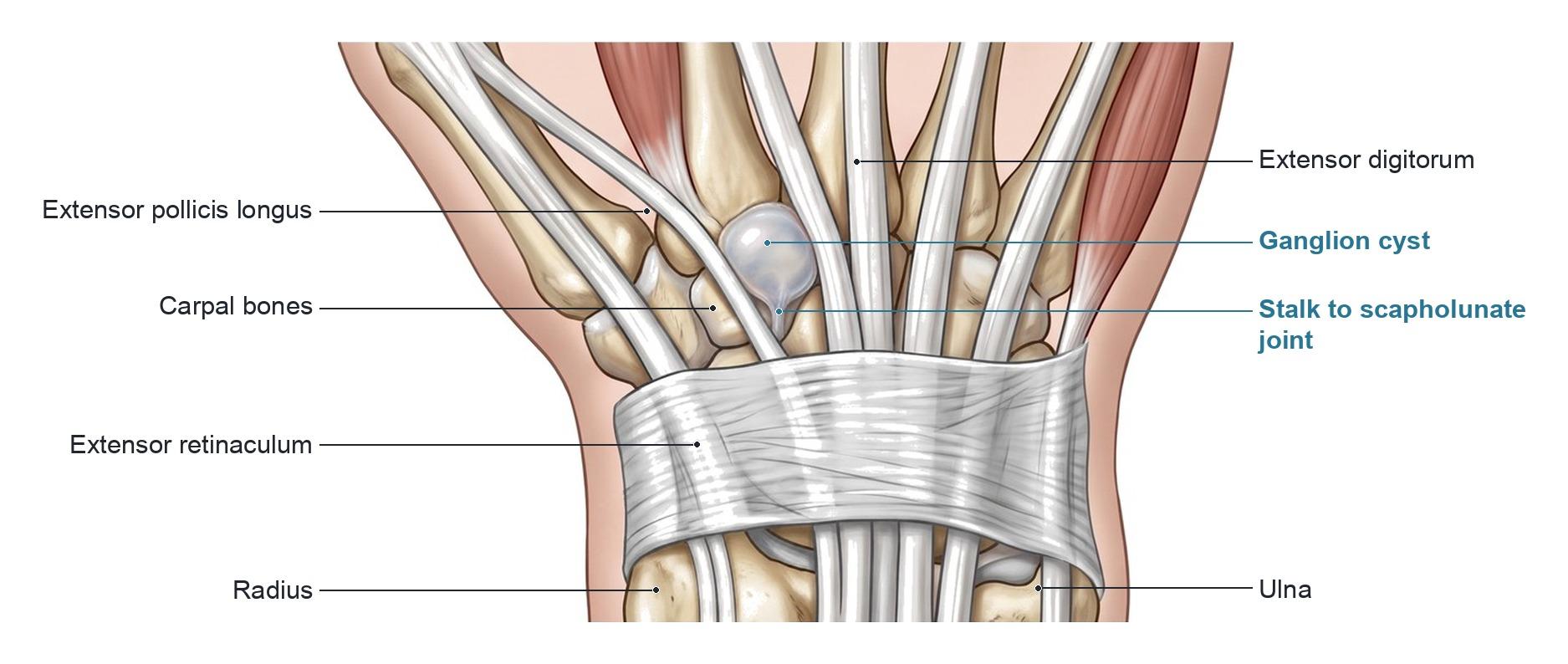
A ganglion cyst is a harmless, fluid-filled lump that grows out of a joint or a tendon sheath. It is the most common soft-tissue lump in the hand and wrist. The cyst holds a thick, clear jelly made mainly of hyaluronic acid, a natural joint lubricant. It is not a tumor and is not cancer. The wrist is a joint of eight small carpal bones that sit between the forearm bones and the hand (see hand and wrist anatomy). The scapholunate ligament holds two of these bones, the scaphoid and the lunate, together. Most wrist ganglions start from this ligament and grow out under the tendons that straighten the fingers, the extensor tendons. Most ganglion cysts form on the back of the wrist, linked to the joint by a stalk (Gude and Morelli, 2008). The illustration above shows a dorsal ganglion cyst with its stalk.
Types
Ganglion cysts are named for where they form.
| Type | Where it forms | Notes |
|---|---|---|
| Dorsal wrist ganglion | Back of the wrist | Most common; stalk usually comes from the scapholunate ligament |
| Volar wrist ganglion | Palm side of the wrist, thumb side | Often lies next to the radial artery, so surgery is more delicate |
| Occult ganglion | Back of the wrist, under the capsule | Too small to see or feel; can still cause wrist pain |
| Flexor tendon sheath cyst | Base of a finger, palm side | Small, firm "seed" lump, tender when gripping |
| Mucous cyst | Back of the last finger joint | Linked to arthritis of that joint |
Ganglions also form in the foot and ankle, often on the top of the foot, and around the knee.
Causes
The exact cause is not known, and there are several theories. Stress on the joint may tear the joint capsule and let fluid leak out. Most current theories say small droplets of jelly form just outside the joint and merge into one cyst, and the wall and stalk form after that (Gude and Morelli, 2008). A narrow stalk, or pedicle, links the sac to the joint. The stalk can act like a one-way valve, so fluid flows in but does not flow back. This is why the cyst can grow larger with activity and shrink with rest.
Risk factors:
- Female sex. In a US military health system study, women had about 2.3 times the rate of dorsal wrist ganglions seen in men among civilian family members, and 2.6 times among active-duty members (Dworak et al., 2020).
- Younger adults. In the same study, adults aged 25 to 34 had about 2.6 times the rate of those aged 45 to 64 among civilians, and 1.7 times among active-duty members. The overall rate was about 7 per 10,000 people each year in civilian family members of service members (Dworak et al., 2020).
- Stress on the wrist joint, which may tear the joint capsule (Gude and Morelli, 2008). Many cysts appear with no clear cause.
- Arthritis of the last finger joint, for mucous cysts.
Symptoms
- A lump on the back or palm side of the wrist, or at the base of a finger. It is usually round, smooth and firm, and does not move much.
- A lump that changes size, larger after heavy use and smaller with rest.
- An aching wrist, often worse with heavy use of the wrist.
- Tingling, numbness or weakness if the cyst presses on a nearby nerve.
- Pain with no visible lump in an occult ganglion.
Many ganglion cysts cause no pain at all, and people only notice the bump.
Diagnosis
A hand surgeon or doctor can usually diagnose a ganglion cyst from the history and exam.
- Exam. The lump is smooth, firm and often slightly tender. Shining a penlight through it (transillumination) makes it glow, because it is full of clear fluid.
- Ultrasound shows a dark, fluid-filled sac and often its stalk to the joint. It also tells a cyst from a solid lump or a blood vessel.
- MRI finds an occult ganglion too small to feel and shows the cyst's link to the scapholunate ligament.
- X-rays look normal around the cyst. They are used to look for arthritis or a carpal boss, a bony bump that can feel like a hard ganglion.
- Aspiration, drawing fluid out with a needle, confirms the diagnosis when thick, clear jelly comes out.
Treatment
Treatment depends on pain, size and how much the cyst gets in the way.
Watchful waiting. A painless cyst can be left alone. About half of ganglion cysts go away on their own (Gude and Morelli, 2008).
Splint or brace. A wrist splint can ease pain for a short time. It does not remove the cyst.
Aspiration. The doctor numbs the skin and draws out the fluid with a needle. It is quick and done in the office, but the cyst often comes back, because the stalk and the leak in the joint stay. In a review of 12 studies with 489 wrist ganglions, the cyst came back after 59% of aspirations on average (Head et al., 2015). Adding a steroid shot does not seem to help much. In a study of 85 dorsal wrist ganglions, 73% came back after aspiration and a steroid injection (Grégoire and Guigal, 2022).
Surgery (ganglion excision). Surgery is for a cyst that hurts, limits hand use, presses on a nerve, or keeps coming back. The surgeon removes the cyst, its stalk and a small cuff of the joint capsule where the stalk starts. This stops the leak and lowers the chance of return.
- The hand is numbed with a nerve block or local anesthetic, sometimes with sedation.
- Open excision: a short cut is made over the cyst. The surgeon moves the extensor tendons aside and follows the stalk down to the joint.
- Arthroscopic excision: the surgeon works through a few small cuts with a camera inside the wrist joint. The stalk and the capsule are removed from the inside.
- The scapholunate ligament is protected, since cutting into it can make the wrist unstable.
- The skin is closed, and a soft dressing or splint is applied.
Both methods work well. A 2023 review of 23 studies and 1,670 surgeries found that cysts came back after 11% of open excisions and 9% of arthroscopic excisions (Clark et al., 2023).
Other conditions on the back and thumb side of the wrist can cause similar pain, such as de Quervain tenosynovitis and a TFCC tear on the little finger side. A finger that catches or locks is a different problem, trigger finger, which can be treated by trigger finger release.
Recovery
- After aspiration: normal use the same day. A short time in a splint is sometimes used.
- After surgery: a soft dressing or splint for a short time. Gentle finger and wrist motion starts early.
- Return to work: desk work usually comes back before heavy lifting and gripping, which can take several weeks or longer.
- Hand therapy helps if the wrist is stiff or weak after surgery.
Complications
- Return of the cyst, most often after aspiration, and less often after surgery (Head et al., 2015)
- Wrist stiffness and loss of grip strength after surgery, usually short-term
- Nerve injury, such as numbness from a small skin nerve near the cut
- Injury to the radial artery during surgery on a volar wrist ganglion
- Scapholunate instability, if the ligament is damaged during removal
- Infection and a tender or thick scar
- Overall complication rates were 11% after open excision and 8% after arthroscopic excision in the 2023 review (Clark et al., 2023)
References
- Gude W, Morelli V. Ganglion cysts of the wrist: pathophysiology, clinical picture, and management. Current Reviews in Musculoskeletal Medicine. 2008;1(3-4):205-211.
- Dworak TC, Balazs GC, Tropf J, et al. Epidemiology of symptomatic dorsal wrist ganglia in active duty military and civilian populations. Journal of Hand Surgery Global Online. 2020;2(6):349-353.
- Head L, Gencarelli JR, Allen M, et al. Wrist ganglion treatment: systematic review and meta-analysis. Journal of Hand Surgery (American Volume). 2015;40(3):546-553.e8.
- Grégoire C, Guigal V. Efficacy of corticosteroid injections in the treatment of 85 ganglion cysts of the dorsal aspect of the wrist. Orthopaedics & Traumatology: Surgery & Research. 2022;108(7):103198.
- Clark DM, Nelson SY, O'Hara M, et al. Surgical and patient-centered outcomes of open versus arthroscopic ganglion cyst excision: a systematic review. Journal of Wrist Surgery. 2023;12(1):32-39.
Related pages
- Hand and wrist anatomyThe normal anatomy of the hand and wrist.
- De Quervain tenosynovitisDe Quervain tenosynovitis is painful swelling of the thumb tendon sheath at the wrist. Learn the causes, symptoms, Finkelstein test, splint and treatment.
- Mallet fingerMallet finger is a torn extensor tendon at the fingertip that leaves the tip drooping. Learn the causes, types, splint care, surgery and recovery time.
FAQ
What is a ganglion cyst in the hand or wrist?+
It is a harmless sac of thick, clear, jelly-like fluid that grows out of a joint or a tendon sheath. It is the most common lump of the hand and wrist. Most form on the back of the wrist, over the ligament that joins the scaphoid and lunate bones. Others form on the palm side of the wrist, at the base of a finger, or near the last finger joint.
Is a ganglion cyst dangerous?+
No. A ganglion cyst is not cancer and does not turn into cancer. It can hurt, look odd, or press on a nearby nerve. A doctor should still check any new lump, because a few other growths can look like a ganglion.
What gets mistaken for a ganglion cyst?+
A carpal boss (a hard bony bump at the base of the index or middle finger metacarpal), a giant cell tumor of the tendon sheath, a lipoma (a fatty lump), swollen tendon sheaths, and arthritis spurs can all look like a ganglion. Rarely, a cancer does. A hard lump on the wrist that feels like bone is more often a carpal boss than a ganglion. An exam and imaging tell them apart.
Will a ganglion cyst go away on its own?+
Often, yes. About half of ganglion cysts go away on their own. Many doctors watch a painless cyst before treating it.
Should you smash a ganglion cyst with a book?+
No. Hitting the cyst to burst it is how it got the old name Bible cyst, and the cyst often comes back. Don't try to pop it at home. See a doctor for aspiration if it needs to be drained.
Does a wrist brace help a ganglion cyst?+
A brace or splint can ease pain for a short time by resting the wrist. It does not remove the cyst.
Does a ganglion cyst need surgery?+
Most do not. Surgery is for a cyst that hurts, limits use of the hand, presses on a nerve, or keeps coming back after drainage. In a review of 1,670 surgeries, the cyst came back after about 11% of open operations and 9% of arthroscopic ones.
How long is recovery after ganglion cyst surgery?+
Light use of the hand starts early. Full grip strength and wrist motion can take several weeks to a few months, and hand therapy helps if the wrist is stiff.
Need this illustration for a patient or a case?
Describe the injury or upload a scan and get a clear, labeled medical illustration for a consult, a chart or a case exhibit.
Try Natomy →