Mallet Finger: Causes, Splint, Surgery & Recovery
Mallet finger is a torn extensor tendon at the fingertip that leaves the tip drooping. Learn the causes, types, splint care, surgery and recovery time.
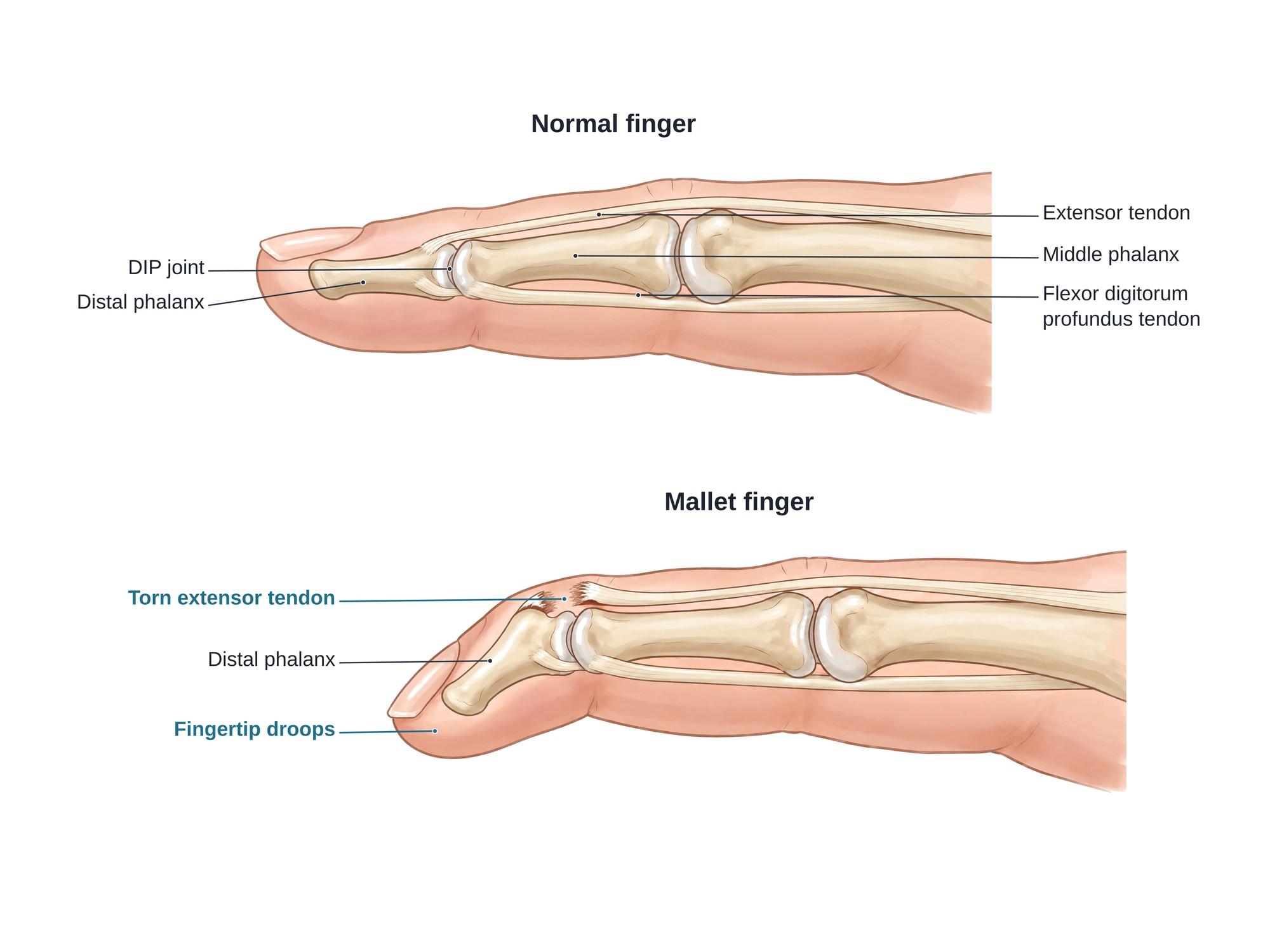
A mallet finger is an injury to the terminal extensor tendon, the thin tendon on the back of the finger that straightens the fingertip. The tendon tears, or it pulls off a small flake of bone from the distal phalanx, the bone of the fingertip. The end joint of the finger, the distal interphalangeal (DIP) joint, then droops and cannot be straightened on its own. The extensor tendon runs along the back of each finger and attaches to the base of the distal phalanx, just past the DIP joint (see hand and wrist anatomy). Mallet finger is common. In a Dutch primary care study, it was diagnosed in about 58 adults per 100,000 each year (0.58 per 1,000 person-years), and 23% of the 161 cases were bony (Krastman et al., 2024). The illustration above shows a normal finger (top) and a mallet finger (bottom).
Types
Hand surgeons often sort mallet injuries with the Doyle classification (Khera et al., 2021; Sivakumar et al., 2023).
| Type | What it is | Usual treatment |
|---|---|---|
| Type I | Closed injury, tendon torn or with a tiny bone flake | Splint |
| Type II | Cut (laceration) through the tendon at or near the DIP joint | Stitch the tendon and skin |
| Type III | Deep scrape (abrasion) with loss of skin and tendon | Wound care, often skin and tendon repair |
| Type IV A | Growth plate fracture of the distal phalanx in a child | Splint or reduction |
| Type IV B | Fracture of 20% to 50% of the joint surface | Splint, sometimes surgery |
| Type IV C | Fracture of more than 50% of the joint surface, often with the joint slipping | Often surgery |
Two plain terms are also used:
- Tendinous mallet finger. The tendon itself tears. This is the most common type.
- Bony mallet finger (mallet fracture). The tendon pulls off a piece of the distal phalanx, or the joint surface is crushed in a jamming injury. The droop is often smaller than with a tendon tear.
Causes
A tendon tear usually happens when a straight fingertip is suddenly forced to bend. A bony mallet injury more often comes from the tip being jammed and forced back, which crushes the joint surface (Giddins, 2022). A ball hits the tip of the finger, or the finger jams against something hard. That is why it is also called baseball finger.
Common causes include:
- Sports, such as baseball, basketball, volleyball and football
- Work injuries, such as a finger caught in a door, a machine or a heavy object
- Falls onto the hand
- Minor everyday force, such as tucking in a sheet or pulling on socks, mostly in older adults
- Cuts and crush injuries, which can cause an open mallet finger
The two main types tend to affect different people. In one hand surgeon's series, tendon tears came from low-energy injuries in older patients, while bony mallet injuries came from higher-energy injuries at a mean age of 40 (Giddins, 2022). The middle, ring and little fingers are hurt most often.
Symptoms
- A fingertip that droops at the end joint
- Not being able to straighten the tip on its own, though it can be pushed straight
- Pain, swelling and bruising over the back of the end joint (often mild with a tendon tear)
- Tenderness at the base of the nail
- Sometimes a bump on the back of the joint
- Later, a swan neck look, with the middle joint bent backward
Diagnosis
- History and exam. The doctor asks how the finger was hurt and checks whether the tip can be straightened. A droop that corrects with help but not on its own points to mallet finger. The doctor also checks the skin for a cut or scrape.
- X-rays. A side view shows whether a piece of bone has been pulled off, how much of the joint surface it includes, and whether the joint has slipped toward the palm (volar subluxation). This decides between splinting and surgery.
- Ultrasound or MRI. Rarely needed. These can show the torn tendon when the diagnosis is unclear.
Mallet finger vs jersey finger
Jersey finger is the mirror image of mallet finger. It is a tear of the flexor digitorum profundus tendon, the tendon on the palm side that bends the fingertip. It happens when a bent finger is forced straight, often when a player grabs another player's jersey. The tip cannot bend, rather than cannot straighten. The ring finger is the usual one. In a series of 32 jersey fingers treated with surgery, 16 were in the ring finger and 13 in the little finger (Tempelaere et al., 2017).
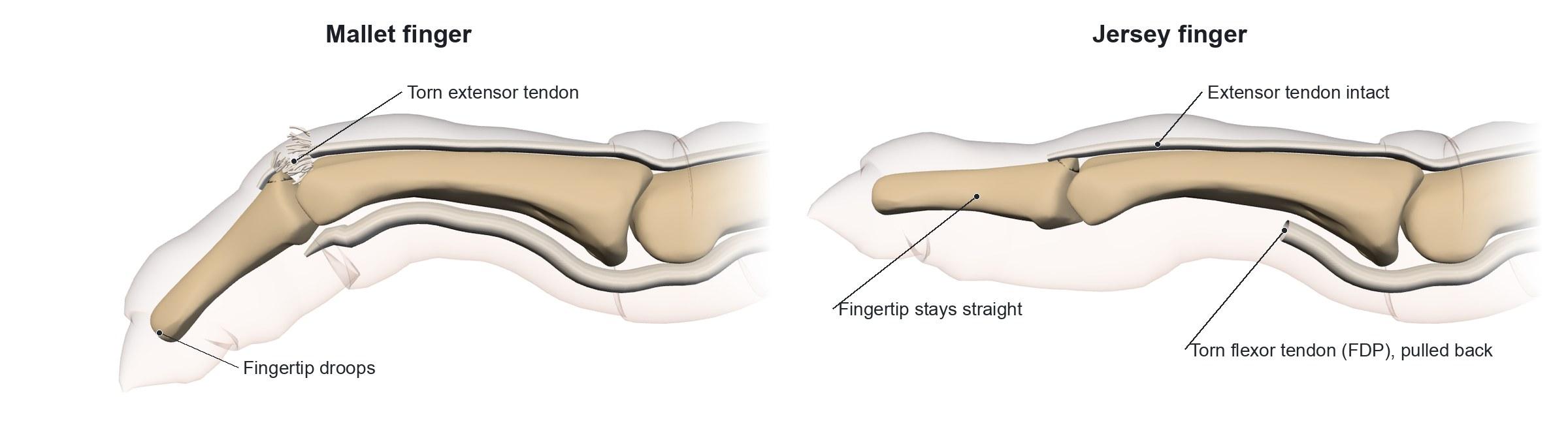
| Feature | Mallet finger | Jersey finger |
|---|---|---|
| Tendon torn | Extensor, on the back of the fingertip | Flexor digitorum profundus, on the palm side |
| How it happens | Tip forced to bend (tendon) or jammed back (bony) | Bent tip forced straight |
| What you see | Tip droops, cannot straighten | Tip stays straight, cannot bend |
| Usual finger | Middle, ring or little | Ring |
| Usual treatment | Splint for 6 to 8 weeks | Early surgery |
Treatment
Splinting is the main treatment for most closed mallet fingers, both tendinous and bony. A mallet finger splint holds the DIP joint straight, or slightly bent back, while the middle joint stays free to move. It is worn day and night, usually for about 6 to 8 weeks (Giddins, 2022). Many surgeons then add a few weeks of night splinting. The tip must stay straight the whole time, even when the splint is changed or the skin is washed. Most mallet fingers heal with splinting over 8 to 12 weeks, even when treatment is delayed by up to 3 to 4 months (Bachoura et al., 2017).
Common splint types include a ready-made stack splint, a custom thermoplastic splint and a finger cast. The type matters for comfort and skin. In a trial of 58 patients, skin problems occurred in 33% of those treated with a finger cast and 64% of those treated with a custom thermoplastic splint (Cavanaugh et al., 2022).
Surgery is used for:
- Open injuries, such as a cut through the tendon
- Large bone fragments that include much of the joint surface
- A joint that has slipped toward the palm (volar subluxation)
- A splint that fails, or someone who cannot wear one
Options include extension block pinning (thin wires that hold the bone fragment in place), open reduction and internal fixation with a small screw or hook plate, direct tendon repair, and fusion of the DIP joint for painful, long-standing cases. A systematic review of 44 studies found similar results with splinting and surgery. The average leftover droop was about 6 degrees after surgery and 8 degrees after splinting. Complications occurred in 15% after surgery and 13% after splinting (Lin and Samora, 2018).
Recovery
- Splint full time for about 6 to 8 weeks, then weaned off over about 2 more weeks, often at night (Khera et al., 2021).
- Gentle bending of the fingertip begins once the tip stays straight on its own.
- Most people can work with a splint on, though some tasks need changes.
- Swelling, stiffness and a bump on the back of the joint can last for months.
- A small leftover droop of a few degrees is common and rarely limits function.
- After pinning, the wires are removed once the bone has healed.
Complications
- Leftover droop (extensor lag), from a tendon that healed long
- Swan neck deformity, when the middle joint bends backward as the end joint stays bent
- Skin problems under the splint, such as sores, peeling or blistering
- Stiffness of the DIP joint
- Arthritis of the DIP joint, more likely after large or displaced fractures
- After surgery, nail deformity, pin site infection, hardware problems and stiffness
References
- Krastman P, de Schepper E, Bindels P, et al. Incidence and management of mallet finger in Dutch primary care: a cohort study. BJGP Open. 2024;8(1):BJGPO.2023.0040.
- Khera B, Chang C, Bhat W. An overview of mallet finger injuries. Acta Biomedica. 2021;92(5):e2021246.
- Sivakumar BS, Graham DJ, Ledgard JP, et al. Acute Mallet Finger Injuries: A Review. Journal of Hand Surgery (American). 2023;48(3):283-291.
- Giddins G. Mallet Finger: Two Different Injuries. Hand Clinics. 2022;38(3):281-288.
- Tempelaere C, Brun M, Doursounian L, et al. Traumatic avulsion of the flexor digitorum profundus tendon. Jersey finger, a 29 cases report. Hand Surgery and Rehabilitation. 2017;36(5):368-372.
- Bachoura A, Ferikes AJ, Lubahn JD. A review of mallet finger and jersey finger injuries in the athlete. Current Reviews in Musculoskeletal Medicine. 2017;10(1):1-9.
- Cavanaugh PK, Watkins C, Jones C, et al. Effectiveness of Quickcast Versus Custom-Fabricated Thermoplastic Orthosis Immobilization for the Treatment of Mallet Fingers: A Randomized Clinical Trial. Hand (New York). 2022;17(6):1090-1097.
- Lin JS, Samora JB. Surgical and Nonsurgical Management of Mallet Finger: A Systematic Review. Journal of Hand Surgery (American). 2018;43(2):146-163.
Related pages
- Hand and wrist anatomyThe normal anatomy of the hand and wrist.
- De Quervain tenosynovitisDe Quervain tenosynovitis is painful swelling of the thumb tendon sheath at the wrist. Learn the causes, symptoms, Finkelstein test, splint and treatment.
- Ganglion cystA ganglion cyst is a fluid-filled lump that grows from a wrist joint or tendon sheath. Learn the causes, symptoms, diagnosis and treatment of wrist ganglions.
FAQ
What is a mallet finger deformity?+
It is a fingertip that droops and cannot be straightened on its own. The end joint of the finger, the DIP joint, stays bent because the tendon that straightens it is torn or has pulled off a small piece of bone. You can push the tip straight with the other hand, but it drops again when you let go.
How do doctors treat a mallet finger?+
Most mallet fingers are treated with a splint that holds the fingertip straight, worn day and night for about 6 to 8 weeks, then at night for a few more weeks. Surgery is used for open wounds, large bone fragments, a joint that has slipped out of line, or a finger that does not heal with splinting.
Can a mallet finger heal in 4 weeks?+
Usually not. The tendon needs about 6 to 8 weeks of nonstop splinting to heal, and a bony mallet finger is splinted for a similar time. If the tip is allowed to bend even once during that time, the healing tendon can stretch and the clock may need to start again.
What happens if a mallet finger is not treated?+
The tip may stay bent for good. Over time, an untreated mallet finger can lead to a swan neck deformity, where the middle joint bends backward and the end joint stays bent. Many people still do well when treatment starts weeks or even a few months late, so it is worth seeing a doctor even after a delay.
Does a mallet finger need surgery?+
Most do not. In a systematic review of 44 studies, splinting and surgery gave similar results, and complications were about as common with each (13% with splints, 15% with surgery). Surgery is kept for open injuries, large fractures, joint subluxation and failed splinting.
What is the difference between mallet finger and jersey finger?+
They are opposite injuries at the same joint. Mallet finger is a tear of the extensor tendon on the back of the fingertip, so the tip droops and cannot straighten. Jersey finger is a tear of the flexor digitorum profundus tendon on the palm side, so the tip cannot bend. Jersey finger usually needs surgery soon after the injury; mallet finger usually does not.
Why does my mallet finger still droop after splinting?+
A small droop of a few degrees is common and often causes no trouble. A larger droop can mean the splint was removed too early, the tip bent during healing, or the tendon healed in a stretched position. A hand surgeon may suggest more splinting or, less often, surgery.
How do you know when a mallet finger is healed?+
The doctor checks that the fingertip stays straight on its own when the splint comes off. Then the finger is weaned out of the splint over a few weeks, usually with night splinting. Swelling and a bump on the back of the joint can last for months even after the tendon has healed.
Need this illustration for a patient or a case?
Describe the injury or upload a scan and get a clear, labeled medical illustration for a consult, a chart or a case exhibit.
Try Natomy →