Crush Syndrome: Causes, Symptoms & Treatment
Crush syndrome is the body-wide illness after crushed muscle is released. Learn the causes, symptoms, treatment and how it differs from compartment syndrome.
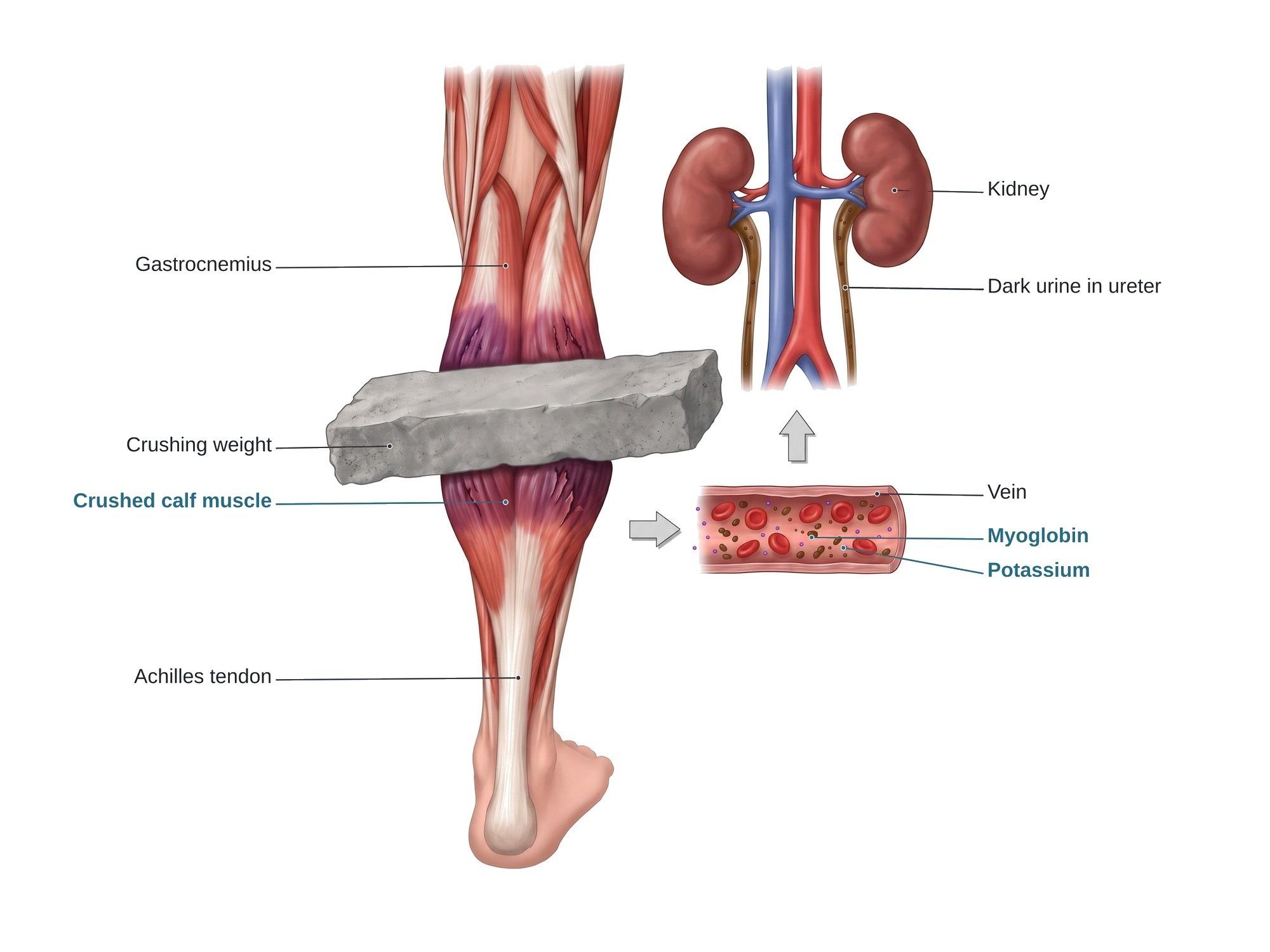
Crush syndrome is the body-wide illness that follows when a large amount of muscle is crushed and then released. It is also called traumatic rhabdomyolysis, which means the breakdown of skeletal muscle after injury. A heavy weight, such as rubble or a vehicle, squeezes a limb for hours. Blood cannot reach the muscle, so its cells swell and die. When the weight is lifted, blood flows back in and washes their contents into the circulation. These include potassium, acid and myoglobin, the protein that stores oxygen in muscle. High potassium can stop the heart, and myoglobin can block and damage the kidneys. The lower limb is the most common site, involved in about 74% of crush injuries (Akrivos et al., 2025). The figure above follows this path from the crushed calf to the kidneys.
Crush syndrome vs compartment syndrome
A crush injury is the local damage in the squeezed body part. Crush syndrome is the effect on the whole body. Compartment syndrome is a separate but related problem, and it often appears in the same limb.
| Feature | Crush syndrome | Compartment syndrome |
|---|---|---|
| What it is | Body-wide illness from muscle breakdown products in the blood | Pressure rise inside a closed muscle compartment |
| Main cause | Prolonged crushing of a large muscle mass, then release | Fracture, crush injury or swelling inside tight fascia |
| Main danger | High potassium, shock and kidney failure | Death of the muscle and nerves in that compartment |
| Key signs | Dark urine, low urine output, irregular heartbeat | Pain out of proportion, pain on stretch, tense limb |
| Main treatment | Intravenous fluids, potassium control, dialysis | Emergency fasciotomy |
Causes
Crush syndrome needs a large muscle squeezed for a long time. Common settings are:
- Collapsed buildings after earthquakes, explosions or bombings
- Industrial accidents, such as a limb pinned under machinery or a load
- Vehicle crashes where a driver or passenger is trapped
- Mine and trench collapses and landslides
- Lying still for many hours on a limb, for example after a stroke, a fall or an overdose, which can cause a similar muscle breakdown without an accident
Earthquakes cause the largest numbers. In 1,024 patients with crush syndrome after the 2023 earthquakes in Turkey, the median time under the rubble was 12 hours (Ozturk et al., 2024). After direct trauma, crush syndrome is the second most common cause of death in mass disasters (Sever and Vanholder, 2011).
The muscle damage has two phases. First, pressure cuts off blood flow (ischemia). With no blood flow at all, the damage becomes permanent within about 4 to 6 hours (Akrivos et al., 2025). Second, when the weight is lifted, blood returns (reperfusion). This brings fresh injury and carries the toxic contents of the dead cells into the body.
Symptoms
In the crushed limb
- Swelling, tightness and hard, tense muscle
- Numbness, weakness or paralysis
- Pale or bruised skin
In the whole body
- Dark, tea-colored urine from myoglobin (myoglobinuria)
- Little or no urine (oliguria), a sign of kidney injury
- Low blood pressure and shock, as fluid leaks into the damaged muscle
- An irregular heartbeat or cardiac arrest from high potassium (hyperkalemia)
- Acid buildup in the blood (metabolic acidosis) and muscle weakness
High potassium can cause sudden death soon after release. Most deaths from it happen in the first 3 days (Akrivos et al., 2025).
Diagnosis
Crush syndrome is diagnosed from the history and the exam: a limb trapped for hours, then swelling, dark urine or shock. Blood and urine tests confirm it:
- Creatine kinase (CK), an enzyme released by damaged muscle, is very high
- Potassium, phosphate and creatinine (a marker of kidney function) are raised
- Blood gases show acid in the blood (metabolic acidosis)
- Urine tests look for myoglobin, which turns the urine dark
- An ECG (heart tracing) looks for rhythm changes caused by high potassium
Doctors also check the limb for compartment syndrome, sometimes with a needle pressure monitor. Imaging looks for fractures and other injuries. The diagnosis itself rests on the history, the exam and the blood and urine tests.
Treatment
Treatment starts at the scene, before the person is freed whenever possible.
- Fluids first. Intravenous normal saline is started while the person is still trapped. One review recommends about 1,000 mL an hour during extrication, halved after 2 hours (Akrivos et al., 2025). Potassium-containing fluids such as Ringer's lactate are avoided.
- Heart monitoring and potassium control. Calcium protects the heart. Insulin with glucose and inhaled albuterol move potassium back into cells.
- Protecting the kidneys. Fluids keep urine flowing so myoglobin does not block the tubules. Some teams add sodium bicarbonate or mannitol, but the benefit of each is debated.
- Dialysis when the kidneys fail or potassium stays dangerously high.
- Surgery on the limb. A fasciotomy is done for compartment syndrome. Dead muscle is removed. A below-knee amputation is a last resort when the limb cannot be saved or is driving the illness.
The kidneys are often hit hard. In the 2023 Turkey series, 68% of patients developed acute kidney injury, and 70% of those needed hemodialysis. Compartment syndrome occurred in 41%, and 76% of them had a fasciotomy (Ozturk et al., 2024).
Recovery
Recovery takes weeks to months. In the Turkey series, patients stayed in the hospital for 20 days on average, and those admitted to intensive care stayed there 11 days (Ozturk et al., 2024). Kidney function often returns once the muscle breakdown stops, though some people need dialysis for weeks. The injured limb may need repeat surgery, wound care and physical therapy. Lasting weakness or numbness can follow if nerves were damaged. See nerve injury types.
Complications
- Cardiac arrest from high potassium, often right after release
- Acute kidney injury and kidney failure
- Shock from fluid loss into the damaged muscle
- Compartment syndrome in the crushed limb
- Infection and sepsis, especially in open wounds and after fasciotomy
- Disseminated intravascular coagulation (DIC), a clotting and bleeding disorder
- Loss of the limb, or lasting muscle and nerve damage
Overall, 10% of the 1,024 patients in the Turkey series died in the hospital (Ozturk et al., 2024). Crush injuries often come with skin and soft tissue damage too, such as a degloving injury or a deep contusion.
References
- Akrivos VS, Koutalos A, Stefanou N, et al. Crush injury and crush syndrome: a comprehensive review. EFORT Open Reviews. 2025;10(6):424-430.
- Ozturk I, Gungor O, Ozturk S, et al. Epidemiological analysis of the victims with crush syndrome in earthquakes of southeastern Turkey. Journal of Nephrology. 2024;37(9):2589-2599.
- Sever MS, Vanholder R. Management of crush syndrome casualties after disasters. Rambam Maimonides Medical Journal. 2011;2(2):e0039.
FAQ
What is the difference between crush injury and crush syndrome?+
A crush injury is the local damage to a body part that was squeezed, such as torn, bruised muscle in the leg. Crush syndrome is what happens to the whole body after that muscle breaks down. Potassium, myoglobin and acid flood the blood once the pressure is released. This can stop the heart and damage the kidneys.
What is the difference between crush syndrome and compartment syndrome?+
Compartment syndrome is a local problem. Pressure builds inside a closed group of muscles and cuts off their blood supply. Crush syndrome is a body-wide problem caused by muscle breakdown products in the blood. The two often happen together. In a study of 1,024 earthquake victims with crush syndrome, 41% also had compartment syndrome.
How long does it take for crush syndrome to develop?+
It depends on how much muscle is trapped and for how long. Muscle with no blood flow at all can die within about 4 to 6 hours. The danger often shows up the moment the weight is lifted, when potassium and myoglobin rush into the blood. Kidney failure can follow over the next hours to days.
What are the signs of crush syndrome?+
The trapped limb is swollen, tense, numb or pale. The person may have low blood pressure, an irregular heartbeat, weakness and little or no urine. Dark, tea-colored urine is a key warning sign. It means myoglobin from broken muscle is passing through the kidneys.
Why can someone die right after being freed?+
A trapped person can seem stable while still pinned. When the weight is lifted, potassium and acid from the dead muscle suddenly reach the heart. This can cause a fatal heart rhythm. That is why fluids are started before the person is freed whenever possible.
How is crush syndrome treated?+
Treatment starts with large amounts of intravenous saline, ideally before the person is freed. Doctors watch the heart and treat high potassium fast. Many patients need dialysis while the kidneys recover. A fasciotomy is done if compartment syndrome develops. Amputation is a last resort when the limb cannot be saved.
Can you survive crush syndrome?+
Yes, most people who reach a hospital survive. In 1,024 patients treated after the 2023 earthquakes in Turkey, about 10% died in the hospital. Early fluids, fast treatment of high potassium and access to dialysis make the biggest difference.
Do the kidneys recover after crush syndrome?+
Kidney function often recovers once the muscle breakdown stops, but some people need dialysis for weeks first. Doctors keep checking kidney function after discharge to make sure it has returned.
Need this illustration for a patient or a case?
Describe the injury or upload a scan and get a clear, labeled medical illustration for a consult, a chart or a case exhibit.
Try Natomy →