Boxer's Fracture: X-ray, Treatment & Healing Time
A boxer's fracture is a break of the fifth metacarpal neck, just below the little finger knuckle. See one on X-ray beside a labeled illustration.
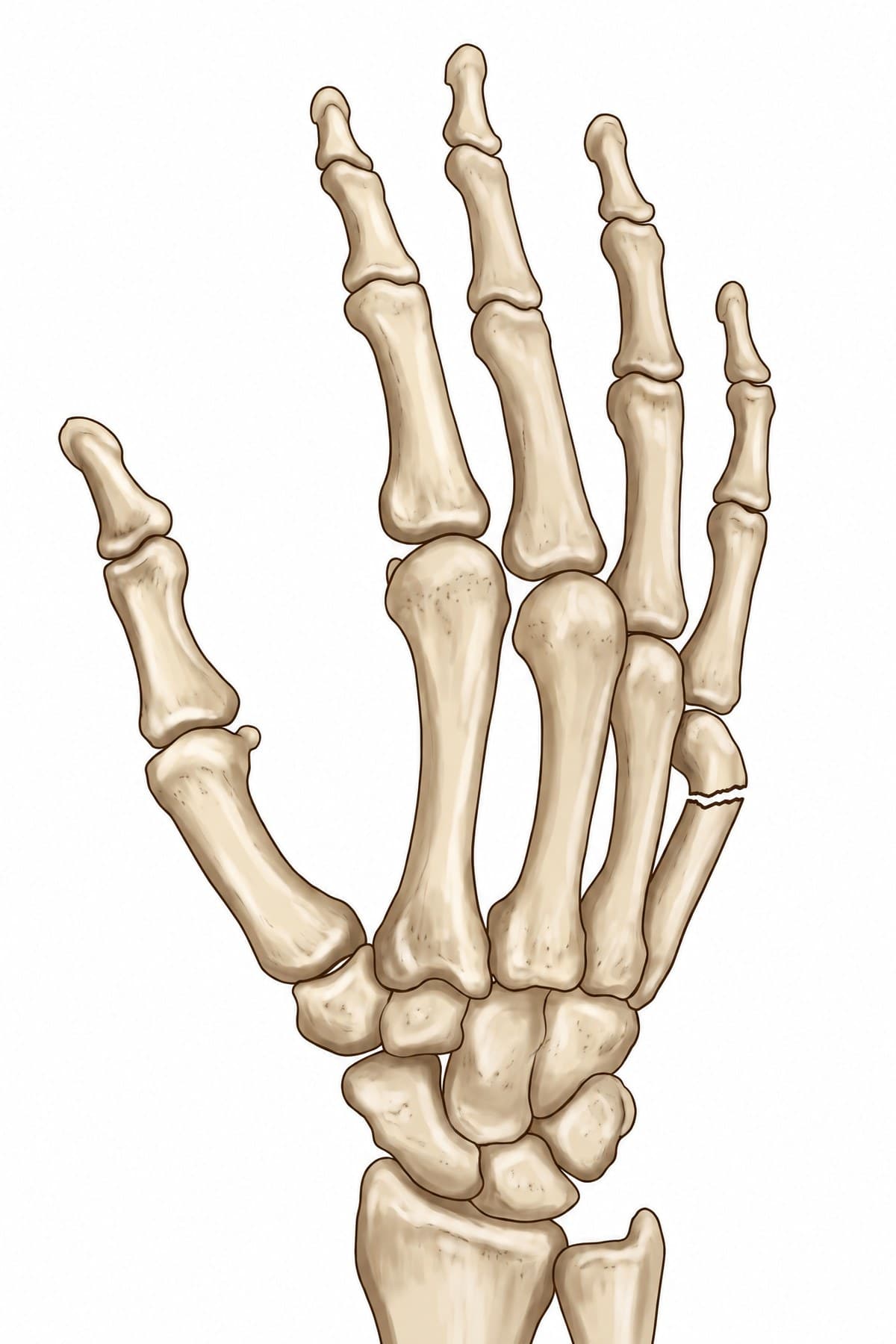
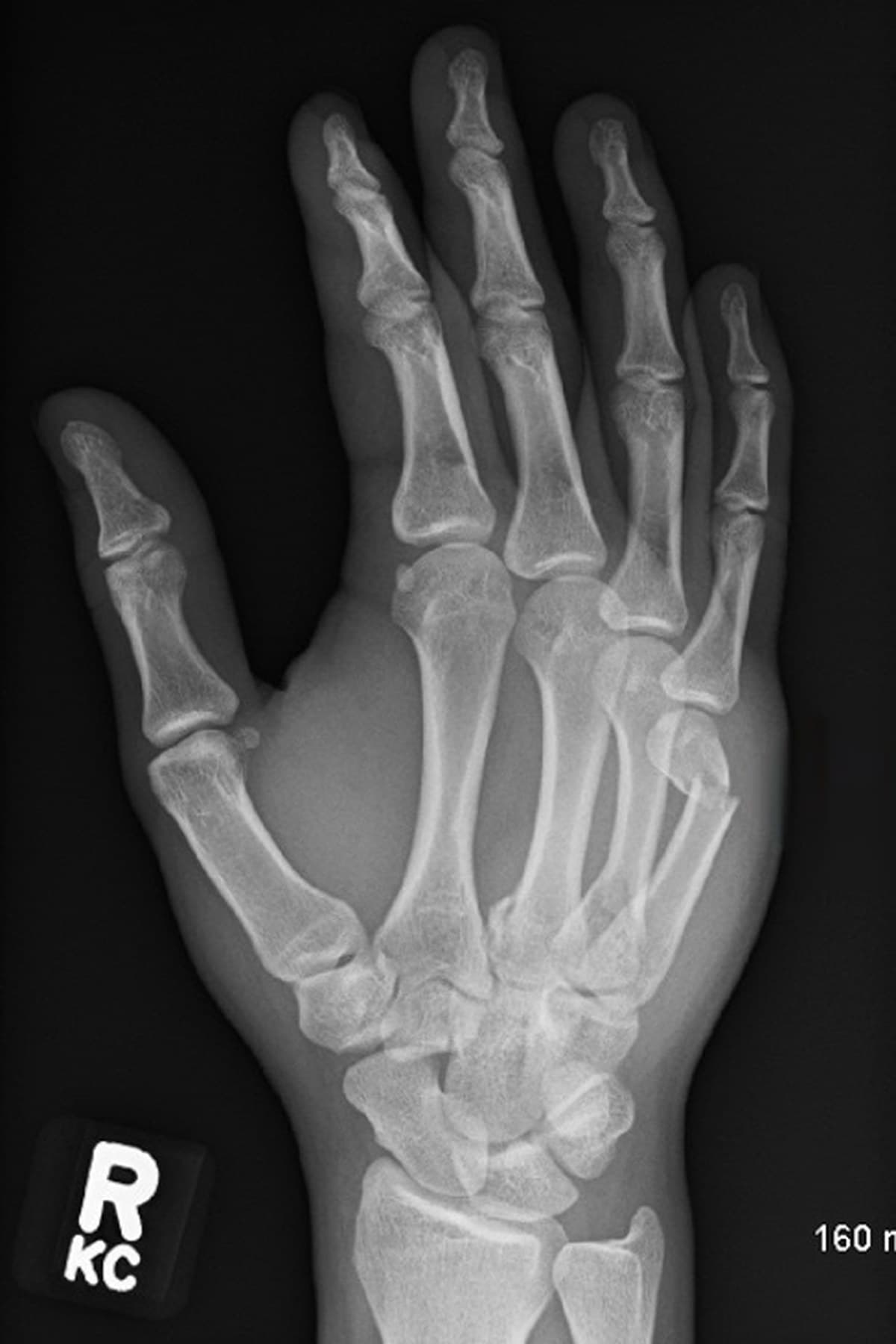
A boxer's fracture is a break of the neck of the fifth metacarpal, the hand bone below the little finger, just behind the knuckle. The head of the bone usually tips toward the palm, flattening the knuckle. It is one of the most common hand fractures, typically from punching a hard object. The figure above shows a real X-ray of a boxer's fracture from punching a wall with a medical illustration drawn from it: drag the slider to compare them.
The fifth metacarpal
The five metacarpals form the palm. Each has a base at the wrist, a long shaft, a narrow neck, and a rounded head that forms the knuckle. The neck of the fifth metacarpal is the weakest point along the edge of a closed fist, which is why it breaks when a punch lands on the little finger side. For the full anatomy of the hand, see hand and wrist anatomy.
Boxer's fracture on X-ray
Three views of the hand are taken: front (PA), oblique and side. On the PA view above, the neck of the fifth metacarpal is broken just below the head, and the head has tilted out of line with the shaft. The other metacarpals are intact.
| Finding | Why it matters |
|---|---|
| Angulation of the head toward the palm | Larger angles more often need realignment or surgery |
| Shortening of the metacarpal | Can weaken grip and leave a sunken knuckle |
| Rotation (finger crosses over when making a fist) | A clinical sign that usually needs correction |
| Fracture extending into the joint | Changes the fracture type and treatment |
Accepted angulation is larger for the fifth metacarpal than for the other fingers, often quoted as up to about 40 to 70 degrees, because the little finger's joint at the wrist is mobile and compensates.
How a boxer's fracture happens
A closed fist striking a wall, a door, a hard surface or another person. Falls onto a closed fist and direct blows to the side of the hand cause the same fracture. It is most common in young men.
Symptoms
- Pain and swelling over the outer side of the back of the hand
- A flattened or sunken little finger knuckle
- Bruising that spreads over the hand
- Pain with gripping and making a fist
- The little finger crossing over the ring finger when you make a fist, if the fracture is rotated
Treatment
- Closed reduction: the head is pushed back into better alignment under a local anesthetic block.
- Splint or cast: an ulnar gutter splint holds the ring and little fingers together for about 3 to 4 weeks.
- Buddy taping: for stable fractures with mild angulation, allowing early movement.
- Surgery: pins (K-wires), screws or a small plate for severe angulation, shortening, rotation or unstable fractures.
Recovery time
The bone heals in about 4 to 6 weeks. Finger stiffness is common after splinting and usually improves with exercises. Most people return to full use of the hand in 6 to 8 weeks, and to contact sports or heavy lifting a little later.
Complications
- Malunion: a permanently sunken knuckle, a bump in the palm, or reduced grip
- Rotational deformity: the little finger overlaps the ring finger
- Stiffness of the little finger
- Fight bite infection: a cut over the knuckle from a tooth can infect the joint and needs urgent treatment
How a boxer's fracture is shown in a personal injury case
Boxer's fractures appear in assault and battery claims, workplace injuries and falls. Because the mechanism is often disputed (punching versus being struck or falling), the fracture location and angulation matter. An illustration drawn from the patient's own X-ray, like the one above, shows which bone broke, how far the head tilted, and why the knuckle looks different afterward. For how these images are used at trial, see demonstrative evidence and medical legal illustration.
Related pages
- Hand and wrist anatomyThe normal bones, joints and soft tissues of the hand and wrist.
- Colles fractureA Colles fracture is a break of the distal radius with the end tilted toward the back of the hand.
- Scaphoid fractureA scaphoid fracture is a break of the small wrist bone below the thumb, often missed on the first X-ray. See one on X-ray beside a labeled illustration.
FAQ
What is a boxer's fracture?+
A boxer's fracture is a break of the neck of the fifth metacarpal, the hand bone that leads to the little finger, just below the knuckle. The head of the bone usually tilts toward the palm. It gets its name because it most often happens when a closed fist hits a hard object, such as a wall or another person.
How do you treat a boxer's fracture?+
Most are treated without surgery. The fracture may be gently realigned, then held in a splint or cast that keeps the ring and little fingers together, usually for 3 to 4 weeks. Surgery with pins or a plate is considered when the head is tilted very far, the bone is shortened, or the finger rotates and overlaps the ring finger when you make a fist.
How long does a boxer's fracture take to heal?+
The bone usually heals in about 4 to 6 weeks. Most people regain near-normal use of the hand within 6 to 8 weeks, although grip strength can take a few months to return fully.
Do you need a cast for a boxer's fracture?+
Usually a splint or cast is used for a few weeks, often an ulnar gutter splint that holds the ring and little fingers together. Some stable fractures with mild angulation are treated with buddy taping and early movement instead.
What happens if a boxer's fracture is not treated?+
Many heal on their own, but the knuckle often ends up sunken and the bone may heal angled or rotated. A rotated fracture can make the little finger cross over the ring finger when you make a fist, which may need surgery later. A cut over the knuckle from a tooth is a separate emergency because it can cause a serious joint infection.
What does a boxer's fracture look like on an X-ray?+
On the front view, a break runs across the neck of the fifth metacarpal just below its head, and the head is tilted out of line with the shaft. A side or oblique view measures how far the head has tilted toward the palm, which guides treatment.
Can you still move your fingers with a boxer's fracture?+
Usually yes, but it hurts, and the knuckle of the little finger may look flattened. Swelling and bruising spread over the back of the hand. Moving the fingers does not rule out a fracture.
Need an illustration of a patient's own X-ray?
Upload an X-ray, CT or MRI and turn it into a clear, labeled medical illustration for a consult, a chart or a case exhibit.
Try Natomy →