Mechanism of Injury: Definition, Types, and How to Show It
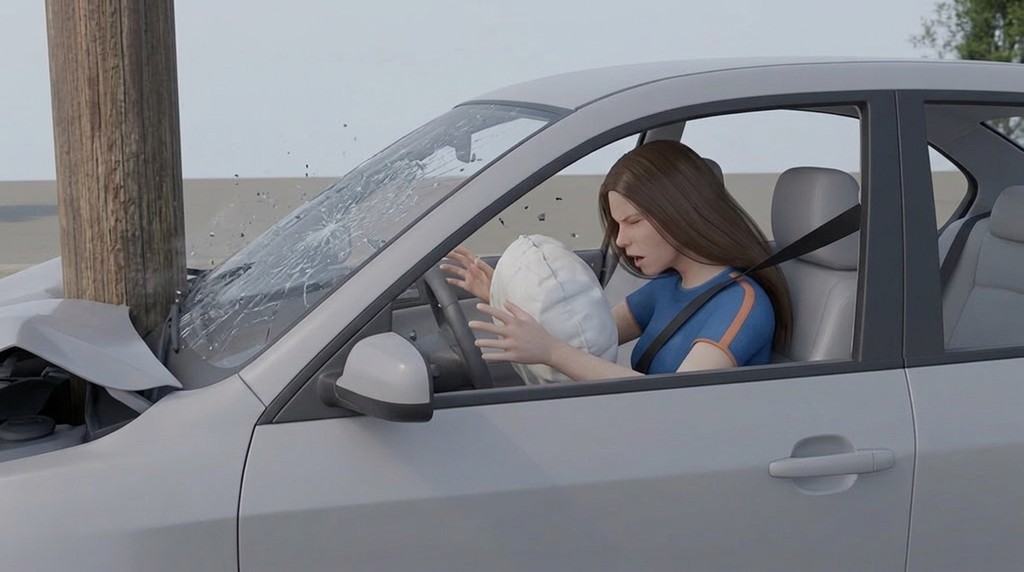 A frontal-impact collision: a belted driver's car strikes a utility pole, the windshield shatters, and the steering-wheel airbag deploys as she is thrown forward into the restraint.
Mechanism of injury started as a clinical concept and became a legal one. This guide is for injury and malpractice attorneys, and for the physicians whose records and testimony bring the mechanism into court.
It covers:
- What mechanism of injury means
- The major types and what injuries each one predicts
- How clinicians document it, and why that matters
- How attorneys prove it
- How to turn it into an exhibit a jury understands
What Mechanism of Injury Means
Mechanism of injury (MOI) describes how an injury physically happened: the type of force, its direction and magnitude, the part of the body it acted on, and the way tissue responded. It is distinct from the injury itself (the diagnosis) and from the event (the crash, the fall). The event applies a force; the mechanism is the path from that force to the damaged tissue; the diagnosis is the result.
Clinicians care about mechanism because it predicts injury. Trauma training teaches that certain mechanisms produce characteristic patterns: a fall from height onto the feet suggests calcaneal, tibial plateau, and lumbar compression fractures; a steering-wheel impact suggests sternal fracture and cardiac contusion; a side impact suggests pelvic and acetabular injury on the struck side. So the mechanism tells the trauma team what to look for before imaging confirms it. EMS and emergency departments record it as a matter of routine.
Attorneys care about mechanism because it is the medical half of causation. A diagnosis alone does not prove the event caused it. A mechanism that is consistent with the diagnosis and explained by a qualified expert is what connects the two.
The Major Types of Mechanism
Trauma is conventionally grouped into a few broad mechanisms, each with subtypes and characteristic injuries. The categories overlap (a rollover produces blunt, deceleration, and sometimes crush injuries at once) but the vocabulary is standard.
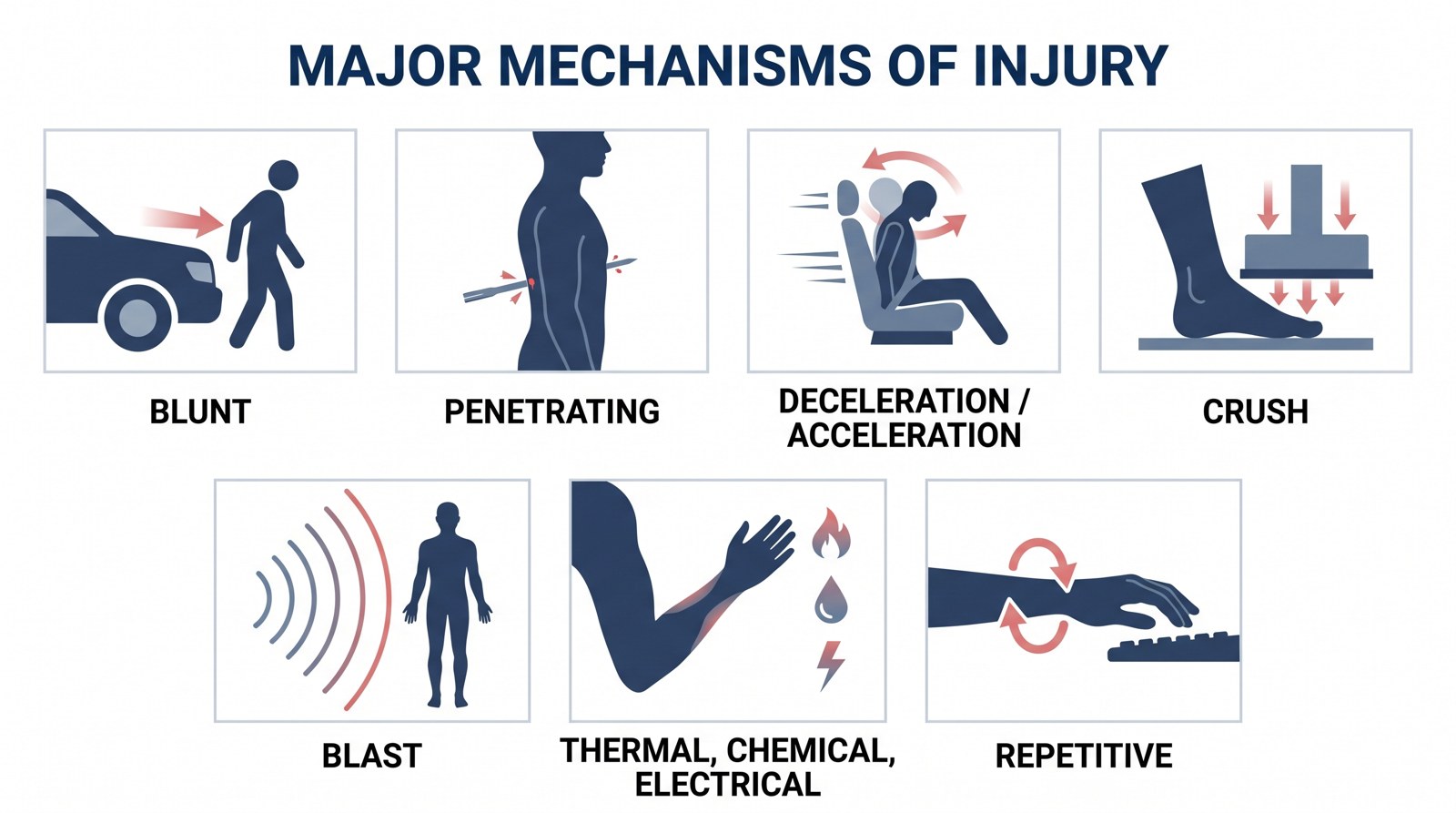 The major mechanisms of injury: blunt, penetrating, deceleration and acceleration, crush, blast, thermal, chemical, and electrical, and repetitive.
Blunt trauma
Force applied to the body without penetration: motor-vehicle collisions, falls, assaults with fists or blunt objects, sports impacts, pedestrian strikes. Energy transfers through the skin to the tissue beneath, producing contusions, lacerations from tearing, fractures, and internal organ injury. Blunt trauma drives most civil injury claims: car accidents alone are nearly 60% of tort trials.
Within blunt trauma, the direction of force matters:
- Frontal impact: occupant continues forward into the restraint, steering wheel, or dash: head and facial injuries, sternal and rib fractures, knee-to-dash injuries (patella, femur, posterior hip dislocation), cervical flexion injuries.
- Rear impact: the seat accelerates the torso forward while the unsupported head lags, then whips forward: the cervical hyperextension-flexion mechanism commonly called whiplash, with injury to the facet joints, discs, and soft tissue; also lumbar strain from the seat loading.
- Lateral (side) impact: intrusion into the occupant compartment: injuries to the near-side shoulder, ribs, pelvis, acetabulum, and head; less restraint protection than frontal.
- Rotational and rollover: multiple force vectors, ejection risk, roof crush: head, cervical spine, and multi-system trauma.
- Falls: the height, the landing surface, and the body part that struck first determine the injury: outstretched hand (distal radius, scaphoid), buttocks (sacrum, lumbar compression, vertebral burst), feet (calcaneus, tibial plateau, hip), head (skull fracture, intracranial hemorrhage).
- Pedestrian and cyclist strikes: bumper height determines the primary injury (tibial plateau, knee ligaments in adults; pelvis and torso in children), followed by hood/windshield head injury and ground impact.
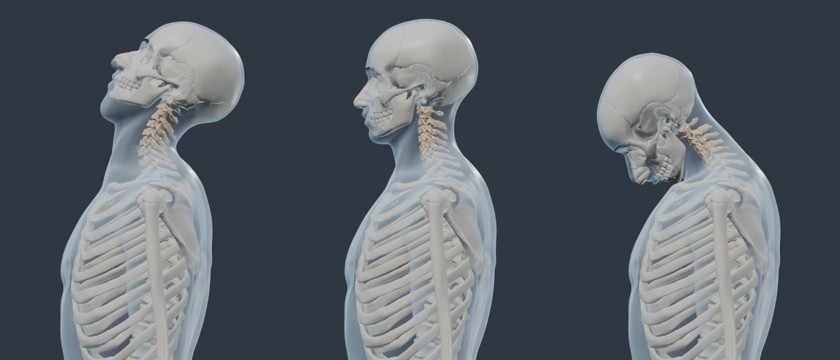 Cervical whiplash
Penetrating trauma
An object pierces the skin: gunshot, stab, impalement, shrapnel. The injury follows the object's path and, for high-velocity projectiles, a cavitation zone around it. Common in criminal matters and in some civil cases (premises security, product failures, industrial accidents).
Deceleration and acceleration injury
Usually classed as a form of blunt trauma, but worth its own heading because the injuries it causes are often internal and easy to miss. The body or an organ stops or starts abruptly and structures tethered at different points move at different rates, producing shear. Aortic tear at the ligamentum arteriosum in high-speed frontal crashes, diffuse axonal injury in the brain from rotational acceleration, mesenteric and renal pedicle injuries. Rear-impact whiplash is fundamentally an acceleration mechanism.
Crush
Sustained compressive force: a pinned limb, a pallet falling, a vehicle rollover onto an occupant. Produces fractures, compartment syndrome, muscle necrosis, and systemic rhabdomyolysis. Common in industrial and construction claims.
Blast
Overpressure wave (primary), fragments (secondary), body displacement (tertiary), and burns or toxic exposure (quaternary). Industrial explosions and, in some cases, product failures such as exploding lithium-ion batteries.
Thermal, chemical, and electrical
Burns by depth and surface area; inhalation injury; electrical conduction injury through the body with entry and exit wounds. Premises, product, and workplace cases.
Repetitive and cumulative
Not a single event but repeated sub-threshold loading: carpal tunnel from typing on a computer, rotator cuff tendinopathy from overhead work. Workers' compensation more than tort, and a different causation analysis.
The Physics Underneath
Mechanism analysis rests on a few principles a jury can follow when they are shown rather than told.
Energy transfer. Kinetic energy rises with the square of velocity; doubling speed quadruples the energy the body must absorb. Restraints, airbags, crumple zones, and padding extend the time over which the body decelerates, reducing peak force.
Force and direction. Tissue fails in characteristic ways under tension, compression, shear, bending, and torsion. A tibia loaded in torsion spirals; loaded in bending, it breaks transversely with a butterfly fragment. The fracture pattern on the X-ray is itself evidence of the mechanism.
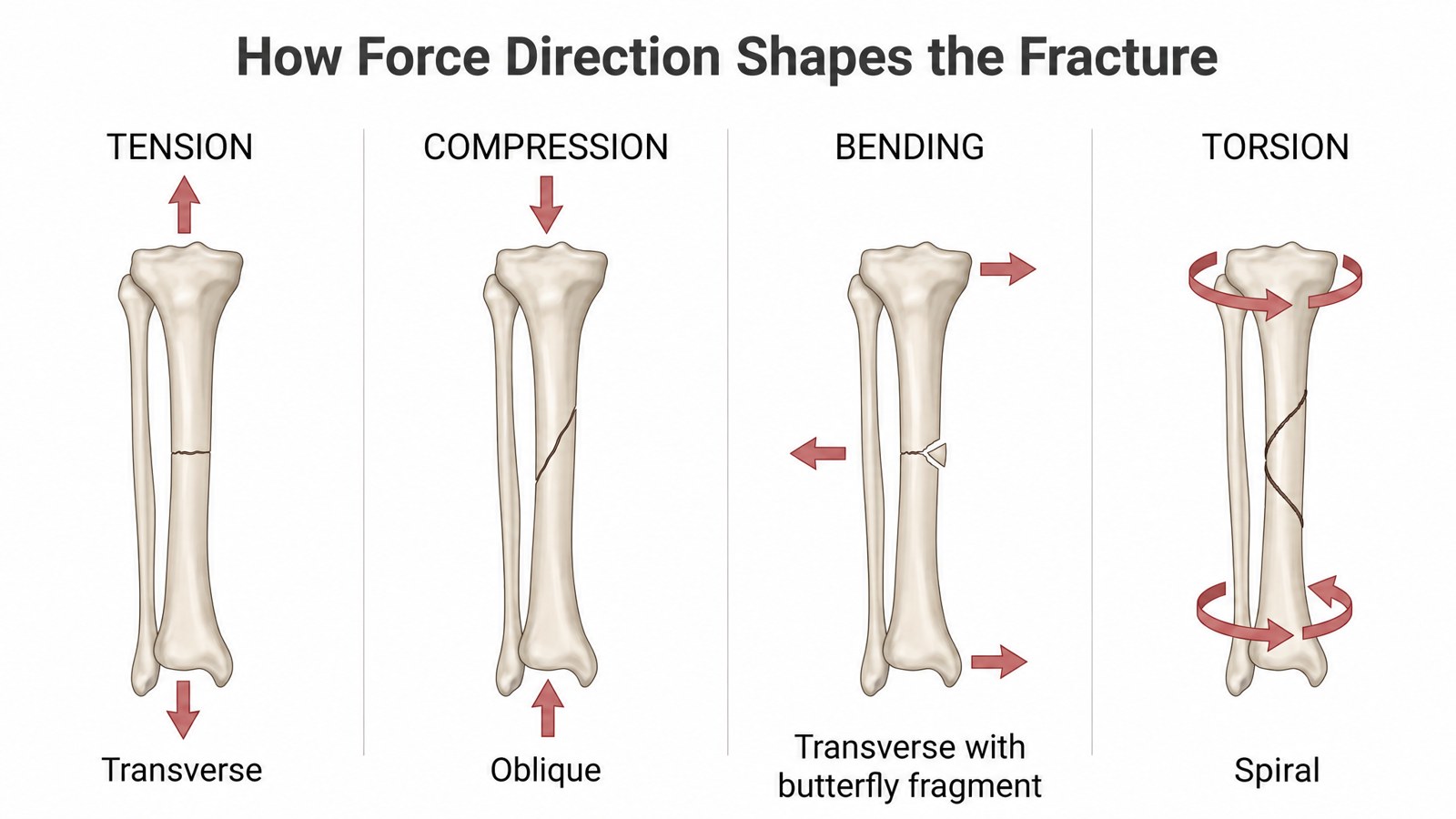 How force direction shapes a tibia fracture: tension causes a transverse fracture, compression an oblique fracture, bending a transverse fracture with a butterfly fragment, and torsion a spiral fracture.
Inertia and the unsupported head. In a rear impact the torso is pushed forward by the seat; the head, unsupported, stays put for a fraction of a second, extending the neck, then is thrown forward. Injury occurs at the extremes of that arc and at the transition, in the facet joints and disc.
Pre-existing condition as susceptibility. A degenerated disc fails under a load a healthy disc would tolerate. This is the eggshell-plaintiff principle in medical terms: the mechanism may have been modest and the injury real because of what was already there. This answers the defense's "it's just degeneration" argument: the degeneration explains why a modest force caused the injury, not that the injury is unrelated.
How Clinicians Document Mechanism
Mechanism is recorded early and often, and each entry has evidentiary weight.
EMS run report. The paramedics' account of the scene: vehicle damage, restraint use, airbag deployment, patient position, extrication, complaints at the scene. Often the most detailed description of the event by anyone without a stake in it.
ED triage and history of present illness. A dedicated MOI field or a sentence in the HPI, recorded within hours: "Fall from 8-ft ladder onto concrete, landed on R hip, unable to bear weight." Because it is contemporaneous, made for treatment, and predates any claim, courts and adjusters treat it as credible.
Imaging and operative reports. The radiologist and surgeon describe what the mechanism produced, and sometimes the mechanism itself: "acute traumatic disc herniation with associated annular tear" versus "chronic degenerative disc disease." That language decides cases.
Subsequent providers. Each repeats the history, usually in the patient's words. Consistency across providers strengthens the account; drift weakens it.
For the attorney, the first step in any causation analysis is to collect every mechanism entry across the record into the medical chronology and read them together. If they agree, the mechanism is established; if they do not, the discrepancy must be understood and explained.
Proving Mechanism in Litigation
Mechanism is proved through three kinds of evidence, which ideally overlap.
The record. The EMS and ED entries above, plus scene photographs, vehicle damage photographs, the police report, event-data-recorder downloads, and witness accounts. This is the factual foundation; everything else interprets it.
Reconstruction. For collisions and falls where the physics is disputed, an accident reconstructionist establishes speeds, angles, and forces from the physical evidence. Their output (delta-V, principal direction of force, occupant kinematics) is the input to the biomechanical analysis.
Biomechanics and medicine. A biomechanical expert (typically an engineer) addresses whether the forces established by the reconstruction could produce the injury mechanism the physician describes; the treating physician addresses whether the mechanism produced this injury in this patient.
Inconsistencies between these witnesses are a common target: the reconstructionist's speed is too low for the forces the biomechanical expert relies on, the biomechanical expert's mechanism differs from the physician's, or the physician's account differs from the ED record. Making sure all three work from the same record, so their independent opinions describe one mechanism, is the core of causation preparation.
Illustrating Mechanism of Injury
Mechanism is the hardest part of an injury case to convey in words and the easiest to convey in a picture, which is why the mechanism-of-injury diagram is one of the standard categories of demonstrative evidence.
The mechanism diagram. A labeled illustration showing the force applied and the anatomical result together: the seat pushing the torso forward while the head lags, with the cervical spine at the extension extreme and the disc under load; the body falling onto the outstretched hand with the distal radius failing in dorsal angulation; the bumper striking the lateral knee with the MCL and tibial plateau loaded. One frame, one mechanism, one labeled injury.
The sequence. Three or four frames (pre-impact, impact, peak loading, injury) when timing matters. It is the still version of a mechanism animation: use it when an animation would be overkill for the case or would draw a Rule 403 objection (or its state equivalent) that a still would not.
Pairing with the record. The exhibit should quote the ED mechanism entry in its caption and match it exactly. An illustration that shows a mechanism the record does not describe is an illustration the defense will exclude.
Pairing with the imaging. Mechanism diagram on one side, the plaintiff's colorized MRI or the fracture X-ray on the other. The jury sees the force and the result together.
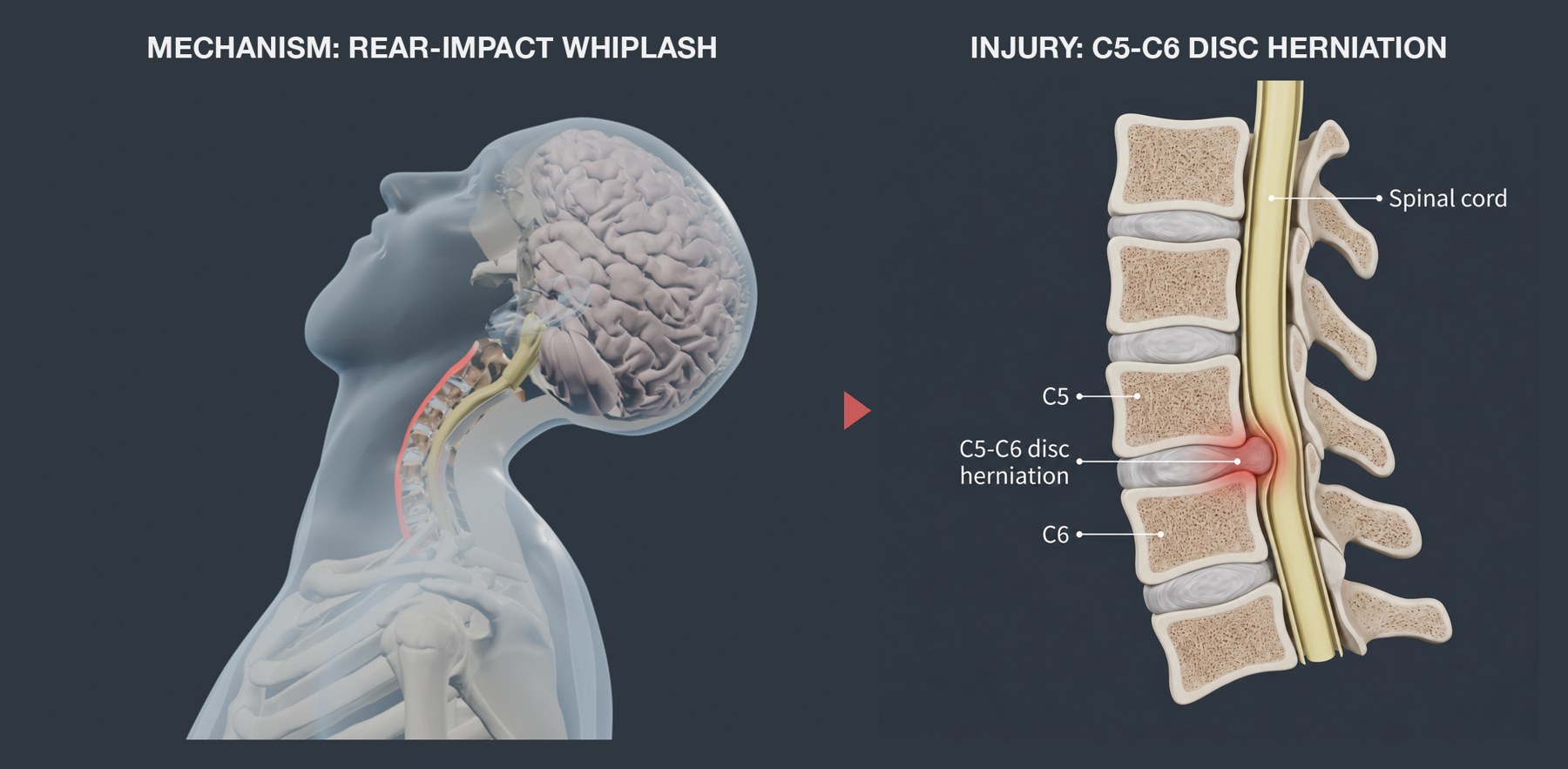 A mechanism-and-injury exhibit: on the left, rear-impact whiplash with the neck extended and the anterior ligament stretched; on the right, a sagittal view of the cervical spine showing a C5-C6 disc herniation pressing on the spinal cord.
Sponsorship. The treating physician, the biomechanical expert, or the reconstructionist, whichever witness's opinion the diagram depicts, reviews and vouches for it. For a purely medical mechanism (how the fall broke the wrist) the physician suffices; for a mechanism that depends on reconstruction data (speeds, delta-V) the reconstructionist or biomechanical expert should be the sponsor.
Producing it. Custom mechanism illustrations were historically a studio commission at $500–2,500 and weeks of lead time. AI-assisted tools have changed that: Natomy generates a labeled anatomical illustration from the plaintiff's imaging or a clinical reference in minutes, which puts a mechanism exhibit within reach of demand packages and mediation on moderate-value cases, not only trials. The expert review is unchanged and remains the step that cannot be skipped; the medical legal illustration guide covers the formats and the foundation.
Restraint. The most common way a mechanism exhibit gets excluded is drama: red for force arrows, a grimacing figure, exaggerated motion. Plain arrows, neutral figure, anatomical accuracy. The exhibit's job is to make the physician's testimony visible, not to make the jury flinch.
Common Disputes and How Mechanism Resolves Them
"Low-speed impact cannot cause a herniation." The defense biomechanical argument. Answered with the reconstruction (actual delta-V rather than property-damage dollars), the biomechanical literature on cervical loading in low-speed rear impacts, and the plaintiff's susceptibility: a degenerated disc fails at lower loads. The mechanism diagram shows the loading; the imaging shows the result.
"The injury is degenerative, not traumatic." Answered with findings that point to an acute injury (edema on MRI, sudden onset documented in the ED record), the asymptomatic prior history from the chronology, and the physician's explanation of why the mechanism produced acute failure of a chronically weakened structure.
"The mechanism described could not produce that fracture pattern." Sometimes true; fracture patterns are mechanism-specific. Get the treating orthopedist's or a radiologist's opinion early, and make sure the mechanism the client describes matches the pattern on the film before the defense does.
"The plaintiff's account of the mechanism changed." The credibility attack. Prevented by collecting every mechanism entry in the record before the plaintiff's deposition and reconciling them; answered by explaining the discrepancy (paraphrase by a provider, a scribe's error, a translation) with the contemporaneous entry as the anchor.
A Working Checklist
- Collect every mechanism entry (EMS, ED, imaging, operative, subsequent providers) into the chronology and reconcile them.
- Obtain the physical evidence the mechanism rests on: scene and vehicle photographs, police report, EDR data, witness statements.
- Match the mechanism to the injury pattern early; get the treating physician's view on consistency before the defense IME.
- Retain reconstruction and biomechanical experts when the physics is disputed; coordinate their inputs and outputs with the physician's mechanism.
- Build the mechanism exhibit from the record's own description; caption it with the ED entry; have the sponsoring expert review it.
- Pair the mechanism exhibit with the imaging exhibit so the jury sees force and result together.
- Prepare the client to describe the mechanism consistently with the record, not a script, an accurate account.
Mechanism of injury is where medicine and causation meet. Documented at the scene, explained by the right expert, and shown to the jury as a picture rather than a paragraph, it is the strongest link in an injury case.
FAQ
What does mechanism of injury mean?+
Mechanism of injury (MOI) is the physical process by which an injury occurred: the type, direction, and magnitude of the force applied to the body and how the body responded to it. A rear-end collision producing rapid neck flexion and extension, a fall onto an outstretched hand, a stab wound: each is a mechanism. Clinicians use it to predict injuries; attorneys use it to connect an event to a diagnosis.
What are the main types of mechanism of injury?+
Trauma is broadly divided into blunt (impact without penetration: collisions, falls, assaults with blunt objects) and penetrating (an object pierces the body: gunshot, stab, impalement). Blunt trauma includes deceleration and acceleration injuries, where the body or an organ stops or starts abruptly and tissues shear. Other categories include crush, blast, thermal, chemical, electrical, and repetitive-strain mechanisms. Within blunt trauma, collisions are further classified by direction: frontal, rear, lateral, rotational, rollover.
Why does mechanism of injury matter in a personal injury case?+
Because causation is the fight. The defense argues the event could not have produced the injury, or that the injury pre-existed. A mechanism that is consistent with the diagnosis (documented in the emergency record, supported by the reconstruction and biomechanics, and explained by the treating physician) is what ties the collision to the herniation or the fall to the fracture. An inconsistent or undocumented mechanism is where causation cases are lost.
Where is mechanism of injury documented in medical records?+
Usually in the emergency department triage note or the history of present illness, often in a dedicated field ("MOI: restrained driver, rear-ended at ~30 mph, airbags did not deploy"), and again in the EMS run report and the admitting history. Later providers repeat or paraphrase it. Because it is recorded within hours of the event and before any claim, the ED mechanism entry is often the most credible statement of how the injury happened in the entire case.
How do you illustrate mechanism of injury for a jury?+
With a mechanism-of-injury diagram or animation: a labeled illustration showing the force applied and the anatomical result: the head's flexion-extension arc in a rear impact with the cervical disc loading, the fall onto the outstretched hand with the distal radius failing. The exhibit is sponsored by the treating physician, biomechanical expert, or reconstructionist and must match the mechanism documented in the record.
What is the difference between mechanism of injury and cause of injury?+
Mechanism is the physical process: the forces and motions. Cause, in the legal sense, is the event or conduct that set the mechanism in motion, and whether it did so to a legal standard of proof. The mechanism is medical evidence that supports (or undermines) legal causation; it is not the same thing.
Ready to create your own medical illustrations?
Upload a clinical photo and generate a professional illustration in seconds.
Try Natomy →