Medical Legal Illustration: How Visuals Strengthen Cases
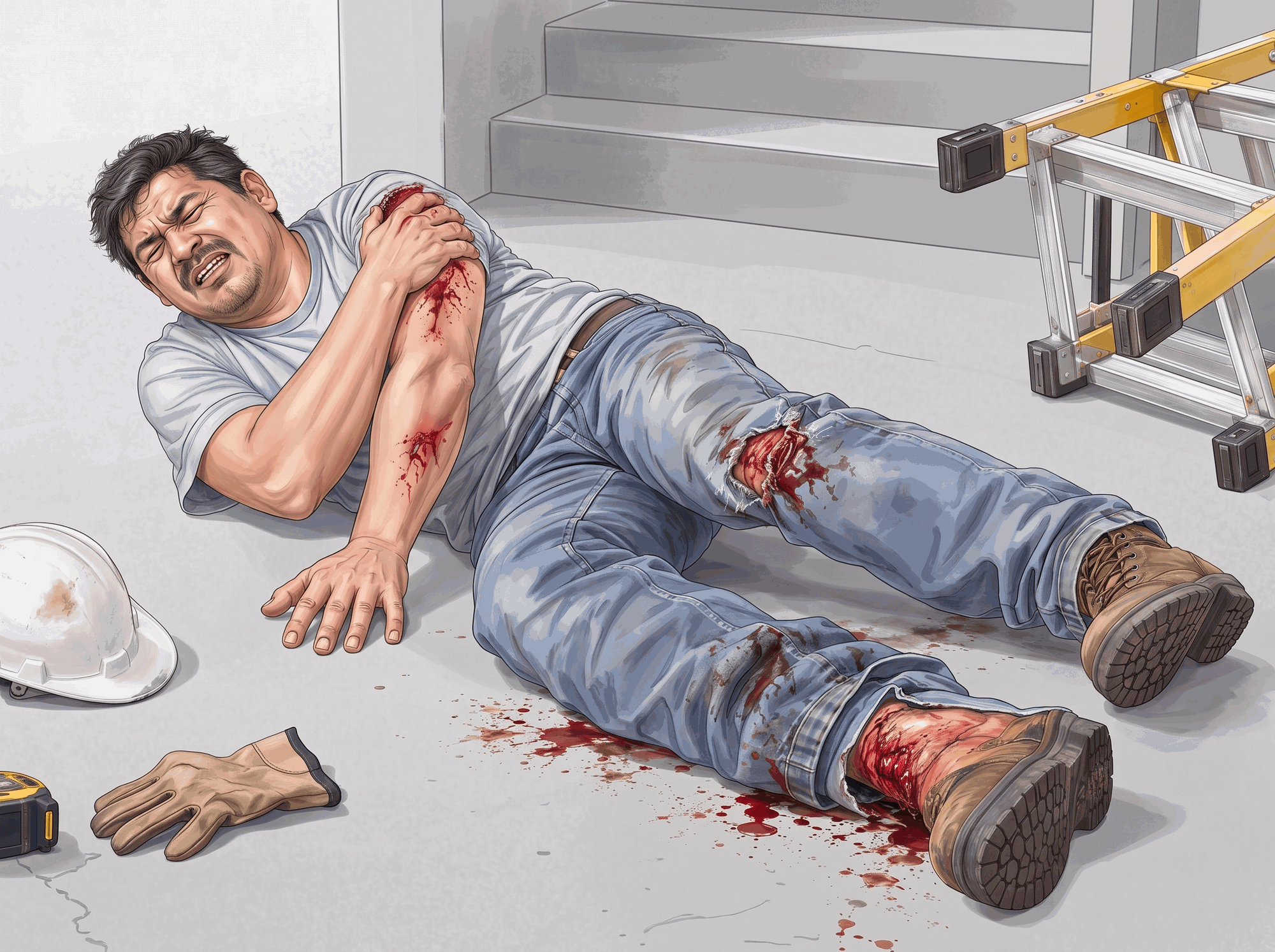 50yo hispanic male sustained multiple injuries from a workplace fall
When a juror hears complex medical terminology like a "Comminuted intra-articular distal femur fracture with associated medial tibial plateau fracture", they nod politely while the information goes over their heads. They say a picture is worth a thousand words and in no other case is this more true than in front of a jury. When they see a color coded labeled illustration showing exactly where the ligament tore, how the fracture displaced, and what the repair involved, they understand. More importantly, they remember.
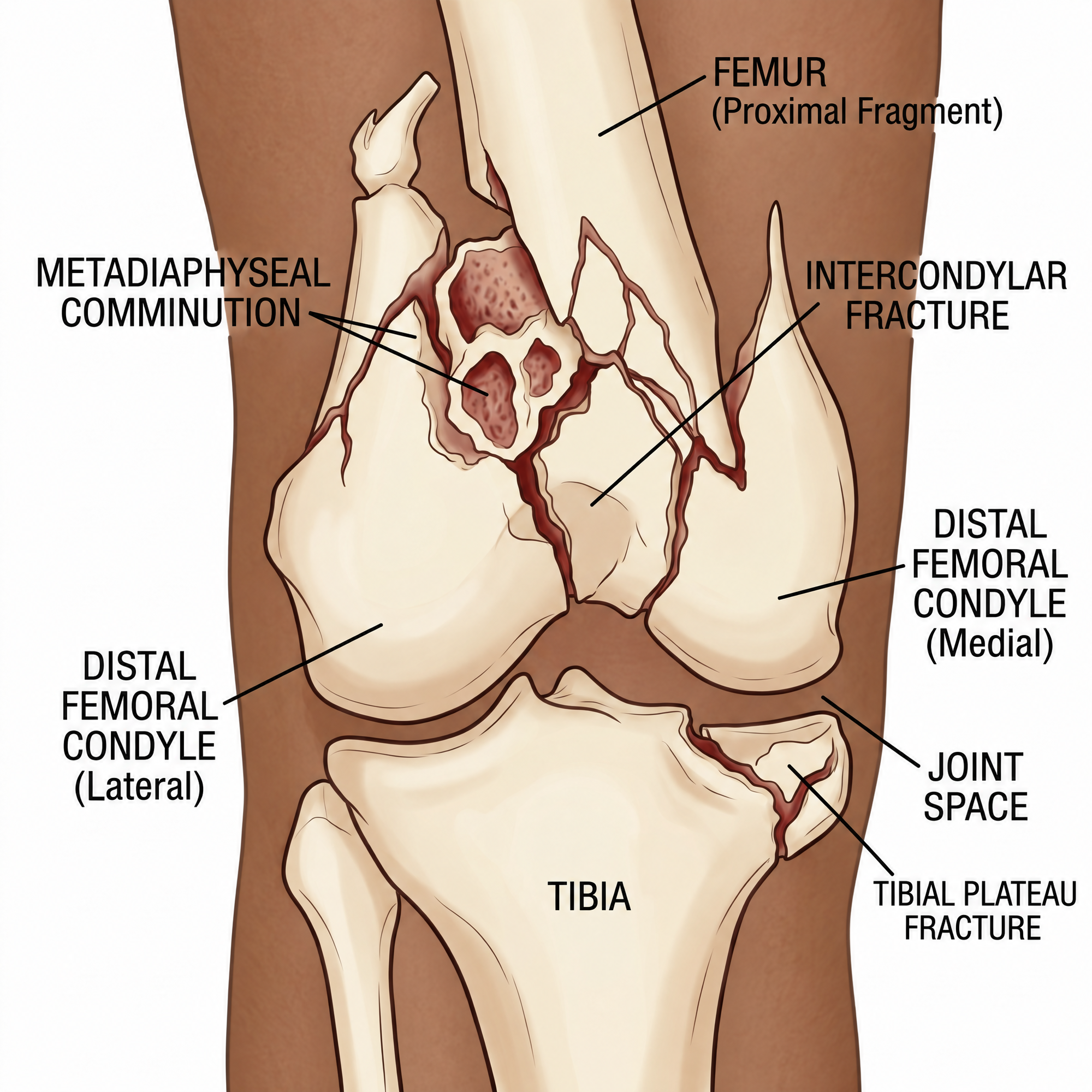 A labeled illustration of a comminuted intra-articular distal femur fracture with associated tibial plateau fracture, the kind of terminology that loses a jury without a visual
This is the value of medical legal illustration: translating clinical complexity into visual clarity. This guide covers everything attorneys need to know: what these visuals are, when they matter most, how they were made before AI, what they cost, and how AI is changing the workflow.
What Is Medical Legal Illustration?
Medical legal illustration is a specialized branch of medical illustration focused on creating anatomical visuals for litigation. These are not generic anatomy diagrams from a textbook. They are custom visuals derived from a specific patient's medical records. Think of all their operative reports, MRI scans, x-rays, and patient charts rendered to document their specific medical injury.
The visuals produced for legal proceedings span a wide range: surgical procedure walk-throughs, injury progression timelines, colorized interpretations of X-rays and MRIs, and full-body trauma maps. Each one is designed to help a layperson grasp what a medical expert is saying without having to have a medical degree.
In federal court, an illustration offered to prove a disputed fact is demonstrative evidence and must satisfy the ordinary rules of admissibility. If it is used only to help the judge or jury understand other evidence or argument, it is an illustrative aid under Federal Rule of Evidence 107 and is not itself evidence. In either role, the illustration should faithfully reflect the underlying medical record and is typically validated by the medical expert and legal team before use.
Rule 107 applies in federal court. State courts follow their own evidence rules and may use these terms differently.
The use of medical illustration goes all the way back to the 1930's with the pioneering work of Melvin Belli who would bring a skeleton model into the courtroom and draw on a portable blackboard (Roanoke Times obituary).
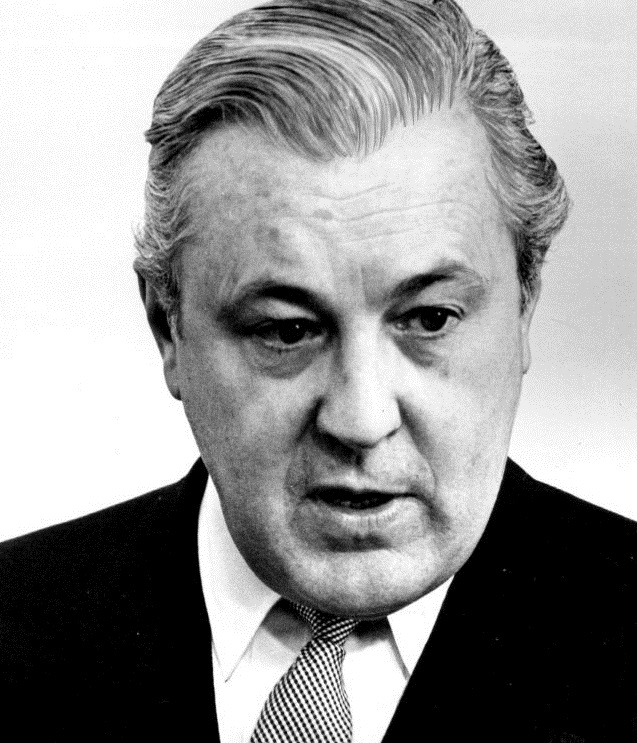 Melvin Belli, whose courtroom use of skeletons and blackboard drawings pioneered demonstrative medical evidence
The Science Behind Why Visuals Win
The persuasive power of medical legal illustrations is not anecdotal. Decades of research show that people understand and recall information far better when it is presented visually alongside verbal explanation than just words alone.
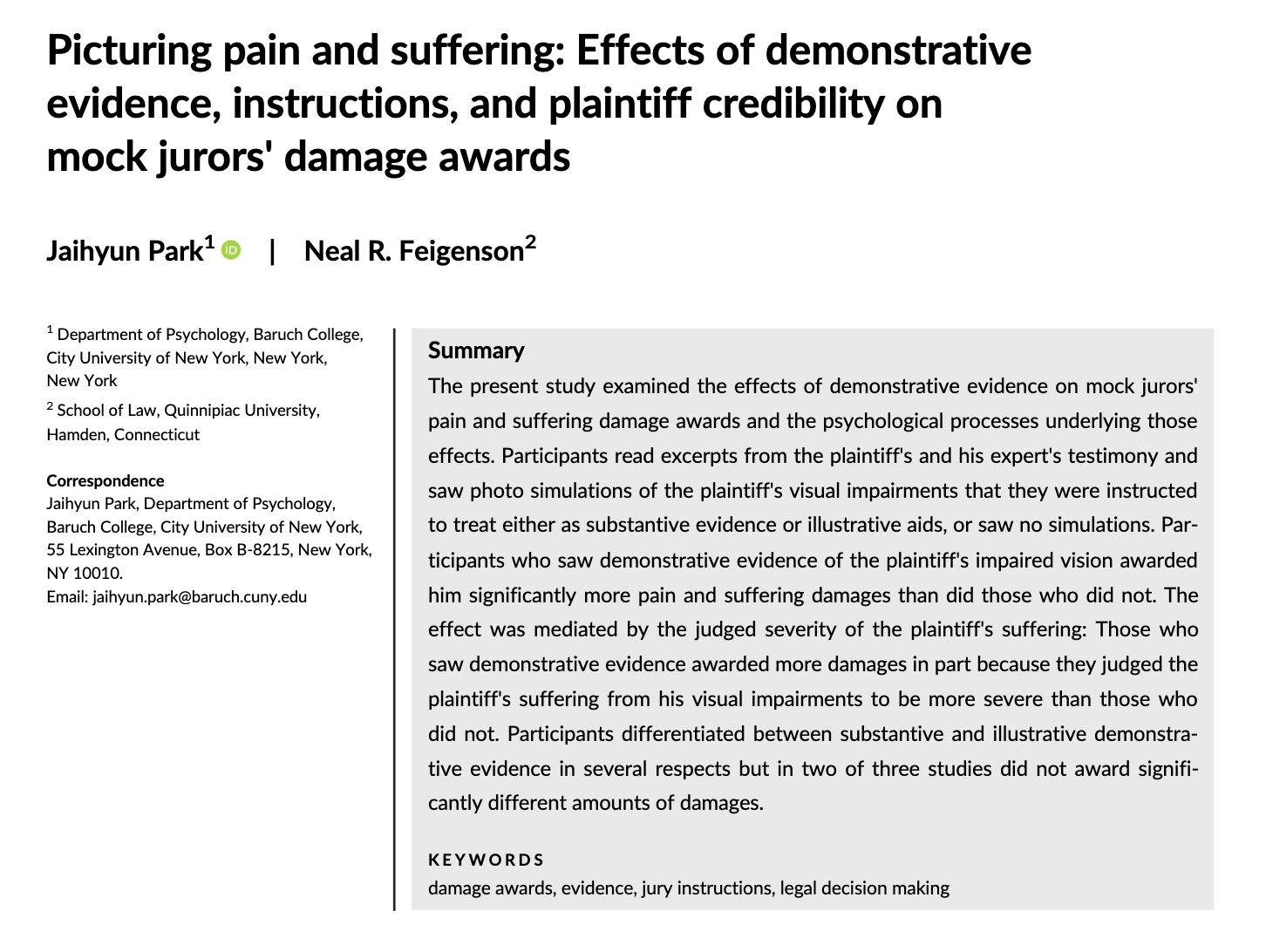 Park & Feigenson, "Picturing pain and suffering: Effects of demonstrative evidence, instructions, and plaintiff credibility on mock jurors' damage awards."
In Park & Feigenson's, "Picturing pain and suffering: Effects of demonstrative evidence, instructions, and plaintiff credibility on mock jurors' damage awards," the authors ran multiple mock-juror experiments in a personal-injury context where participants either saw visual simulations of the plaintiff's impairment or did not. Participants who saw the demonstrative visuals generally awarded higher pain-and-suffering damages, and the effect was partly explained by jurors perceiving the plaintiff's suffering as more severe.
In Study 3, for example, the mean awards were about $299K with no image, $451K when the image was presented as an illustrative aid, and $776K when the same type of image was presented as substantive evidence. The overall effect of demonstratives was statistically significant.
Importantly, the researchers concluded that seeing the visuals increased damages in part because participants judged the plaintiff’s suffering as more severe, not simply because the images made them more emotional.
Types of Medical Legal Illustrations
Not all medical legal illustrations serve the same purpose. Here is a short non exhaustive list of some of the most common types.
Surgical Procedure Illustrations
Step-by-step diagrams walking jurors through what happened in the operating room. These are especially critical in surgical malpractice cases, where the central dispute often involves whether a surgeon deviated from the standard of care.
Injury Mechanism Diagrams
These show how a force from a motor vehicle impact, a fall, a crush injury, or a product failure traveled through the body and caused a specific pattern of damage. Biomechanical illustrations of this type are foundational in product liability and vehicle accident litigation.
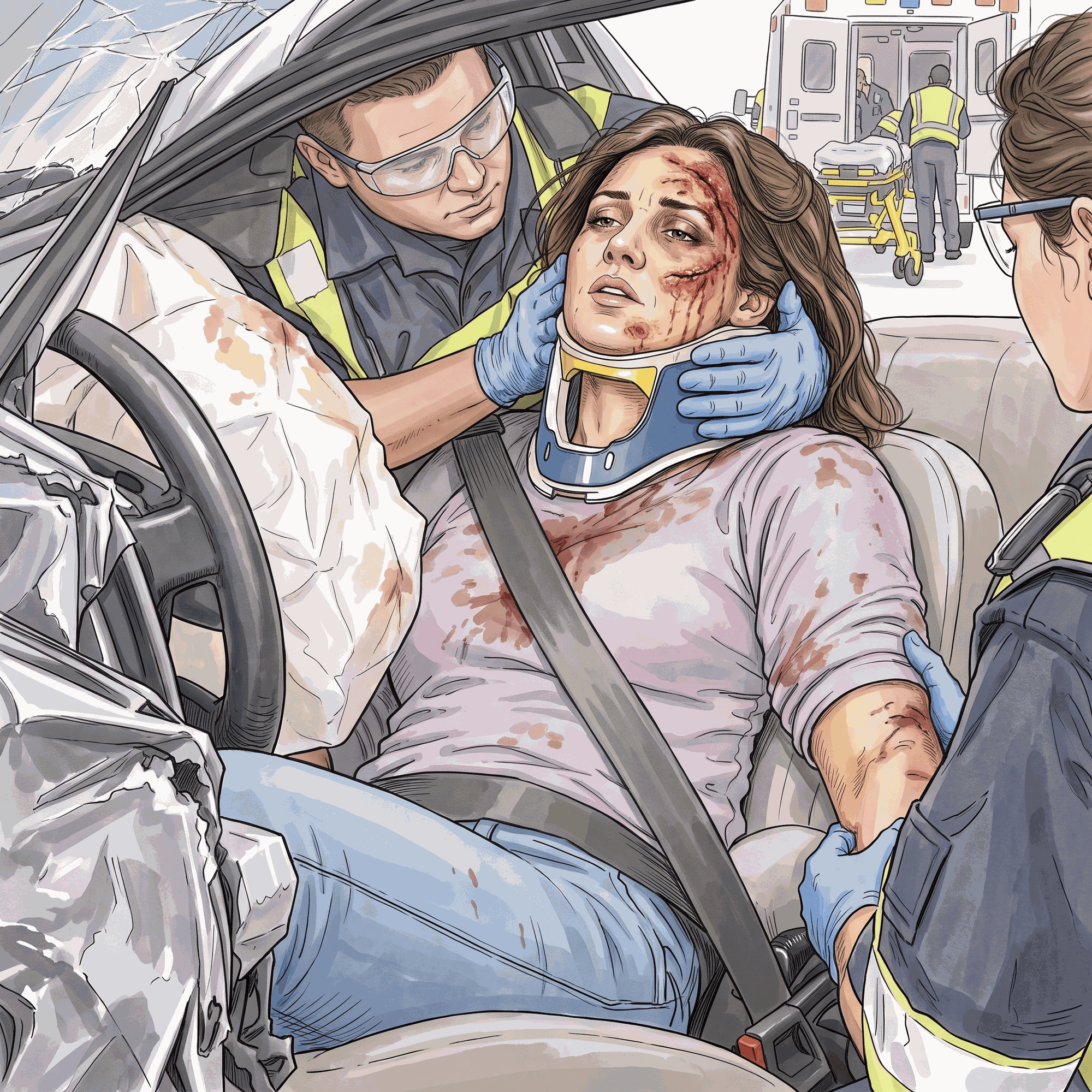 EMTs extricating and stabilizing a woman with a cervical collar after a motor vehicle collision
Comparative Anatomy: Before and After
Side-by-side illustrations showing the patient's anatomical condition before injury versus after, or pre-surgery versus post-surgery. These are among the most persuasive exhibits in cases involving permanent disability, because they make the permanence of loss visually undeniable rather than abstractly claimed.
Colorized Radiology Interpretations
Standard MRI, X-rays, and CT images are grayscale and hard to understand. Colorized overlays with clean labels highlight specifically where disc herniation occurred, where the fracture is, or what surgical implant was placed.
Trauma Maps
Full-body diagrams documenting the distribution and severity of injuries across multiple body regions. Used in cases involving multi-system trauma, burn injuries, or cases where the number and combination of injuries (not any single one) is central to the damages argument.
Animation Sequences
For cases where static images cannot capture the dynamic nature of an injury or event, such as a vehicle collision, a spinal cord injury, or a cardiac catheterization complication, see the guide to forensic animation for when it helps and what it costs. Animation sequences reconstruct the event in real time. These are the most expensive and time consuming category to create, but in complex cases they are frequently the most persuasive.
Where Medical Legal Illustrations Are Used
The obvious venue is trial, but these visuals provide value at every stage of litigation.
Case preparation. They help attorneys and experts understand complex injuries, anatomy, imaging, and surgical procedures.
Mediation and settlement. They make injuries easier for mediators, insurers, and opposing counsel to understand.
Depositions. Experts can use illustrations to explain medical findings clearly and consistently.
Trial. Illustrations help juries understand complicated medical evidence that may be difficult to grasp from records, scans, or testimony alone.
Case Types That Benefit Most
Medical legal illustration is relevant across a broad range of litigation types:
Motor vehicle accidents. Orthopedic injuries involving spinal discs, fractures, and joint damage are commonly litigated in motor vehicle accident cases.
Surgical malpractice. These cases focus on what a surgeon did or failed to do while operating. Without a visual guide to the anatomy involved and the specific steps of the procedure, expert testimony is largely inaccessible to the jury.
Traumatic brain injury. TBI cases involve the brain, its structures, the mechanisms by which acceleration causes diffuse axonal injury, etc.
Birth trauma litigation. Cases involving hypoxic-ischemic encephalopathy, brachial plexus injuries, or shoulder dystocia require illustrations that show both normal delivery anatomy and the mechanism of injury.
Toxic exposure and occupational disease. Cases involving pulmonary disease from occupational exposure, mesothelioma from asbestos, or neurological damage from chemical exposure require illustrations of physiological mechanisms that textbooks cover abstractly but litigation requires to be case and patient specific.
Product liability. Cases involving medical devices, implants, and pharmaceutical products require illustrations of what the device does, how it was placed, what failure mode caused harm, and what the consequences were.
Admissibility Standards
The applicable standard depends on how the medical legal illustration will be used. If it is offered to prove a disputed fact, it is demonstrative evidence. If it is used only to help the factfinder understand other evidence or argument, it is an illustrative aid and is not itself evidence.
Accuracy and fair representation. A case-specific illustration should fairly and accurately represent the underlying medical facts. Although Rule 107 does not expressly require expert approval of every illustrative aid, review by the expert whose testimony the illustration accompanies helps ensure that the visual is accurate and not misleading.
Rule 403 balancing. Under Rule 403, even accurate illustrations offered as evidence can be excluded if their probative value is substantially outweighed by the danger of unfair prejudice. Illustrative aids are governed instead by Rule 107's similar balancing test, which weighs their utility in assisting comprehension. Graphic depictions of surgical trauma may be limited, and the degree of anatomical detail shown at trial is subject to judicial discretion.
AI-generated content. Federal rulemakers are considering how evidentiary standards should apply. In 2025 the Judicial Conference's Advisory Committee on Evidence Rules published proposed Rule 707 for public comment. The proposal is not currently law and addresses expert-like machine-generated evidence offered without an expert witness, not every AI-assisted exhibit. Whether a visual is demonstrative evidence or an illustrative aid depends on how it is used, not whether AI helped create it. Disclose the production method when required, and ensure that a qualified person can support the visual's accuracy.
Expert sponsorship. Expert testimony itself is governed by Rule 702. A technical medical illustration offered as evidence ordinarily requires an appropriate foundation. An illustrative aid may accompany expert testimony without being admitted as evidence, and entering it into the trial record under Rule 107(c) does not convert it into evidence.
What the Creation Process Looks Like
A well-produced medical legal illustration is the result of an iterative, collaborative process, not a single design session.
Medical record review. The illustrator begins by reviewing the complete relevant record: operative notes, imaging studies, pathology reports, emergency documentation, and the treating physicians' own descriptions of what they found and what they did. This review may require several hours of reading before a single image is started.
Expert consultation. The illustrator typically consults directly with the expert witness to ensure the illustration reflects the expert's specific opinions, not a generalized version of the injury but the precise clinical picture that will be testified to at trial. This is the step that converts a generic anatomical diagram into a case-specific demonstrative visual.
Draft, review, revision. The first draft goes back to the expert and the attorney for review. Anatomical inaccuracies are corrected. Emphasis decisions, including what to show and what to de-emphasize, are made in light of the litigation strategy. This cycle may repeat several times.
Final approval. Before an exhibit is considered ready for use, both the expert who will sponsor it and the attorney who will present it need to sign off. The expert is effectively testifying that the visual accurately represents their opinion; they need to be comfortable with every element.
Cost and Timeline
Understanding the economics of medical legal illustration helps attorneys decide when the investment is justified.
Traditional custom illustration. Certified medical illustrators typically charge around $100 per hour and the time it takes depends on the type of illustration required. Medical animations range from $5,000 to $50,000+ or more for professionally produced sequences. Most medical animation studios bill by the seconds of footage required. So if a studio charges $750 per second of animation, a 30 second animation would cost you $22,500.
When the cost is justified. The math is straightforward in high-value cases: if a well-illustrated presentation increases the probability of a favorable outcome by even a modest margin in a case with seven-figure damages at stake, the exhibit cost is trivial. The harder question arises in moderate-value cases where the illustration budget matters more. Here, efficiency matters: can exhibits be produced quickly enough to be useful, and at a cost that preserves the economics of the case?
AI-assisted illustration and cost compression. The introduction of AI-assisted illustration workflows has begun to compress both timeline and cost significantly. Visuals that previously required weeks of back-and-forth with a traditional illustrator can now be produced in minutes with the right tool. The expert review and approval step remains non-negotiable regardless of how the underlying visual was produced.
What Separates a Useful Exhibit from One That Will Be Challenged
The standard is not aesthetic quality. It is anatomical accuracy tied to a specific patient's documented medical condition.
An illustration of a generic herniated disc is not the same as one that depicts the specific level (L4-L5 versus L5-S1), the specific laterality (left paracentral versus right foraminal), and the specific nerve root involvement documented in a particular patient's MRI report. An illustration of a surgical repair is only credible if it reflects what the operative note says actually happened, including which specific hardware was used, how many levels were fused, and what the post-operative anatomy looked like.
This precision is what makes expert review non-negotiable. The expert who reviews the illustration before trial is, in effect, testifying that the visual accurately represents their opinion of the medical facts.
How to Find a Medical Legal Illustrator
Several resources exist for attorneys and legal teams sourcing qualified illustrators.
The Association of Medical Illustrators (AMI) maintains a directory of Certified Medical Illustrators (CMIs) and members with forensic and legal specialization. CMI applicants must meet the Board of Certification of Medical Illustrators' eligibility requirements and pass its competency assessment. A graduate degree is one eligibility path, but qualifying professional experience can also make an applicant eligible.
Specialized litigation support firms. Companies like MediVisuals, Medical Legal Art, and Visible Productions focus specifically on the legal market and offer package pricing for litigation exhibit production.
Medical illustration studios. Academic medical illustration programs at UIC, Johns Hopkins, and the University of Toronto train graduates who work as independent contractors and at studios. A studio with legal illustration experience should understand the specific visual conventions that courts are accustomed to.
AI and the Future of Medical Legal Illustration
The key practical reality is that AI does not change how a court classifies a visual. An AI-assisted exhibit offered to prove a disputed fact must satisfy the applicable rules of evidence. A visual used only to explain evidence or argument is an illustrative aid. Accuracy, case specificity, and qualified review remain important. What has changed is the timeline and economics of producing the visual. For attorneys managing litigation budgets in cases where high-quality illustrations previously were not affordable, this is a genuine shift.
Platforms like Natomy approach this specifically. Natomy transforms clinical photographs and radiology imaging into professional medical illustrations. The underlying visual is grounded in actual clinical imagery which you can verify yourself within the app.
This matters for legal use. An expert can testify that the illustration accurately represents what the clinical record shows because the illustration was built from that clinical record.
Turn Complexity Into Clarity
Medicine is visual by nature. Surgeons see anatomy before they describe it. Radiologists read images before they dictate findings. Jurors, though, rarely see anything unless someone puts it in front of them.
Medical illustration closes that gap. It takes the complexity that exists in imaging studies, operative notes, and expert opinions, and makes it understandable to the common man.
If you're working with personal injury or medical malpractice cases and need professional looking medical illustrations check out Natomy.
FAQ
What is medical legal illustration?+
Medical legal illustration is custom anatomical artwork created from a specific patient's medical records, including imaging, operative reports, and physician testimony, for use in litigation. Depending on how it is offered, it may be admitted as demonstrative evidence or used only as an illustrative aid.
Are medical legal illustrations admissible in court?+
Potentially, but the terminology matters. In federal court, an illustration offered to prove a disputed fact is demonstrative evidence and must satisfy the ordinary rules of admissibility. An illustration used only to help the factfinder understand evidence or argument is an illustrative aid under Federal Rule of Evidence 107 and is not itself evidence. State rules and court-specific disclosure requirements vary.
How much does a medical legal illustration cost?+
Certified medical illustrators charge roughly $500 to $2,500 per static illustration and $5,000 to $25,000 or more for animation, with two to eight weeks of turnaround. AI-assisted workflows that build the illustration from the patient's clinical images have reduced the static cost to a small fraction of that, though expert review remains required.
Who reviews a medical legal illustration before trial?+
The expert witness who will sponsor it, usually the treating surgeon or a retained physician. They confirm every element matches the medical record and their opinion, and they testify to that at deposition or trial. Attorneys should document that review.
What is the difference between medical legal illustration and trial graphics?+
Trial graphics is the umbrella term for all visual exhibits in a case, including timelines, damages charts, scene diagrams, colorized imaging, and animation. Medical legal illustration is the anatomical subset: drawings of the injury, procedure, or anatomy built from the patient's records.
Ready to create your own medical illustrations?
Upload a clinical photo and generate a professional illustration in seconds.
Try Natomy →