Distichiasis: Double Eyelashes, Causes & Treatment
Distichiasis is an extra row of eyelashes growing from the oil gland openings and rubbing the eye. See double eyelashes illustrated vs normal.
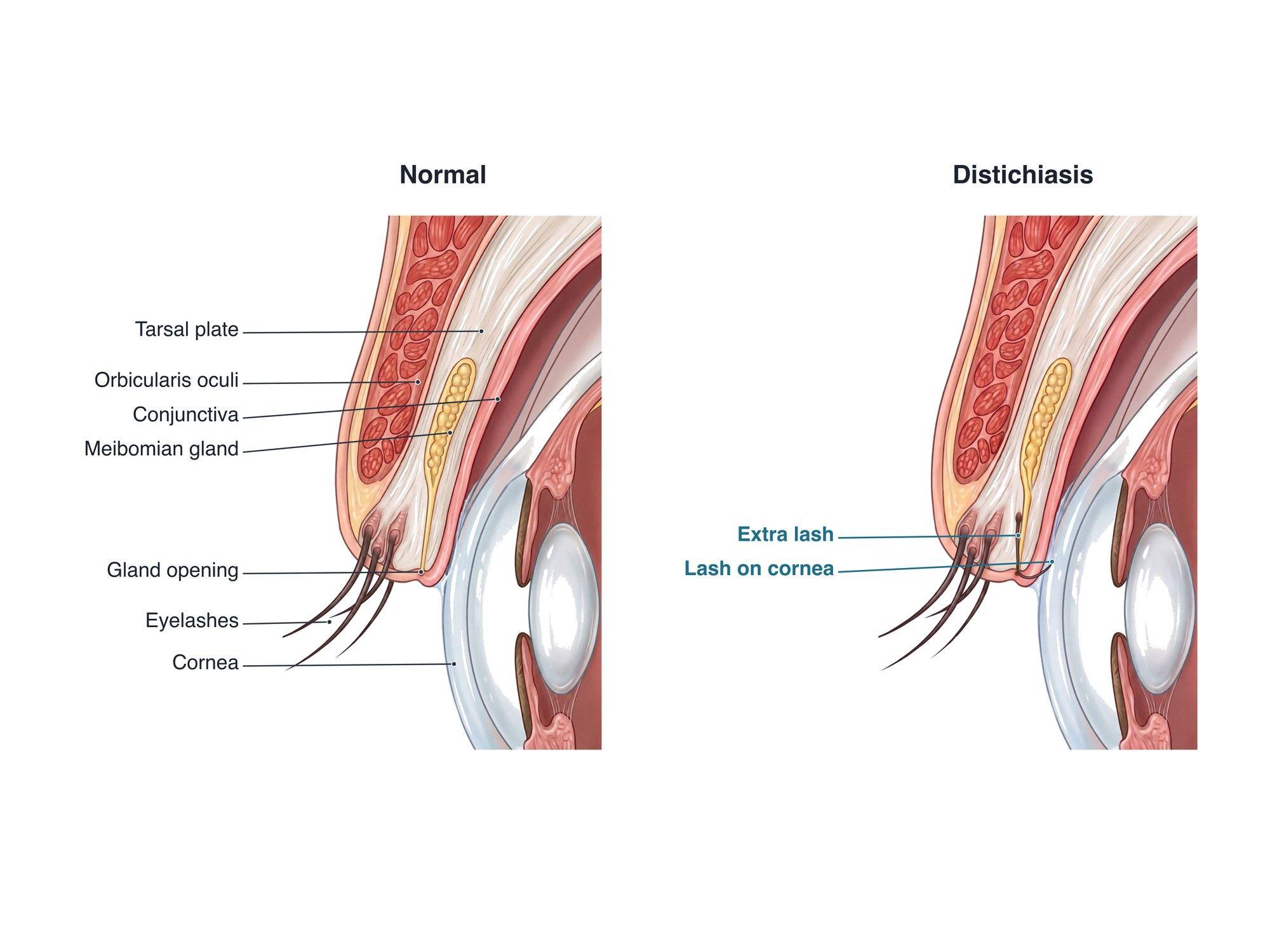
Distichiasis is a condition in which an extra row of eyelashes grows from the wrong place on the eyelid. Normal lashes grow from the front edge of the lid and point away from the eye. In distichiasis, extra lashes grow from the back edge of the lid, out of the tiny openings of the meibomian glands (the oil glands of the eyelid). These lashes often point toward the eye and rub the cornea, the clear front window of the eye. The result can be pain, redness, tearing and, over time, damage to the cornea. Distichiasis can be present from birth or appear after eyelid inflammation or injury. The illustration above shows a normal eyelid beside an eyelid with distichiasis.
The anatomy
The eyelid has two main layers. The front layer is skin and the orbicularis oculi muscle, which closes the eye. The back layer is the tarsal plate, a firm strip of tissue that gives the lid its shape, lined by the conjunctiva, a moist pink lining that faces the eye.
The free edge of the lid is called the lid margin. It has two features that matter here:
- The lash line at the front of the margin. Each lash grows from a hair follicle, a small pocket in the skin, set in front of the tarsal plate.
- The meibomian gland openings at the back of the margin. About 25 to 40 meibomian glands run up and down inside the upper tarsal plate, with fewer in the lower lid. Each one opens through a tiny pore on the lid margin. The glands release oil that stops tears from drying out.
Between the two is a faint line called the gray line. In distichiasis, a meibomian gland turns into a hair follicle and grows a lash out of its opening, behind the gray line.
Types
| Type | Cause | Notes |
|---|---|---|
| Congenital | Present from birth. Often part of lymphedema-distichiasis syndrome (FOXC2 gene) | Usually affects all four lids. Leg swelling (lymphedema) often starts around puberty |
| Acquired | Long-lasting inflammation or scarring of the lid margin | Often affects only some lids. The extra lashes are fewer and more scattered |
The inherited form is passed from parent to child in an autosomal dominant pattern. That means one copy of the changed gene is enough, and each child of an affected parent has about a one in two chance of inheriting it.
Causes
The cause is a change in the meibomian glands. Instead of making oil, a gland develops into a hair follicle and grows a lash. This change is called metaplasia, one type of tissue turning into another.
Congenital distichiasis comes from a change in the FOXC2 gene, which guides how certain tissues form before birth. The same gene affects the lymph vessels, so many people with it also develop swelling of the legs.
Acquired distichiasis follows damage to the lid margin. Common causes are:
- Stevens-Johnson syndrome and toxic epidermal necrolysis, severe reactions to a medicine that blister the skin and the lining of the eyes
- Ocular cicatricial pemphigoid, an immune disease that scars the conjunctiva
- Chemical burns of the eye, from acids or alkalis such as cleaning products, lime or cement
- Heat burns of the face and eyelids
- Severe chronic blepharitis and meibomian gland dysfunction, long-term inflammation of the lid margin
- Trachoma, a bacterial eye infection common in some parts of the world
Symptoms
Some people have no symptoms, especially when the extra lashes are soft and fine. When the lashes touch the eye, symptoms include:
- A feeling of grit or something in the eye that gets worse with blinking
- Eye pain and irritation
- Redness of the eye
- Watery eyes (epiphora)
- Light sensitivity (photophobia)
- Blurred vision if the cornea is scratched or scarred
- Frequent eye infections
Diagnosis
An eye doctor diagnoses distichiasis with a slit lamp, a microscope with a bright light. On exam, the doctor:
- Looks at the lid margin and sees a second row of lashes coming out of the meibomian gland openings, behind the normal lash line
- Checks which way the lashes point and whether they touch the cornea
- Stains the cornea with fluorescein, an orange dye that glows under blue light. It shows scratches or rough spots where the lashes rub.
- Looks for signs of a cause, such as scarring of the conjunctiva, blepharitis or old burns
- Asks about family history and leg swelling when the condition seems to be present from birth
No scans are needed to see distichiasis. A doctor may order genetic testing or a check of the lymph system when lymphedema-distichiasis syndrome is suspected.
Treatment
The goal is to stop the lashes from rubbing the cornea and to protect the eye.
Simple measures ease symptoms but do not fix the cause:
- Lubricating eye drops and ointment
- A soft bandage contact lens that shields the cornea from the lashes
- Epilation, plucking the extra lashes with fine forceps. They grow back, often within a few weeks.
Treatments that destroy the lash roots give longer relief:
- Electrolysis or radiofrequency ablation. A fine needle is placed into each lash root and an electric current destroys it. This works well for a few scattered lashes.
- Cryotherapy. The lid margin is frozen to destroy the follicles. It treats many lashes at once but can damage the normal lashes and lighten the skin.
- Lid splitting with follicle removal. The surgeon opens the lid margin along the gray line, separates the front and back layers, and removes or freezes the extra follicles while sparing the normal lash row.
- Laser treatment of the follicles in selected cases.
Acquired cases also need treatment of the underlying disease, such as blepharitis or cicatricial pemphigoid. Severe scarring can turn the lid inward too, a problem called entropion. That needs its own surgery. When the lid sags outward instead, it is called ectropion.
Recovery
- After plucking, relief lasts until the lashes grow back, often a few weeks.
- After electrolysis or radiofrequency ablation, the lid may be red and tender for a few days.
- After cryotherapy or lid surgery, swelling and bruising usually settle in 1 to 2 weeks.
- Antibiotic ointment is often used for about a week after a procedure.
- Some lashes regrow, so follow-up visits are needed to treat any that come back.
Complications
Of the condition, if not treated:
- Corneal abrasion, a scratch on the cornea
- Corneal ulcer and infection
- Corneal scarring and permanent blurred vision
- Chronic irritation and tearing
Of treatment:
- Lashes growing back
- Loss of normal lashes nearby
- Lighter skin on the lid margin after freezing
- Notching or scarring of the lid margin
- Lid turning in or out after surgery
How distichiasis is shown in a personal injury case
Most distichiasis is inherited, but the acquired form can be the result of an injury or a drug reaction. A chemical splash to the eye at work, a burn to the face, or Stevens-Johnson syndrome after a prescribed medicine can scar the lid margin and cause extra lashes to grow months later. The person may then need repeated treatments, and the rubbing lashes can scar the cornea and harm vision. In these cases the key questions are whether the lashes were present before the injury and whether the injury caused them. A clear medical illustration of a normal eyelid beside an eyelid with distichiasis shows a jury where the extra lashes come from, why they scrape the eye with every blink, and why treatment is ongoing. For how these images are used at trial, see demonstrative evidence and medical legal illustration.
FAQ
What causes double eyelashes?+
Distichiasis can be present from birth or develop later. The inherited form is often part of lymphedema-distichiasis syndrome, caused by a change in the FOXC2 gene. The acquired form follows long-lasting inflammation or scarring of the eyelid, such as Stevens-Johnson syndrome, ocular cicatricial pemphigoid, chemical or heat burns, or severe chronic blepharitis.
How do you tell double eyelashes from normal eyelashes?+
Normal lashes grow in two or three rows from the front edge of the lid and curve away from the eye. In distichiasis, an extra row of fine lashes grows from the back edge of the lid, where the tiny oil gland openings are. These lashes are often thinner, lighter and shorter, and they point toward the eye. An eye doctor sees them clearly with a slit lamp microscope.
What is the difference between trichiasis and distichiasis?+
In trichiasis, lashes grow from the normal place on the lid but are bent toward the eye. In distichiasis, an extra row of lashes grows from the wrong place, the meibomian gland openings at the back of the lid margin. Both can rub the cornea, and both are treated by removing or destroying the offending lashes.
Why does it feel like something is stuck under my eyelid?+
A lash rubbing the eye feels like grit or a foreign body, and the feeling gets worse with each blink. Extra lashes from distichiasis are one cause. Others are a loose eyelash, trichiasis, dry eye, a scratch on the cornea or a small particle under the lid. An eye exam can find the cause.
Can distichiasis be cured?+
Plucking the lashes gives relief for a few weeks, but they grow back. Lasting treatment destroys or removes the lash roots with electrolysis, radiofrequency ablation, freezing (cryotherapy) or surgery that splits the lid and removes the follicles. Lashes can still regrow after any of these, and some people need more than one treatment.
Did Elizabeth Taylor have distichiasis?+
The actress Elizabeth Taylor is widely reported to have had distichiasis, which gave her eyes a dark, heavily lashed look. In her case the extra lashes were not known to cause problems. Many people with distichiasis are not that lucky, because the extra lashes rub the cornea.
Is distichiasis dangerous?+
Mild cases may cause only irritation. When the extra lashes rub the cornea for a long time, they can cause scratches, ulcers, infection and scarring of the cornea. That damage can blur vision for good, which is why rubbing lashes should be treated.
Do dogs get distichiasis?+
Yes. Distichiasis is common in dogs, especially some breeds such as cocker spaniels, shih tzus and bulldogs. Veterinarians treat it the same way, by removing or destroying the extra lashes. This page covers distichiasis in people.
Need this illustration for a patient or a case?
Describe the injury or upload a scan and get a clear, labeled medical illustration for a consult, a chart or a case exhibit.
Try Natomy →