Arcus Senilis (Corneal Arcus): Causes & What It Means
Arcus senilis (corneal arcus) is a gray-white ring of fat at the edge of the cornea, common with age. See it illustrated beside a normal eye.
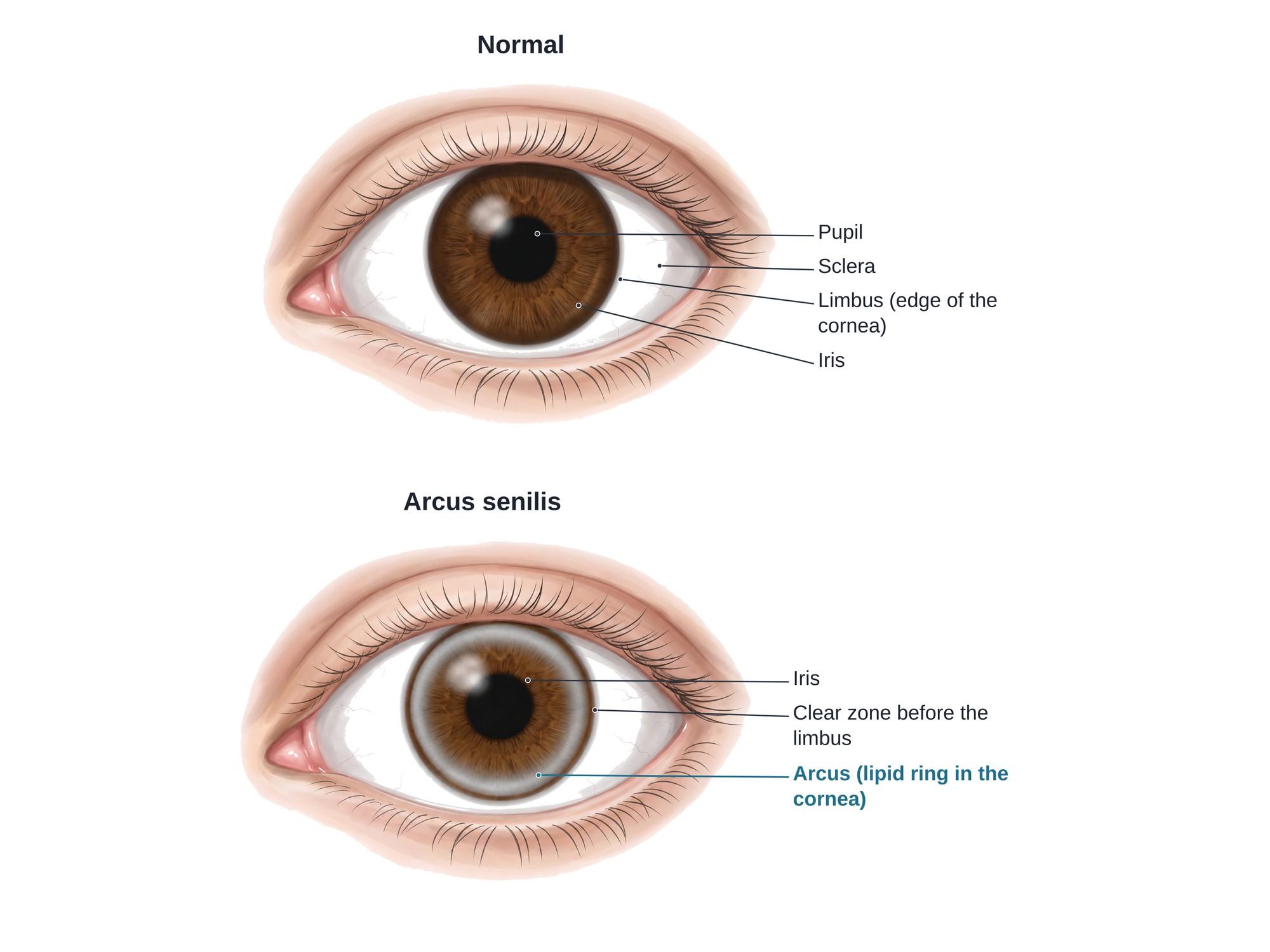
Arcus senilis, also called corneal arcus, is a gray-white ring at the outer edge of the cornea. It is made of fat (lipid), mostly cholesterol, stored in the cornea's middle layer. A thin clear band usually separates the ring from the white of the eye. Arcus is very common with age and does not affect vision. In a younger person, it can be a sign of high cholesterol. The illustration above shows a normal eye beside an eye with arcus senilis.
The anatomy
The cornea is the clear dome at the front of the eye. It covers the colored iris and the black pupil. The white of the eye is the sclera. Where the cornea meets the sclera is a narrow band called the limbus.
The cornea has five layers. The thick middle layer is the stroma, made of tightly packed collagen fibers. Tiny blood vessels run around the limbus but stop at the edge of the cornea, so the cornea stays clear.
In arcus, fat leaks out of those limbal vessels and settles in the outer stroma. It collects most near the front and back of the stroma, close to the Bowman layer and Descemet membrane. That is why the ring sits just inside the limbus.
The ring and the clear zone
An arcus has a typical look:
- Gray, white or yellow-white color, easy to see over a brown iris
- A sharp outer edge near the limbus
- A soft, hazy inner edge toward the pupil
- A clear zone, also called the lucid interval of Vogt, a thin band of clear cornea between the ring and the limbus
The ring usually starts as an arc at the top of the cornea, then the bottom. Over time the arcs join into a full circle. This is where the name comes from, since "arcus" means arc or bow.
Types
| Type | Age | What it usually means |
|---|---|---|
| Arcus senilis | Over 50 to 60 | Normal aging change. Very common, especially after 80. |
| Arcus juvenilis | Under about 40 | More often linked to high cholesterol, including familial hypercholesterolemia |
| One-sided (unilateral) arcus | Any age | Can point to reduced blood flow on the side without the ring, such as carotid artery narrowing |
Arcus senilis vs other rings in the eye
| Ring | Color | Where it is | Cause |
|---|---|---|---|
| Arcus senilis | Gray-white | Outer cornea, with a clear zone at the limbus | Fat deposit, aging or high cholesterol |
| Kayser-Fleischer ring | Golden-brown or green-brown | Edge of the cornea, no clear zone | Copper deposit, Wilson disease |
| Limbal ring | Dark brown or black | Border of the iris | Normal, more visible in young people |
Causes
- Aging. The limbal vessels let more fat through with age. This is the most common cause.
- High cholesterol. High LDL cholesterol and other blood fat (lipid) problems raise the chance of arcus, mainly in younger people.
- Familial hypercholesterolemia, an inherited condition that causes very high LDL cholesterol from birth.
- Smoking and alcohol have been linked to arcus in some studies.
- Genes and ethnicity. Arcus is more common in men and in people of African descent.
Symptoms
Arcus causes no symptoms. It does not hurt, itch or blur vision. Most people notice it in the mirror, or a doctor sees it during a routine exam. Some people with very high cholesterol also have xanthelasma, yellow fatty patches on the eyelids.
Diagnosis
An eye doctor sees arcus with a slit lamp, a microscope with a narrow beam of light. The beam shows the gray-white deposit in the stroma and the clear zone beside the limbus. No scan is needed.
The more important question is why it is there. In a person under about 50, doctors usually order a fasting lipid panel, a blood test for cholesterol and triglycerides. If there is a family history of early heart disease, they may test other family members too. Arcus in only one eye may prompt a check of the carotid arteries on the clear side.
Treatment
Arcus itself needs no treatment. It does not harm the cornea and does not affect vision. It does not go away when cholesterol is lowered.
Treatment, when needed, is for the cause:
- Diet, exercise and quitting smoking to lower cholesterol and heart risk
- Cholesterol medicines such as statins when blood tests show high LDL
- Treatment of familial hypercholesterolemia, often starting young
For cosmetic reasons, some people ask about corneal tattooing. This is rarely done and carries its own risks.
Recovery
There is no recovery period, because arcus is not an injury or an illness of the eye. The ring usually stays for life and may slowly become more complete. Vision stays normal.
Complications
Arcus has no complications in the eye. The concern is what it may point to:
- High cholesterol, which raises the risk of heart attack and stroke
- Coronary artery disease, mainly when arcus appears at a young age
- Carotid artery disease, when arcus is in one eye only
How arcus senilis is shown in a personal injury case
Arcus senilis is not caused by trauma. It most often comes up in medical malpractice cases about a missed sign of high cholesterol or heart disease. For example, a young adult with arcus juvenilis may later have a heart attack, and the question is whether a doctor should have ordered a cholesterol test. It also comes up when an injury claim involves the eye, because the defense may point to arcus as a change that was there before the accident. A clear medical illustration of a normal eye beside an eye with arcus shows a jury what the ring is, where it sits, and that it does not affect vision. It can also be shown beside a Kayser-Fleischer ring to explain why the color and position of a ring matter. For how these images are used at trial, see demonstrative evidence and medical legal illustration.
FAQ
What is the cause of corneal arcus?+
Corneal arcus is caused by fat (lipid), mostly cholesterol, leaking from the small blood vessels at the edge of the cornea and settling in the cornea's middle layer. With age, these vessels let more fat through. High blood cholesterol, smoking and family genes also make it more likely.
Does corneal arcus mean I have high cholesterol?+
Not always. In people over 60, arcus is very common and usually just a sign of aging. In people under about 40 to 50, arcus (arcus juvenilis) is more often linked to high cholesterol, including inherited familial hypercholesterolemia. Doctors usually check a cholesterol panel in a younger person with arcus.
What is the difference between arcus senilis and cataracts?+
Arcus is a ring of fat at the edge of the cornea, the clear front window of the eye. It does not block vision. A cataract is clouding of the lens, which sits behind the pupil. A cataract does blur vision and shows as a cloudy or yellow look inside the pupil, not a ring at the edge.
What causes brown rings around the iris?+
A dark ring around the iris is often a normal limbal ring, which is more visible in young people. A golden-brown or green-brown ring at the edge of the cornea can be a Kayser-Fleischer ring from copper buildup in Wilson disease. Arcus is white or gray, not brown.
Can arcus senilis be reversed?+
No. Arcus is permanent, and lowering cholesterol does not usually make it fade. It also does not need treatment, because it does not harm the eye or vision. The treatment, when needed, is for the cholesterol or heart risk it may point to.
Does arcus senilis affect vision?+
No. The ring sits at the very edge of the cornea, outside the part of the cornea used for seeing. It causes no pain, blur or glare.
Is arcus senilis in one eye a concern?+
Arcus in only one eye is unusual. It can mean the other side has reduced blood flow, often from narrowing of the carotid artery on the side without the ring. A doctor may order a carotid ultrasound to check.
At what age does arcus senilis appear?+
It usually appears after age 50 to 60 and becomes more common each decade. Most people over 80 have some degree of arcus. When it appears before age 40, it is called arcus juvenilis.
Need this illustration for a patient or a case?
Describe the injury or upload a scan and get a clear, labeled medical illustration for a consult, a chart or a case exhibit.
Try Natomy →