Kayser-Fleischer Ring: Wilson Disease Eye Sign vs Normal Eye
A Kayser-Fleischer ring is a golden-brown ring of copper at the edge of the cornea, a key sign of Wilson disease. See it illustrated beside a normal eye.
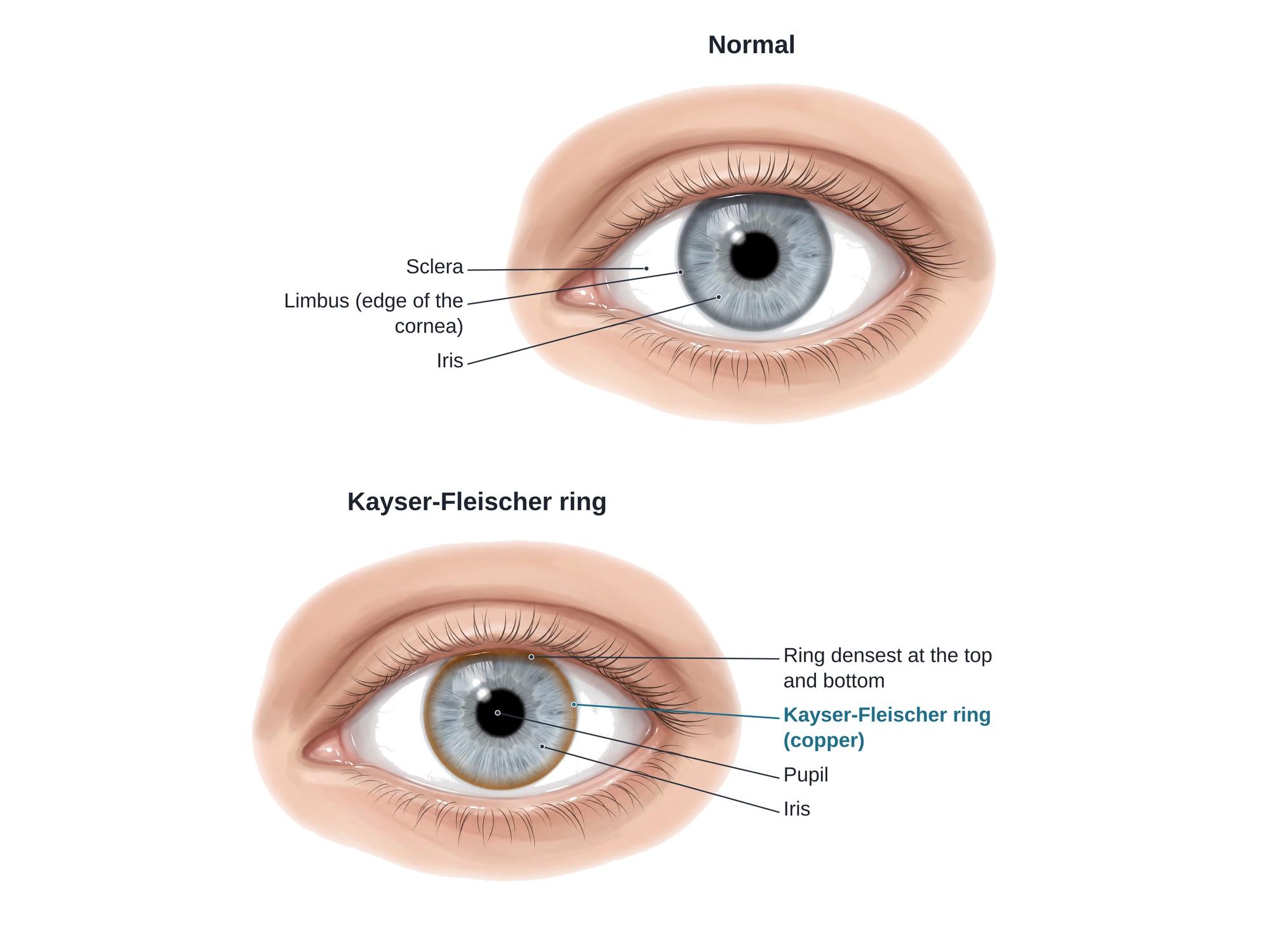
A Kayser-Fleischer ring is a golden-brown ring at the outer edge of the cornea, caused by copper stored in a deep layer of the cornea. It is a classic sign of Wilson disease, an inherited condition in which copper builds up in the body. The ring does not affect vision. It matters because it points to a serious, treatable disease. It is found in nearly all people whose Wilson disease affects the brain and in about half of those with only liver disease. The illustration above shows a normal eye beside an eye with a Kayser-Fleischer ring.
The anatomy
The cornea is the clear dome at the front of the eye. It sits over the colored iris and the black pupil. Where the cornea meets the white sclera is a narrow band called the limbus.
The cornea has five layers, from front to back:
- Epithelium, the thin outer skin
- Bowman layer, a tough sheet under the epithelium
- Stroma, the thick clear middle layer
- Descemet membrane, a thin sheet near the back
- Endothelium, a single layer of cells that pumps fluid out of the cornea
In a Kayser-Fleischer ring, copper granules collect in Descemet membrane at the outer edge of the cornea. That is why the ring sits right at the limbus and over the outer rim of the iris.
How the ring forms
In Wilson disease, the liver cannot pass extra copper into bile. Copper first builds up in the liver. When the liver is full, copper spills into the blood. From there it is stored in other tissues, including the brain and the cornea.
The ring usually appears first at the top of the cornea, then at the bottom, and finally at the sides. Over time it can form a full circle. This is why the illustrated ring is densest at the top and bottom.
Kayser-Fleischer rings vs normal eye
| Feature | Normal eye | Kayser-Fleischer ring |
|---|---|---|
| Edge of the cornea | Clean edge, sometimes a thin dark limbal ring | Golden-brown or green-brown band |
| Where it is | No deposit | Inside the limbus, in Descemet membrane |
| Pattern | No ring | Often starts at the top, then the bottom, then the sides |
| Brown eyes | Clean edge | Hard to see without a slit lamp |
| Effect on vision | None | None |
Other rings can look similar:
- Arcus (arcus senilis) is a white or gray ring of fat at the edge of the cornea, with a clear band between it and the limbus. It is common with age.
- A limbal ring is a normal dark ring around the iris, more visible in young people.
Causes
- Wilson disease is by far the most common cause. It is an autosomal recessive disease, meaning a person inherits a changed ATP7B gene from both parents.
- Other long-term liver diseases with poor bile flow (cholestasis), such as primary biliary cholangitis, can rarely cause similar rings.
- Copper in the eye from a copper-containing foreign body can cause a similar deposit, called chalcosis.
Symptoms
The ring itself causes no symptoms. The symptoms come from copper elsewhere in the body.
- Liver: tiredness, yellow skin or eyes (jaundice), swelling of the belly or legs, easy bruising, and sometimes sudden liver failure.
- Brain and nerves: tremor, stiffness, clumsy movements, drooling, slurred speech and trouble swallowing.
- Mental health: mood changes, depression, anxiety, personality changes or trouble at school or work.
- Eye: the Kayser-Fleischer ring and sometimes a sunflower cataract.
Symptoms usually start between the ages of 5 and 35, but they can start earlier or later.
Diagnosis
An eye doctor looks for the ring with a slit lamp, a microscope with a narrow beam of light. The beam shows the golden-brown deposit at the level of Descemet membrane. Gonioscopy, a special lens that shows the edge of the cornea, can find faint rings. A scan of the cornea's layers (anterior segment optical coherence tomography) can show the deposit in Descemet membrane.
Doctors confirm Wilson disease with:
- A low blood level of ceruloplasmin, the protein that carries copper
- High copper in a 24-hour urine sample
- High copper in a liver biopsy
- Genetic testing for ATP7B changes
- Brain imaging when there are nerve symptoms
Brothers and sisters of a person with Wilson disease are usually tested too.
Treatment
Treatment is for Wilson disease. It is lifelong.
- Chelating medicines such as penicillamine or trientine bind copper so the body can pass it in the urine.
- Zinc blocks copper from being absorbed from food. It is often used for maintenance or for people without symptoms.
- A low-copper diet, avoiding foods such as shellfish, liver, nuts, chocolate and mushrooms, especially early in treatment.
- Liver transplant for sudden liver failure or severe liver disease that does not respond to medicine.
Recovery
With steady treatment, Kayser-Fleischer rings usually fade over months to a few years. Liver tests often improve. Nerve and mental health symptoms improve more slowly, and some can last. People who keep taking their medicine usually have a normal life span. Stopping treatment can be dangerous and can cause sudden liver failure.
Complications
The ring itself has no complications. Untreated Wilson disease can cause:
- Cirrhosis, scarring of the liver
- Acute liver failure, which can be fatal without a transplant
- Lasting nerve damage, such as tremor, stiffness and speech problems
- Psychiatric illness
- Kidney problems and hemolytic anemia, a breakdown of red blood cells
How a Kayser-Fleischer ring is shown in a personal injury case
Kayser-Fleischer rings come up most often in medical malpractice cases about a delayed diagnosis of Wilson disease. A young person may see several doctors for liver tests, tremor or mood changes before anyone checks the eyes. By then, the liver or brain may have permanent damage. A clear medical illustration of a normal eye beside an eye with a Kayser-Fleischer ring shows a jury what the sign looks like, where it sits, and why a slit lamp exam could have found it. For how these images are used at trial, see demonstrative evidence and medical legal illustration.
FAQ
What color are Kayser-Fleischer rings?+
They are usually golden-brown, copper-brown or greenish-brown. The color comes from copper stored in a deep layer of the cornea. The ring is easy to see over a blue or gray iris and much harder to see over a brown iris, where an eye doctor often needs a slit lamp.
What are the common eye findings in Wilson disease?+
The main eye finding is the Kayser-Fleischer ring at the edge of the cornea. Some people also have a sunflower cataract, a flower-shaped copper deposit on the front of the lens. Both usually fade with treatment. Vision itself is usually normal.
What does a ring in your eye mean?+
It depends on the color and where it is. A golden-brown ring at the edge of the cornea can be a Kayser-Fleischer ring and needs testing for Wilson disease. A white or gray ring at the edge of the cornea is usually arcus, a fatty deposit common with age or high cholesterol. A dark rim around the iris is often a normal limbal ring.
What is Wilson's disease?+
Wilson disease is a rare inherited condition in which the body cannot get rid of extra copper. A change in the ATP7B gene stops the liver from passing copper into bile. Copper builds up in the liver, brain, eyes and other organs. Without treatment it can cause liver failure and nerve and mental health problems. With lifelong treatment, most people do well.
Are Kayser-Fleischer rings always caused by Wilson disease?+
Most are. Rarely, similar rings are seen in other long-term liver diseases that cause copper buildup, such as primary biliary cholangitis, and in some people with copper-containing foreign bodies in the eye. A doctor confirms Wilson disease with blood, urine and liver tests.
Do Kayser-Fleischer rings go away?+
Yes, they usually fade with treatment. The rings often begin to fade within months of starting copper-lowering medicine and may disappear over 3 to 5 years. If a ring comes back, it can be a sign that the person stopped treatment or is not getting enough.
Can you see a Kayser-Fleischer ring with the naked eye?+
Sometimes, especially in light-colored eyes. Early or faint rings, and rings over brown eyes, are often seen only with a slit lamp exam by an eye doctor. A normal eye exam by a non-specialist does not rule out a ring.
Do Kayser-Fleischer rings affect vision?+
No. The copper sits at the very edge of the cornea, outside the area used for seeing. The rings do not cause pain or blurred vision. Their value is as a clue to Wilson disease.
Need this illustration for a patient or a case?
Describe the injury or upload a scan and get a clear, labeled medical illustration for a consult, a chart or a case exhibit.
Try Natomy →