Trial Exhibits: How to Prepare, Label, and Introduce Them
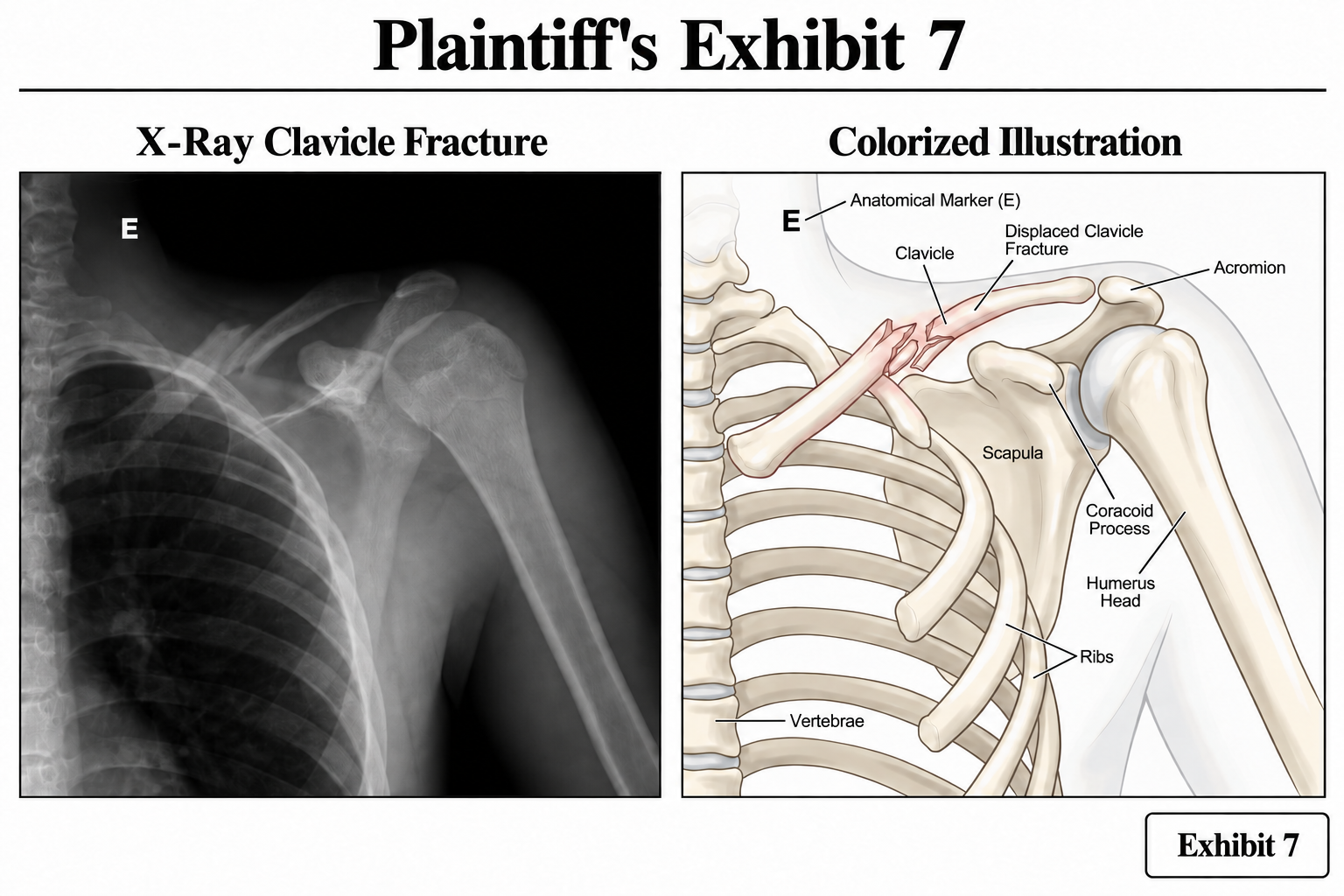 Plaintiff's Exhibit 7: a shoulder X-ray showing a displaced clavicle fracture next to a colorized anatomical illustration of the same fracture, with the clavicle, scapula, ribs, and humerus head labeled.
A personal-injury trial may involve dozens or hundreds of proposed exhibits, including medical records, bills, imaging, photographs, employment records, and case-specific visuals. Each item must be handled according to the pretrial order and the applicable evidentiary rules. A disclosure, authentication, or admissibility problem can keep a critical exhibit away from the jury.
This guide covers the mechanics. It is written for the associates and paralegals who build the exhibit list and the trial attorney who has to get each item in. It covers what counts as an exhibit, how exhibits are numbered and labeled, how to build the exhibit list (with a template), the script for introducing an exhibit, physical versus digital presentation, and the objections you will hear. For what the visual exhibits should look like and cost, see trial graphics; for the rules governing illustrative aids specifically, see demonstrative evidence.
What Are Exhibits in Court?
An exhibit is an item marked for identification in a case. The word is procedural: it does not establish that the item has been admitted into evidence. A marked exhibit may later be admitted, used only as an illustrative aid, excluded, or withdrawn. A medical bill, a photograph, the plaintiff's MRI, a labeled anatomical illustration, and a spine model can all be marked as exhibits.
Exhibits fall into a few types, and the type determines how you handle them.
Documentary exhibits: medical records, bills, employment records, insurance correspondence, expert reports (where admissible). When offered for their contents, they may raise hearsay, authentication, and other admissibility issues. Medical and employment records may qualify as business records if the proponent satisfies Rule 803(6), often through stipulation, witness testimony, or a certification that satisfies Rule 902(11) or (12).
Real (physical) exhibits: the actual object: the failed implant, the shoe the plaintiff was wearing, the defective ladder. Authenticated by a witness who can identify it and, where it matters, establish chain of custody.
Photographs, imaging, and recordings: scene photos, injury photos, MRI and CT studies, surveillance video, and deposition video. An ordinary photograph may be authenticated by a witness with personal knowledge who says it fairly and accurately depicts the scene. Technical imaging and digital recordings may instead require evidence about the process or system that produced them under Rule 901, a certification, a stipulation, or another permitted method.
Demonstrative evidence: illustrations, diagrams, models, animations, or other materials offered to prove a disputed fact through a visual or physical demonstration. These items are evidence only if the court admits them after the proponent satisfies the applicable evidentiary requirements.
Illustrative aids: charts, diagrams, timelines, models, and animations used only to help the factfinder understand evidence or argument. Under Rule 107, an illustrative aid is not evidence and ordinarily does not go to the jury room. The court may permit its use when its value in assisting comprehension is not substantially outweighed by the dangers identified in the rule.
Rule 1006 summaries: charts, calculations, or tables offered to prove the contents of voluminous admissible materials that cannot conveniently be examined in court. The proponent must make the underlying originals or duplicates available to the other parties at a reasonable time and place. A chart used only to explain evidence is an illustrative aid instead. Rule 1006 expressly preserves that distinction.
How Exhibits Are Numbered and Labeled
There is no universal rule. Three conventions are common, and the judge's standing order or the pretrial order will tell you which applies.
Plaintiff numbers, defendant letters. Some courts number the plaintiff's exhibits and letter the defendant's exhibits. Other courts give both sides numbers with party-specific prefixes.
Joint or allocated numerical ranges. Some judges use one numbered series, while others reserve a separate block of numbers for each party. A current Northern District of California standing order, for example, reserves 1 through 1000 for joint exhibits, 2000 through 2999 for the plaintiff, and 3000 through 3999 for the defendant. Northern District of California trial order.
Joint exhibits. Items both sides intend to use may be designated J-1, J-2, or placed in a joint numerical range. The parties may stipulate to authenticity or admissibility, but admission remains subject to court approval.
The physical label also varies. A court may require a sticker, an electronic stamp, a particular corner, a party designation, or a court-provided form. California's statewide guidance tells litigants to ask whether counsel or the clerk should mark exhibits, while the Northern District of California order cited above requires pre-marking in the lower-right corner. California Courts exhibit guidance. Place the label where it does not obscure content and follow the instructions for the specific courtroom.
Multi-page exhibits should be internally paginated so a witness can be directed to a specific page. Whether photographs or related documents may be grouped as subparts varies. Some courts permit labels such as 22-A or 22-1, while others require every item to have a separate exhibit number.
How conventions vary by jurisdiction
There is no national standard, and the differences are the kind that embarrass a trial team on the first morning. A non-exhaustive sampling:
- Federal courts use judge-specific numbering and submission procedures. Some require allocated numerical ranges and exhibit binders. Courts that use the Jury Evidence Recording System, or JERS, require compatible electronic files and allow jurors to review only the exhibits released at the judge's direction. Official JERS instructions.
- New York generally requires parties in civil cases to confer and pre-mark uncontested exhibits into evidence, subject to court approval, while contested exhibits are marked for identification. New York Uniform Civil Rule 202.34.
- California procedures vary by local rule and judge. State guidance says that a court may have counsel mark an exhibit or may require the clerk to do it. Some local courts require advance numbering and a joint exhibit list. California Courts exhibit guidance, Riverside County Local Rule 3401.
- Florida procedures also vary by judge. One current Twentieth Judicial Circuit procedure requires advance exchange, party-specific numbering, and a specified label, while Eleventh Judicial Circuit judges publish different marking procedures. Twentieth Judicial Circuit example, Eleventh Judicial Circuit example.
The lesson is procedural, not substantive: read the pretrial order, the local rules, the judge's standing order, and the clerk's instructions, in that order, before the first sticker goes on.
Exhibit binders
Many judges require exhibit binders, while others use electronic exhibits or a combination of formats. When binders are required, the standing order usually specifies the number of copies, tabbing, pagination, and delivery deadline. Prepare them from the final exhibit list and follow the court's format rather than assuming a standard number of sets.
When the court permits counsel to choose the sequence, numbering exhibits roughly in anticipated order of use can make presentation easier. Leave unused numbers only if the court's numbering system permits it. Some judges expressly allocate ranges for later-added exhibits, while others require a strict sequence.
The Exhibit List
The exhibit list identifies the exhibits a party may offer. Depending on the pretrial order, it may be exchanged, filed, lodged, or submitted jointly by a specified deadline. The courtroom deputy or clerk may use it to track what has been marked, offered, and admitted. Objections may be noted on the list, presented in a separate filing, or addressed at the pretrial conference as the court directs.
Exhibit list template
Many courts publish a form; when they do, use it. Where they do not, this structure is a useful starting point, subject to the court's instructions:
| Ex. No. | Description | Sponsoring witness | Offered | Admitted | Objection / ruling |
|---|---|---|---|---|---|
| P-1 | Medical records, Mercy Hospital ED, 3/14/2025 (Bates P000001–P000042) | Custodian / stipulated | |||
| P-2 | MRI lumbar spine, 4/2/2025, radiology report and images | Dr. A. Patel (radiologist) | |||
| P-3 | Operative report, L4-L5 microdiscectomy, 6/18/2025 | Dr. R. Chen (surgeon) | |||
| P-4 | Summary of medical expenses by provider (Rule 1006) | Plaintiff / paralegal custodian | Def.: foundation | ||
| P-5 | Photographs of intersection, 3/15/2025 (12 photos, P-5A–P-5L) | Plaintiff | |||
| P-6 | Colorized MRI, L4-L5 with herniation labeled, illustrative aid | Dr. R. Chen | n/a | Def.: Rule 107 | |
| P-7 | Anatomical illustration, L4-L5 herniation and L5 nerve root, illustrative aid | Dr. R. Chen | n/a | Def.: Rule 107, accuracy | |
| P-8 | Treatment timeline, 3/2025–2/2026, illustrative aid | Dr. R. Chen | n/a | ||
| P-9 | Surgical sequence illustration, microdiscectomy (3 panels), illustrative aid | Dr. R. Chen | n/a | ||
| P-10 | Wage records, employer, 1/2024–12/2025 | HR custodian / stipulated |
Note how these visuals are handled: items used only to assist testimony are identified as illustrative aids, with "n/a" in the Admitted column because they will not be offered as evidence. A visual offered to prove a disputed fact should be identified as proposed demonstrative evidence, and the Admitted column should remain open. A Rule 1006 summary should be labeled separately as summary evidence because Rule 1006 has its own requirements.
Keep a working copy with two more columns for the trial team only: source records (where the exhibit came from, for the foundation) and status (final, awaiting expert sign-off, needs re-export for the courtroom display).
Building the list
- Pull every document and image from the case file that any witness might need.
- Cut it to what you will actually use. An exhibit list padded with 300 records you never touch signals disorganization and invites objections to the ones that matter.
- Order by witness, then by chronology within each witness.
- Assign designations with gaps only if the court permits them.
- Identify the foundation method for each exhibit. That may be testimony from a sponsoring witness, a certification, a stipulation, self-authentication, judicial notice, or another method allowed by the applicable rules.
- For each technical or medical visual, confirm that the sponsoring expert has reviewed it for accuracy, and note the approval date in your working copy.
- Exchange by the deadline; log the other side's objections on your copy.
The tools attorneys use to organize medical evidence (chronology builders, case-management systems) usually export a records index that becomes the first draft of the documentary half of the list.
How to Introduce an Exhibit at Trial
A common sequence for an exhibit that requires witness foundation appears below. Stipulated, pre-admitted, certified, self-authenticating, and impeachment exhibits may follow a different procedure under the court's rules and orders.
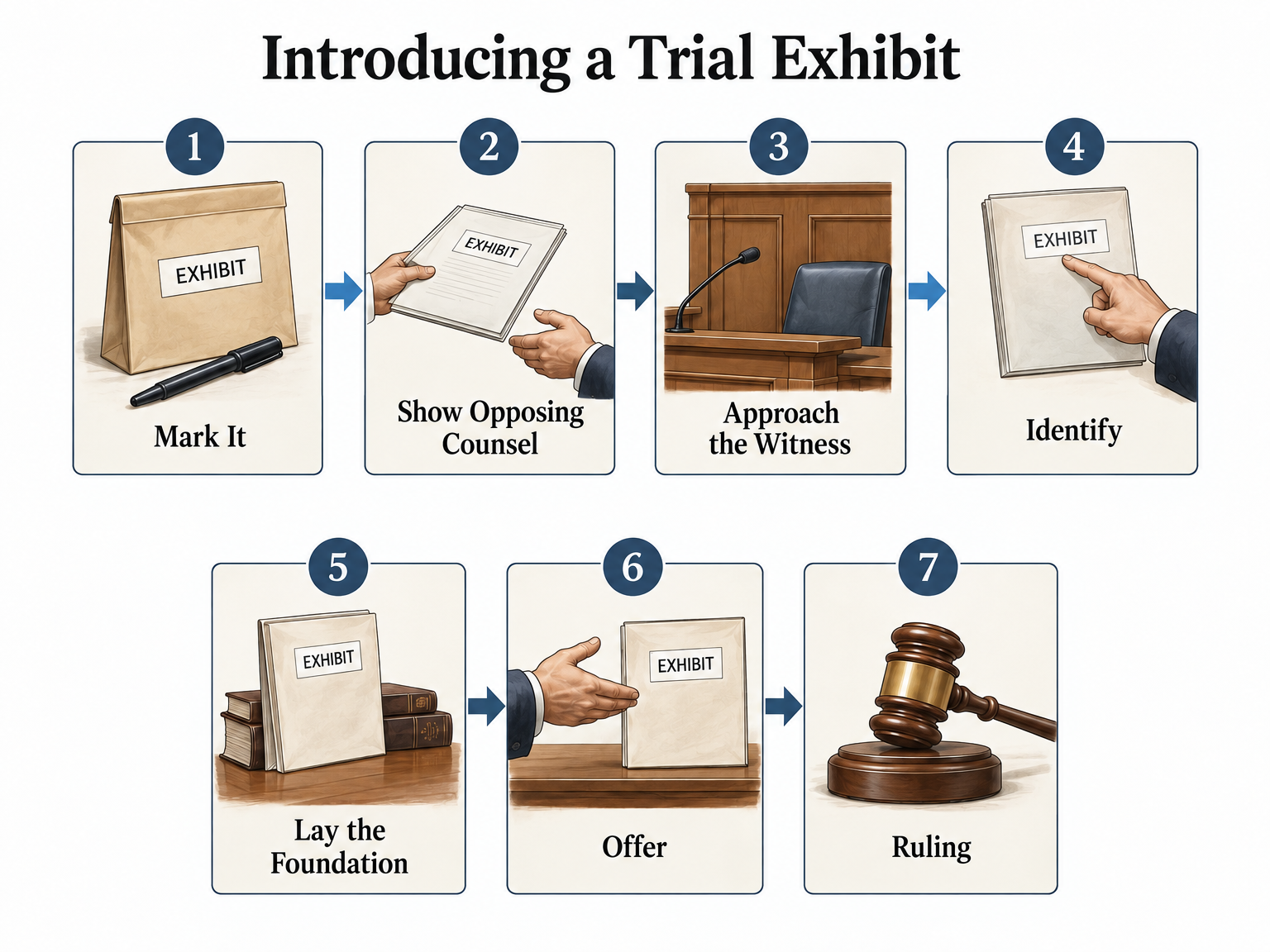 A seven-step flowchart titled Introducing a Trial Exhibit: mark it, show opposing counsel, approach the witness, identify, lay the foundation, offer, and ruling.
- Mark it. "Your Honor, I've had this marked as Plaintiff's Exhibit 7." (Pre-marked exhibits skip this.)
- Show opposing counsel as required. Exhibits are often exchanged before trial, but the judge may still require counsel to show or identify the item before presenting it to the witness.
- Approach the witness. If the courtroom requires permission, ask, "May I approach?" Then hand the witness the exhibit or display it on the courtroom screen.
- Identify. "Dr. Chen, do you recognize Plaintiff's Exhibit 7?" "What is it?"
- Lay the foundation. The questions depend on the exhibit type:
- Business record: Establish each required element of Rule 803(6), unless the foundation is supplied by a stipulation or a qualifying certification under Rule 902.
- Photograph: A witness with personal knowledge may identify what the photograph depicts and testify that it fairly and accurately represents what the witness observed. Other imaging or recordings may require a different authentication method under Rule 901.
- Illustrative aid: Establish what the aid depicts, the basis for the witness's testimony about it, and how it will help explain the evidence or argument. For a technical or medical visual, establish its accuracy through a qualified witness.
- Offer. For evidence: "Your Honor, I offer Plaintiff's Exhibit 7." For an illustrative aid: "Your Honor, I ask permission to use Plaintiff's Exhibit 7 to assist the witness's testimony."
- Ruling. Wait. If admitted, publish it to the jury as the court permits. If an objection is sustained, address the defect and re-offer if appropriate, or move on.
Rule 107 does not turn on one foundation question. The court may permit an illustrative aid when its utility in helping the factfinder understand the evidence or argument is not substantially outweighed by the danger of unfair prejudice, confusing the issues, misleading the jury, undue delay, or wasting time. Review technical and medical visuals with the sponsoring witness before testimony; the trial illustration guide explains how to build a visual that accurately reflects the supporting evidence and opinion.
Trial Boards vs. Digital Display
Visual courtroom exhibits are commonly presented on a physical board, through a digital display, or through a combination of the two.
Trial boards: foam-core or rigid prints, often 30×40 or 36×48 inches, on an easel. Their virtue is persistence: a board can remain visible while the witness testifies, subject to the judge's control of the presentation. They work when the courtroom lacks reliable display technology and for the few visuals counsel wants to keep visible. Test the board from the jury box or a comparable distance, use large labels, and keep each board focused on one idea. No single minimum font size works for every courtroom and board size.
Digital display: the exhibit on the courtroom monitors, driven by trial presentation software (TrialPad, TrialDirector, Sanction) from counsel table or by a trial technician. Digital display allows zooming into a record line, side-by-side comparison, annotation in real time, and video. It can make a large exhibit list easier to manage. The risks are technical: know the courtroom's connections in advance, carry a backup on a second device, and have paper copies of critical exhibits in case the display system fails.
Preserve the version shown to the jury as the applicable rules and the judge's instructions require. For an illustrative aid, Rule 107(c) provides that the aid must be entered into the record when practicable even though it is not evidence. Ask in advance how the court wants a board, animation, or live digital annotation preserved.
Objections to Trial Exhibits, and Prevention
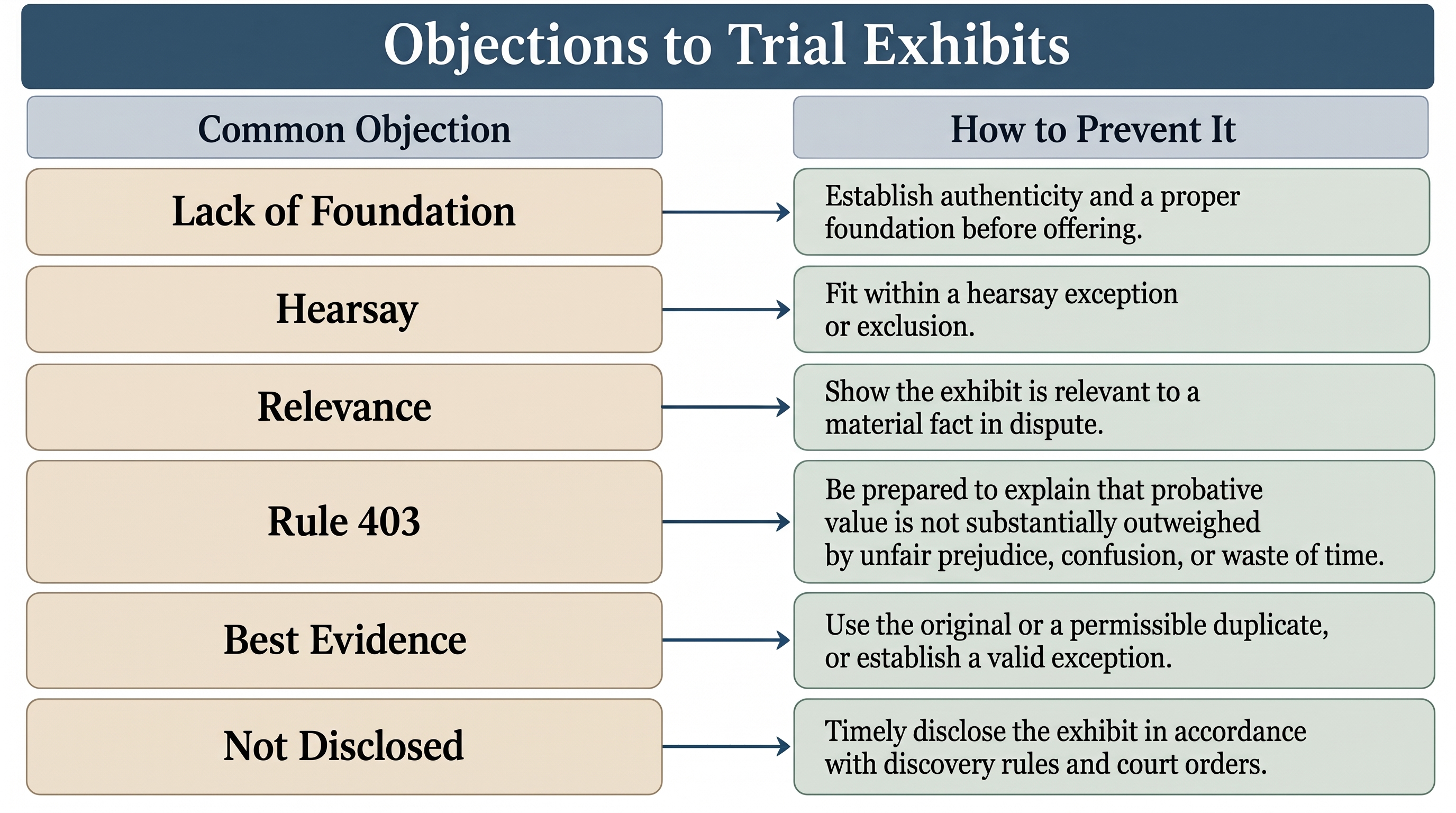 A two-column chart pairing the six most common objections to trial exhibits, including lack of foundation, hearsay, relevance, and Rule 403, with the corresponding way to prevent each one.
Lack of authentication or foundation. The proponent has not supplied evidence sufficient to support a finding that the item is what the proponent claims, or has not established another required foundation. Prevention: identify the appropriate method before trial, which may be witness testimony, a certification, a stipulation, self-authentication, or another method permitted by the rules. See Rule 901 and Rule 902.
Hearsay. An out-of-court statement is offered for its truth without an applicable exclusion or exception. Prevention: determine whether the records satisfy Rule 803(6), whether a proper certification under Rule 902 is available, or whether the parties will stipulate. A Rule 1006 summary must summarize admissible underlying materials and does not cure hearsay in those materials.
Relevance. Prevention: identify the fact of consequence that the exhibit tends to make more or less probable under Rules 401 and 402, and consider omitting exhibits that do not advance a material issue.
Rule 403: unfair prejudice, confusion, or needless cumulative evidence. Rule 403 applies to evidence, including admitted demonstrative evidence and graphic photographs. An illustrative aid is governed directly by Rule 107's separate balancing test, which uses similar but not identical considerations. Prevention: use restraint in design, connect admitted evidence to a disputed issue, and avoid needless repetition. See demonstrative evidence.
Original-writing rule. When a party seeks to prove the content of a writing, recording, or photograph, Rule 1002 generally requires an original unless another rule or statute provides otherwise. A duplicate is generally admissible under Rule 1003 unless a genuine question is raised about the original's authenticity or it would be unfair to admit the duplicate.
Not disclosed. The exhibit was not disclosed as required by a rule, scheduling order, or pretrial order. Prevention: complete the list by the deadline and follow the court's procedure for any supplemental disclosure. A reserved exhibit number does not excuse an untimely disclosure.
Misleading / not to scale / assumes facts not in evidence. These objections often target demonstrative evidence and illustrative aids. Prevention: state scale and orientation where relevant, trace factual elements to supporting evidence or a disclosed expert opinion, and use vocabulary that matches the witness's testimony.
Public Access and Exhibit Custody
Public access and post-trial custody are separate questions, and both depend on the court. The federal judiciary explains that exhibits admitted into evidence become part of the public record, although access may be affected by logistics and a judge may restrict access in some circumstances. U.S. Courts guide to trial exhibits. Sealed material and exhibits subject to a specific access order require separate analysis under the applicable rules.
Custody practices vary even among federal districts. The District of Oregon returns all exhibits to offering counsel after trial and requires counsel to maintain them through the time for appeal and any appeal. District of Oregon Local Rule 5-6. Other courts may retain exhibits for a period or impose different procedures. Check the local rule and the trial judge's instructions before the proceeding ends.
Dos and Don'ts
Do
- Pre-mark everything the court allows you to pre-mark; it saves minutes per exhibit in front of the jury.
- Use a consistent label location, size, and format where the exhibit type and the court's instructions permit.
- Describe exhibits on the list specifically enough that the clerk can tell two similar records apart ("Mercy Hospital ED records 3/14/2025," not "medical records").
- Seek stipulations to authenticity or admissibility for routine, undisputed items where appropriate.
- Keep the working copy of the list updated in real time during trial: offered, admitted, excluded, withdrawn.
Don't
- Don't reuse a designation once it has appeared in the record unless the court directs otherwise; the transcript may already reference it.
- Don't skip gaps in numbering when a court requires strict sequence, and don't create gaps when it does.
- Don't cover content with the label, or place it on the front when the clerk wants it on the back.
- Don't hand the witness an exhibit before showing it to opposing counsel when the court's procedure requires that step.
- Don't show a demonstrative to the jury before the court has ruled you may use it.
A Pre-Trial Checklist
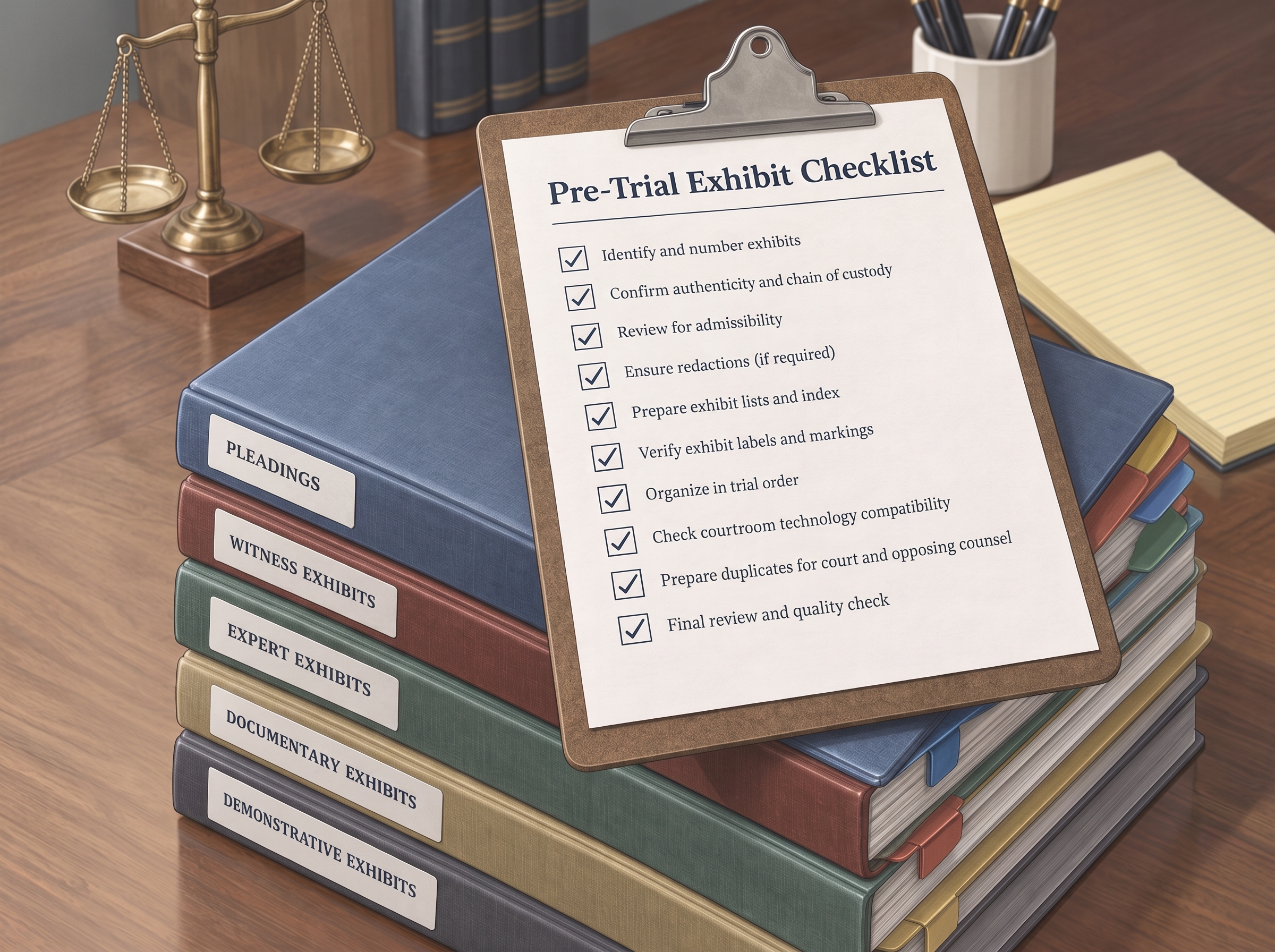 A pre-trial exhibit checklist on a clipboard resting on a stack of tabbed binders labeled pleadings, witness exhibits, expert exhibits, documentary exhibits, and demonstrative exhibits.
- Exhibit list complete, in the required order and numbering format, by the scheduling-order deadline.
- The foundation method for every exhibit is identified, whether witness testimony, certification, stipulation, self-authentication, or another permitted method.
- Every technical or medical visual has documented expert review and a source sheet.
- Stipulations obtained on records and undisputed items; joint exhibits designated.
- Objections received, logged, and motions in limine briefed on the contested demonstratives.
- Physical exhibits labeled; digital exhibits loaded in the presentation software and tested on the courtroom system.
- Paper backups prepared for critical exhibits where practical.
- Boards printed for any visuals that counsel plans to display persistently, if the court permits that use.
- Exhibit binders assembled in the number and format the court requires.
- Electronic exhibit files delivered to the clerk in the required format if the court uses a jury evidence system.
Careful preparation reduces the risk of exclusion, but admissibility ultimately depends on the governing evidence rules, pretrial disclosures, court orders, and the judge's rulings.
Ready to create your own medical illustrations?
Upload a clinical photo and generate a professional illustration in seconds.
Try Natomy →