Laryngomalacia: Symptoms, Causes, Treatment & When to Worry
Laryngomalacia is a floppy voice box that collapses into a baby's airway when breathing in, causing noisy stridor. See it illustrated beside a normal larynx.
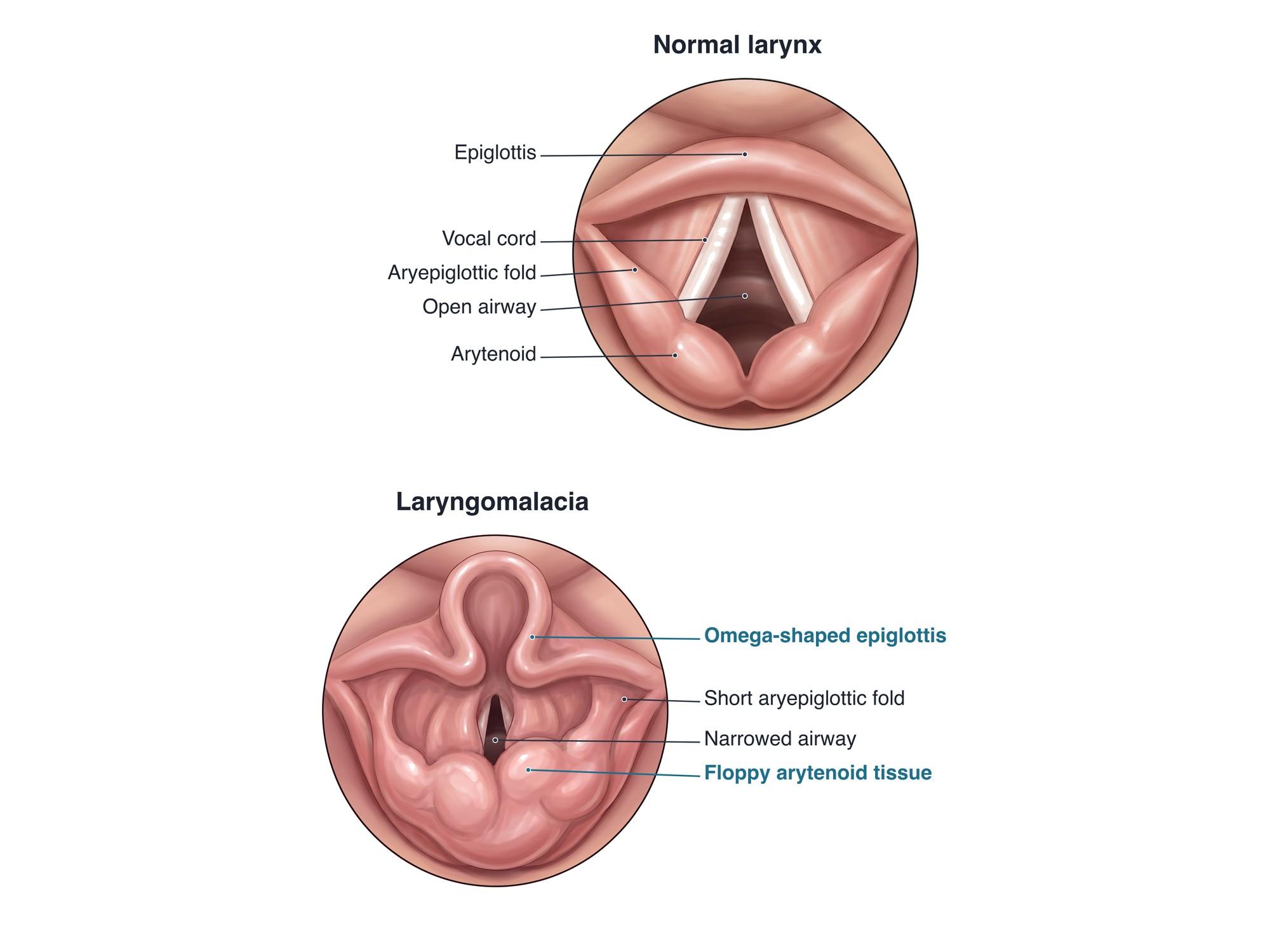
Laryngomalacia is a softness of the tissue at the top of a baby's voice box (larynx) that makes it collapse into the airway when the baby breathes in. "Laryngo" means larynx, and "malacia" means softening. It is the most common cause of noisy breathing in newborns and infants. The noise, called stridor, is a high-pitched sound heard when breathing in. Most cases are mild and go away by 12 to 24 months of age. The illustration above shows a normal infant larynx beside one with laryngomalacia, seen from above.
The anatomy
The larynx sits at the top of the windpipe (trachea). The part above the vocal cords is called the supraglottis. It includes:
- The epiglottis, a leaf-shaped flap at the front that covers the airway when swallowing.
- The aryepiglottic folds, two folds of tissue that run from the sides of the epiglottis back to the arytenoids.
- The arytenoids, two small cartilages at the back. They are covered by soft lining (mucosa) and move the vocal cords.
- The vocal cords, which form an upside-down V below these structures.
In laryngomalacia, these supraglottic tissues are too soft or too crowded. When the baby breathes in, the airflow pulls them inward and partly blocks the opening.
Types
Laryngomalacia is often grouped by which tissue collapses. Many babies have more than one type.
| Type | What collapses | What it looks like |
|---|---|---|
| Type 1 | Arytenoid mucosa | Loose tissue over the arytenoids falls forward into the airway |
| Type 2 | Short aryepiglottic folds | Tight, short folds pull the sides in; the epiglottis is often curled into an omega shape |
| Type 3 | Epiglottis | The epiglottis falls backward over the airway |
The omega-shaped epiglottis gets its name from its curled shape, like the Greek letter omega. It is common in laryngomalacia but can also be seen in some healthy babies.
Causes
The exact cause is not fully known. Leading ideas are:
- Immature nerve control. The nerves that keep the larynx firm and coordinated are not fully developed. This is the main theory.
- Soft or immature cartilage, which is more common in premature babies.
- Crowded anatomy, such as short aryepiglottic folds or extra arytenoid tissue.
- Reflux. Stomach acid coming up into the throat (gastroesophageal reflux) causes swelling. Swollen tissue collapses more easily, and hard breathing in can worsen reflux.
Laryngomalacia is not caused by anything the parents did. It is more common in babies with some neurological conditions and some genetic syndromes.
Symptoms
- Stridor, a high-pitched noise when breathing in. It usually starts within the first 2 weeks of life.
- Noise that is worse when lying on the back, feeding, crying, or with a cold.
- Noise that often peaks at about 4 to 8 months of age.
- Feeding problems, such as coughing, choking or spitting up during feeds.
- Reflux symptoms.
Signs of severe laryngomalacia include:
- Poor weight gain (failure to thrive).
- Pauses in breathing (apnea) or blue or gray color around the lips (cyanosis).
- Deep pulling in at the base of the neck or between the ribs with each breath (retractions).
- Ongoing trouble feeding or food going into the lungs (aspiration).
Diagnosis
A doctor usually suspects laryngomalacia from the baby's history and the sound of the breathing. The diagnosis is confirmed with flexible laryngoscopy. A thin, flexible camera passes through the nose while the baby is awake. It shows the supraglottic tissue collapsing inward with each breath in, as in the illustration.
For more severe cases, a microlaryngoscopy and bronchoscopy under anesthesia checks the whole airway. This looks for a second airway problem lower down, such as tracheomalacia or subglottic stenosis (narrowing below the vocal cords). Swallow studies, sleep studies and oxygen checks may also be done.
Treatment
- Watchful waiting. Most babies with mild laryngomalacia need no treatment. The doctor tracks breathing, feeding and weight.
- Reflux treatment. Feeding changes, upright feeding, and sometimes acid-reducing medicine.
- Feeding support, such as thickened feeds or paced bottle feeding, guided by a feeding specialist.
- Supraglottoplasty. Surgery for severe cases, done through the mouth under anesthesia with tiny instruments or a laser. The surgeon trims extra arytenoid tissue and cuts the short aryepiglottic folds so the airway opens. Most babies improve a lot after this surgery.
- Tracheostomy, a breathing tube through the neck, is rarely needed. It is reserved for the most severe cases or babies with other serious conditions.
Recovery
- Mild laryngomalacia usually improves on its own. Most children outgrow it by 12 to 24 months.
- After supraglottoplasty, babies often stay in the hospital for 1 to 2 nights. Breathing noise and feeding often improve within days to weeks.
- Some children need a second surgery, especially those with neurological conditions.
- Weight checks and feeding follow-up continue until the child is growing well.
Complications
- Failure to thrive from the extra work of breathing and trouble feeding.
- Aspiration, food or liquid going into the lungs, which can cause pneumonia.
- Low oxygen levels and pauses in breathing, especially during sleep.
- Pulmonary hypertension, high pressure in the lung arteries that strains the heart, in long-lasting severe cases.
- Surgical complications after supraglottoplasty, such as swelling, bleeding, scarring or aspiration. These are uncommon.
How laryngomalacia is shown in a personal injury case
Laryngomalacia is usually harmless, but it can matter in a case when warning signs were missed. Examples include a baby with noisy breathing, poor weight gain and breathing pauses who was told to wait, or a second airway problem that was never looked for. Injuries can include low-oxygen brain injury, failure to thrive, and emergency procedures. A clear illustration of a normal larynx beside the floppy one shows a jury what the scope revealed, why the airway narrows with each breath, and why the baby struggled to breathe and feed. For how these images are used at trial, see demonstrative evidence and medical legal illustration.
FAQ
What does it mean when a newborn baby has a floppy larynx?+
It usually means laryngomalacia. The soft tissue above the vocal cords is floppy and gets pulled into the airway when the baby breathes in. This makes a high-pitched, noisy breathing sound called stridor. In most babies it is mild and goes away on its own.
When should I worry about laryngomalacia?+
Get prompt medical care if the baby has trouble feeding, chokes or coughs a lot with feeds, is not gaining weight, has pauses in breathing, turns blue or gray around the lips, or pulls in hard at the neck or ribs with each breath. These are signs of severe laryngomalacia.
What does laryngomalacia sound like?+
It sounds like a high-pitched squeak, wheeze or snore when the baby breathes in. It is often louder when the baby is lying on the back, crying, feeding, excited or has a cold. It is usually quieter when the baby is calm or lying on the stomach while awake and watched.
Is laryngomalacia dangerous?+
Most cases are not dangerous and need only watching. A small share of babies, often quoted as about 10 to 20 in 100, have a severe form that affects breathing, feeding or growth. Those babies may need surgery. Rarely, untreated severe cases can cause low oxygen or heart strain.
When does laryngomalacia go away?+
The noise often starts in the first 2 weeks of life, gets louder until about 4 to 8 months of age, and then slowly fades. Most children outgrow it by 12 to 24 months as the airway grows and the tissue firms up.
What is congenital tracheomalacia?+
Tracheomalacia is a similar problem lower down, in the windpipe (trachea). The trachea's walls are soft and partly collapse, often when breathing out or coughing. It can cause a barking cough or noisy breathing. Laryngomalacia affects the voice box above the vocal cords instead.
What is tracheobronchomalacia?+
Tracheobronchomalacia is softness of both the trachea and the large airways that branch from it (the bronchi). Like tracheomalacia, it causes airway collapse, usually when breathing out. It is diagnosed with a scope and is treated differently from laryngomalacia.
What is the best sleep position for a baby with laryngomalacia?+
Babies with laryngomalacia should still sleep on their back, on a flat, firm surface, unless their doctor gives other advice. Stomach sleeping can quiet the noise, but it raises the risk of sudden infant death. Tummy time while awake and watched is fine.
Need this illustration for a patient or a case?
Describe the injury or upload a scan and get a clear, labeled medical illustration for a consult, a chart or a case exhibit.
Try Natomy →