Medical Illustrator: Salary, Training, and What the Job Is Actually Like
A medical illustrator (also called a medical artist, the older term still standard in the UK) is a professional artist with graduate-level training in anatomy and medicine who creates accurate visuals of the human body, disease, and clinical procedures for surgeons, medical educators, publishers, device and pharmaceutical companies, and attorneys. Most hold a two-year master's degree from one of five accredited programs in North America, and salaried practitioners earn a median of $83,500 a year, according to the Association of Medical Illustrators (AMI).
This guide covers what the job involves day to day, what medical illustrators earn, how to become one (including the exact prerequisites, programs, and certification exam), where the jobs are, how the role differs from a scientific illustrator, a short history of the field, the illustrators whose work defined it, and how AI is changing the profession.
Medical illustrator at a glance
| What they do | Turn anatomy, surgery, pathology, and research into accurate 2D and 3D illustrations, animations, and interactive media |
| Education | Bachelor's (art + premed sciences) → two-year master's from a CAAHEP-accredited program |
| Accredited programs | Five in North America: Johns Hopkins, UIC, Augusta, Toronto, RIT |
| Certification | Certified Medical Illustrator (CMI), optional, renewed every five years |
| Median salary (salaried) | $83,500, up to $170,000 (AMI 2022 survey) |
| Median income (self-employed) | $85,000 gross |
| Employers | Academic medical centers, hospitals, publishers, device and pharma companies, law firms, animation studios, and self-employment |
| Professional body | Association of Medical Illustrators (founded 1945); Medical Artists' Association and IMI in the UK |
What does a medical illustrator do?
The core of the job is visual translation: taking information locked inside a surgical procedure, a research paper, a set of imaging studies, or a patient's chart and turning it into an image that a clinician, a student, a patient, or a juror can understand at a glance.
The output is more varied than most people expect. In a single year a working medical illustrator might produce:
- Surgical illustrations for a textbook or atlas, drawn from observing the procedure in the operating room
- Patient education materials that a practice hands out before a consent conversation
- 3D models and animations of a medical device's mechanism of action for a company's sales team or FDA submission
- Journal figures and graphical abstracts for a research group
- Medical-legal exhibits that explain a plaintiff's injuries and surgeries to a jury
- Anatomy teaching assets for a medical school, increasingly in AR/VR formats
- Editorial illustration for medical magazines and consumer health publications
- Interactive and e-learning modules for continuing medical education
The AMI lists universities, hospitals, research institutions, publishers, pharmaceutical firms, law firms, government agencies, medical education companies, and animation studios as typical employers. Many illustrators move between several of these over a career.
Medical illustrator salary
The most reliable data comes from the AMI's own member survey, because the U.S. Bureau of Labor Statistics does not track medical illustrators separately. The BLS folds them into "fine artists, including painters, sculptors, and illustrators," a category whose median was $55,490 in May 2025 and which the BLS projects to decline 1% through 2035. Neither number describes trained medical illustrators, who are a small, highly credentialed slice of that bucket, so treat any salary site that quotes the BLS figure with caution.
From the 2022 AMI salary survey:
| Role | Median | Upper range |
|---|---|---|
| Salaried medical illustrator or animator | $83,500 | $170,000 |
| Art or creative director | $104,000–$126,000 | $300,000 |
| Self-employed (gross income) | $85,000 | $300,000 |
| Business owner with employees (gross revenue) | $1,250,000 | $6,000,000 |
Crowd-sourced sites land in the same neighborhood for salaried roles: Glassdoor reports an average of about $80,000 (25th–75th percentile roughly $61,000–$106,000) and Salary.com about $68,000. ZipRecruiter's figure of over $160,000 is an outlier that almost certainly mixes in unrelated job postings; ignore it.
Some context for the AMI numbers:
- Entry level salaried positions at academic medical centers and hospitals typically start in the $55,000–$70,000 range. Salaries rise with 3D and animation skills, which command a premium over 2D-only work, and with medical-legal or pharma experience.
- About 32% of salaried illustrators supplement their income with freelance work, per the AMI.
- Self-employed income is gross, before software, insurance, and the unpaid time spent finding clients. Roughly a third of practitioners work for themselves, and the spread is wide: a solo freelancer doing editorial work and a medical-legal studio owner producing trial exhibits are both "self-employed."
- Medical-legal work pays the best per project. Demonstrative exhibits for personal injury and malpractice cases routinely bill in the thousands of dollars per illustration, which is why a disproportionate number of studio businesses in the field serve attorneys. See our guide to medical-legal illustration for how that market works.
- Geography matters less than in most fields because so much of the work is remote and project-based, but salaried positions cluster where the academic medical centers are: Baltimore, Chicago, Boston, Rochester, Toronto, the Bay Area, and the Texas Medical Center in Houston.
How to become a medical illustrator
There is no shortcut. The standard path runs through an accredited master's program, and admission to that program is the hardest step. Here is the full sequence.
Step 1: Undergraduate degree with art and premed science
Admissions committees want to see both halves of the job. The AMI's guidance is a bachelor's degree with a major in art and a minor in biological sciences, or the reverse. Coursework they look for:
- Art: drawing, life drawing, painting, color theory, graphic design, illustration, and computer graphics
- Science: general biology or zoology, vertebrate anatomy, developmental biology, physiology, chemistry, and cell biology
A minimum GPA around 3.0 is recommended, and every program requires a portfolio and most an interview.
A handful of universities offer an undergraduate major built for this path. The AMI lists thirteen, including RIT's BFA in Medical Illustration, the Cleveland Institute of Art's BFA in Life Sciences Illustration, Iowa State's BA in Biological and Pre-Medical Illustration, Rowan University's BFA in Biomedical Art and Visualization, Ferris State/Kendall's BFA in Pre-Medical Illustration, and scientific-illustration tracks at Arcadia, the University of Florida, and the University of Georgia. The AMI is explicit that these programs "are not required for, nor do they guarantee admission to, graduate programs." They are a convenience, not a prerequisite: plenty of admitted students come from a biology degree with studio electives or an art degree with premed courses added on.
Step 2: Build a portfolio that shows observation, not just polish
The portfolio matters more than the transcript. Programs are looking for evidence that you can draw what is in front of you accurately: life drawing, figure studies, still lifes, and anatomical sketches from bone and specimen. Finished digital pieces and 3D work help, but a portfolio of only stylized digital art without observational drawing is the most common reason strong applicants are rejected. If your undergraduate program did not include figure drawing, take it before you apply.
Step 3: A two-year accredited master's degree
Five graduate programs in North America are accredited by the Commission on Accreditation of Allied Health Education Programs (CAAHEP) on the recommendation of the Accreditation Review Committee for the Medical Illustrator (ARC-MI):
| Program | Degree | Founded |
|---|---|---|
| Johns Hopkins University School of Medicine, Art as Applied to Medicine (Baltimore) | M.A. | 1911 |
| University of Illinois Chicago, Biomedical Visualization | M.S. | 1921 |
| University of Toronto, Biomedical Communications | M.Sc.BMC | 1945 |
| Augusta University, Medical Illustration (Augusta, GA) | M.S.M.I. | 1951 (first degree) |
| Rochester Institute of Technology, Medical Illustration | M.F.A. | — |
All five are two years. Each accepts 20 or fewer students a year, so fewer than 100 accredited graduates enter the field across the continent annually. That bottleneck is the single biggest reason the profession stays small, and it is also why the credential carries weight.
The curriculum is why medical illustrators can be trusted on accuracy. Students take human gross anatomy with cadaver dissection, often alongside first-year medical students, plus physiology, pathology, histology, neuroanatomy, and embryology. Surgical observation is built into the program: students scrub in, sketch in the OR, and learn to draw what a surgeon actually sees rather than what a textbook shows. The art side covers 2D illustration, 3D modeling, animation, interactive media, and a thesis project that becomes the core of a professional portfolio.
Cost. Tuition varies widely. The public programs (UIC, Augusta) are substantially cheaper for in-state students than the private ones; Johns Hopkins lists total program tuition and fees above $100,000. Most programs offer some graduate assistantships or scholarships, and the small cohort size means it is worth asking each program directly what funding is typical.
Outside North America. In the UK the profession is usually called medical art, and its practitioners medical artists. The Medical Artists' Association of Great Britain is the professional body, the Institute of Medical Illustrators (IMI) accredits courses, and the Medical Artists' Education Trust runs a part-time postgraduate training programme in medical art. The MSc in Medical Visualisation and Human Anatomy at the Glasgow School of Art and the University of Glasgow is the best-known degree route. Note that in the UK "medical illustration" as an NHS job title usually means clinical photography and video, which is a different career from medical art.
Step 4 (optional): The Certified Medical Illustrator exam
After graduating, illustrators can sit for the Certified Medical Illustrator (CMI) credential from the Board of Certification of Medical Illustrators. The details, per the BCMI:
- Eligibility: graduation from an accredited medical illustration program, or five years of professional experience plus proof of a completed human gross anatomy dissection course.
- Part I: a half-day written examination covering biomedical science, business practices, ethics, and drawing skills.
- Part II: a portfolio of eight original pieces, submitted within two years of passing Part I, reviewed for the application of knowledge and skill to real projects.
- Renewal: every five years, with a minimum of 35 contact hours of approved continuing education per term.
Certification is voluntary, but it signals to employers and clients that the illustrator has been independently tested on both the science and the craft, and it is the route by which experienced illustrators without an accredited degree get formally credentialed.
Skills and software medical illustrators use
Scientific knowledge. Graduate-level anatomy, physiology, and pathology are the baseline. The illustrator needs to know not just what a structure looks like but how it moves, how it fails, what the surgeon sees from a given approach, and what matters clinically, because every illustration is an argument about what to include and what to leave out.
Observational drawing. Still the foundation, and still what admissions and certification test. Traditional media like carbon dust (a technique Max Brödel developed at Hopkins), pen and ink, and gouache remain in use for editorial and fine-art work.
Digital 2D. Adobe Photoshop and Illustrator are the industry standard; Procreate and Clip Studio Paint are common for sketching.
3D modeling and animation. ZBrush for sculpting, Autodesk Maya and Cinema 4D for modeling and animation, Blender increasingly for both, plus Substance Painter for texturing. Animation and 3D skills command the salary premium.
Interactive and immersive. Unity and Unreal Engine for AR/VR anatomy content, e-learning modules, and surgical simulators.
Communication and business. Illustrators spend a great deal of time with physicians, researchers, attorneys, and marketing teams who have strong opinions about the image and no design vocabulary. Translating "that doesn't look right" into a specific anatomical or compositional fix is a core skill. Freelancers also need contracts, licensing, and pricing, which is why the CMI exam includes business practices.
What a typical day looks like
Ask working illustrators and the honest answer is that there is no typical day, but the work falls into a few recognizable modes.
Research and reference. Before drawing anything, the illustrator reads the literature, studies imaging, and consults with the subject-matter expert. For a surgical illustration that might mean attending the procedure and photographing each step; for a device animation it means reading the engineering specs; for a legal exhibit it means going through the patient's operative reports and radiology.
Drafting and review. A first sketch goes to the physician or client for accuracy review. Revisions are the norm, not the exception: a nerve routed slightly wrong, a retractor placed where the surgeon would never put it, a proportion that reads incorrectly at thumbnail size. A finished piece typically goes through several rounds of clinical feedback.
Production. Rendering the final piece in whatever medium the project calls for, then preparing deliverables: print-resolution files for a publisher, layered files for a marketing team, video for a device company, board-sized prints for a courtroom.
Everything else. Salaried illustrators at a hospital or university spend part of the week in meetings with faculty and communications staff. Freelancers spend a meaningful share of their time on proposals, contracts, invoicing, and licensing.
Where medical illustrators work
- Academic medical centers and teaching hospitals are among the largest salaried employers, producing everything from surgical atlases to patient handouts to grant figures. Mayo Clinic, Cleveland Clinic, Johns Hopkins, and the large university health systems all employ in-house illustration teams.
- Medical device and pharmaceutical companies hire illustrators and animators for mechanism-of-action videos, sales materials, regulatory submissions, and training.
- Publishers of textbooks, journals, and consumer health content, though this segment has contracted as publishing has.
- Medical-legal studios produce demonstrative exhibits for personal injury, medical malpractice, and product liability cases. See trial graphics for the kinds of work involved.
- Animation and visualization studios serving healthcare marketing and education.
- Museums and science centers for permanent and traveling exhibits.
- Government and the military, including the National Institutes of Health and the armed forces' medical education units.
- Self-employment. Roughly a third of practitioners freelance or run small studios, often serving several of the segments above at once.
What job postings actually look like
Open salaried positions with the exact title "medical illustrator" are rare at any given moment. A nationwide Indeed search in September 2026 turned up one: a patient-education role at DecisivEdge in Newark, Delaware, paying $65,000–$85,000 and open to recent graduates. Everything else in the results was generic graphic design.
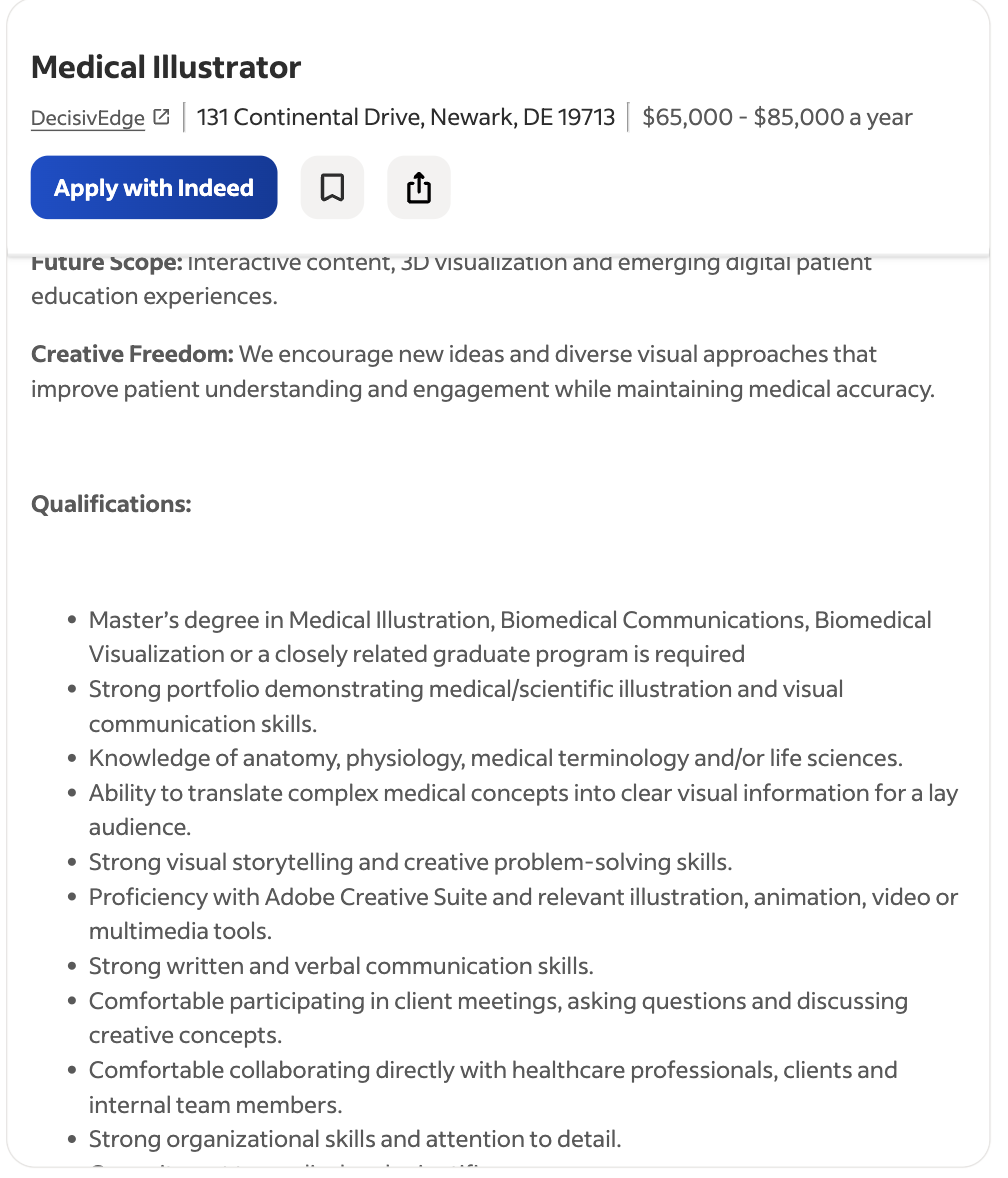 Indeed job posting for a Medical Illustrator at DecisivEdge, Newark DE, $65,000–$85,000 a year, requiring a master's degree in medical illustration, biomedical communications, or biomedical visualization
A representative posting, September 2026. Note the first qualification: an accredited master's degree is required, not preferred.
The posting is typical of the salaried market in three ways: the master's degree is a hard requirement, the pay range brackets the entry-level figures above, and the role is broader than drawing, with storyboarding, script contribution, client meetings, and asset management all in the description. Postings also frequently use titles other than "medical illustrator," so search for biomedical visualization specialist, medical animator, scientific illustrator, 3D medical artist, and medical multimedia designer as well.
The AMI maintains a job board and a member directory that clients use to find illustrators, and the annual AMI meeting is the main networking event in the field. Most new graduates find their first position through the program's alumni network or a thesis-year internship rather than open postings, which is why the public boards look so thin.
Medical illustrator vs. scientific illustrator
The terms overlap, and both fall under the umbrella of science communication, but they describe different specialties.
A scientific illustrator works across the natural sciences: zoological and botanical specimens, geological formations, paleontological reconstructions, astronomical subjects, molecular and cellular structures. The work appears in field guides, natural history museums, academic journals, and science magazines. Training is less standardized. Some scientific illustrators come through certificate programs (the Science Illustration program at California State University, Monterey Bay is the best known), many come from biology or art degrees, and there is no single accredited master's track or certification equivalent to the CMI. The professional organization is the Guild of Natural Science Illustrators (GNSI).
A medical illustrator specializes in the human body, clinical medicine, and healthcare. The subject matter is narrower but the stakes are higher: an anatomical error in a surgical atlas or a patient consent illustration can mislead a trainee or a patient in ways that affect care. That is why the profession has built a formal accredited-degree path and a certification exam around it.
In practice, the two fields share tools, techniques, and often the same practitioners. If your interest is specifically in anatomy, surgery, and medicine, the medical illustration path is the one to pursue; if it is biology broadly, scientific illustration is the wider door.
A short history of medical illustration
The profession is older than the term. Leonardo da Vinci's anatomical drawings from dissection in the early 1500s were the first to treat the body as something to be observed rather than copied from Galen, though they went unpublished for centuries. Andreas Vesalius's De Humani Corporis Fabrica (1543), with its woodcuts attributed to the workshop of Titian, established the modern anatomical atlas and the idea that an accurate image could correct a textbook. Henry Vandyke Carter's drawings for the first edition of Gray's Anatomy (1858) set the clear, labeled style that anatomy teaching still uses.
The modern profession begins with Max Brödel, a German artist brought to Johns Hopkins in the 1890s to illustrate for the surgeon Howard Kelly and the neurosurgeon Harvey Cushing. Brödel developed the carbon dust technique, insisted his illustrators dissect and understand what they drew, and in 1911 founded the Department of Art as Applied to Medicine at Hopkins, the first academic medical illustration program in the world. Every accredited program since descends from that model. Brödel's students included Dorcas Hager Padget, whose illustrations of cerebral aneurysms for Walter Dandy remain in use.
Frank H. Netter, a physician-turned-illustrator, produced the Atlas of Human Anatomy (1989) and thousands of plates for CIBA over four decades; his work is still the visual reference most physicians learned from, and "Netter style" remains shorthand for the painterly, clinically precise look many clients request. The Association of Medical Illustrators was founded in 1945 to set professional standards, and the accreditation and certification system described above grew out of it.
Notable medical illustrators
A short list of the people whose work defined the field, useful both as a reading list and as a sense of the range the job covers.
Historical
- Jan van Calcar (c. 1499–1546) — The artist most often credited with the woodcuts in Vesalius's De Humani Corporis Fabrica (1543), the plates that made the anatomical atlas a genre.
- Jan Wandelaar (1690–1759) — Drew the plates for Bernhard Siegfried Albinus's Tabulae Sceleti et Musculorum Corporis Humani (1747), still regarded as the most precise anatomical engravings of the 18th century.
- Henry Vandyke Carter (1831–1897) — Illustrated the first edition of Gray's Anatomy (1858); his clear, labeled woodcuts set the visual grammar of anatomy teaching.
- Max Brödel (1870–1941) — The founder of the modern profession. Brought to Johns Hopkins in 1894, he developed the carbon dust technique and in 1911 established the Department of Art as Applied to Medicine, the first academic medical illustration program in the world.
- Tom Jones (1885–1961) — Founded the University of Illinois program in 1921 and was a founder of the Association of Medical Illustrators in 1945.
- Dorcas Hager Padget (1906–1973) — Trained under Brödel and became Walter Dandy's neurosurgical illustrator; her drawings of cerebral aneurysm surgery are still reproduced. She later did original research in neuroembryology, publishing the first major work on the development of the cerebral arteries and veins.
- Frank H. Netter (1906–1991) — A physician who left practice to paint full-time for CIBA (now Novartis) over four decades. His Atlas of Human Anatomy (1989) is the anatomy reference most physicians learned from, and "Netter style" remains shorthand for a painterly, clinically exact look.
- Ranice Crosby (1915–2007) — Directed the Johns Hopkins department for 40 years (1943–1983), the first woman to direct a department at the Hopkins School of Medicine, and trained a large share of the profession's mid-century leaders.
Contemporary
- Carlos Machado, MD — The primary artist carrying on the Netter atlas since Netter's death, with nearly 100 plates of his own in the current editions.
- David Bolinsky — Former lead medical illustrator at Yale and co-founder of XVIVO; his 2006 film The Inner Life of the Cell was the first molecular animation built from atomically accurate protein structures with a cinematic aesthetic.
- Drew Berry — Biomedical animator at Australia's Walter and Eliza Hall Institute since 1995 and a 2010 MacArthur Fellow, known for animations of DNA replication, malaria, and apoptosis built directly from published structural data.
- Janet Iwasa, PhD — Biochemist and molecular animator who founded the Animation Lab at the University of Utah in 2018; her work appears in Nature, Science, Cell, and The New York Times.
The through-line is instructive: nearly everyone on this list either held a science degree or worked embedded in a research or surgical department. The profession has always been defined by artists who understood the medicine, which is the reason the accredited-degree model exists.
How AI is changing medical illustration
Generative image models have changed what a medical illustrator's week looks like more than anything since the shift from carbon dust to Photoshop. It is worth being precise about what has changed and what has not.
What AI models still get wrong
General-purpose text-to-image models optimize for images that look plausible, not images that are anatomically correct. Those are different objectives, and the gap shows up under scrutiny. Peer-reviewed evaluations of major image generators on anatomical tasks have found visually impressive output with unreliable structure: wrong rib counts, misplaced vessels, proportions that don't match any real body.
The errors that matter most in clinical work are the ones a layperson never notices: a left-right swap, the wrong vertebral level, a muscle attached to the wrong landmark, a view that does not match the one requested. None of those are stylistic quibbles. In a patient education handout or a trial exhibit they are substantive errors, and catching them requires someone who knows the anatomy.
What has actually changed
The workflow. Concept sketches that used to take a day can be roughed out in minutes. Background elements, reference poses, and early-stage visualization for a client pitch are cheaper. Illustrators who use these tools spend less time on first drafts and more time on the part of the job that was always the point: making the image correct, clear, and appropriate for its audience.
Purpose-built tools are narrowing the accuracy gap in specific use cases. Natomy, for example, is built to turn clinical photographs and imaging into illustration-quality anatomical visuals for physicians and attorneys, with the source image constraining what the model can invent. That is a different problem from open-ended text-to-image generation, and it is where the technology is most useful today. We cover the broader landscape in our review of AI medical illustration generators.
Will AI replace medical illustrators?
The most honest framing is that AI-assisted medical illustration is already a workflow tool, not a replacement. Platforms like Natomy are built specifically for this middle ground — using AI to transform clinical photographs into anatomical illustration-quality visuals, with outputs calibrated for medical context rather than general aesthetics. For physicians, researchers, and medical educators who need professional-quality visuals without the lead time and cost of commissioning custom illustration work, this kind of purpose-built tool fills a real gap.
What changes is the shape of the job. The illustrators who do well over the next decade will be the ones who treat AI as a drafting tool, keep the anatomical knowledge that models don't have, and position themselves as the accuracy layer between raw output and anything that gets published, handed to a patient, or shown to a jury. For a profession whose entire value proposition has always been "an artist who knows the medicine," that is a familiar role with new tools.
Is medical illustration a good career?
For the right person, yes. The work is intellectually varied, the salary data from the AMI is solid for a creative field, and demand for accurate medical visuals is growing across patient education, device and pharma marketing, surgical training, medical-legal work, and scientific publishing. The number of accredited graduates each year is under 100, so trained illustrators are not competing in a crowded market.
The honest costs: the graduate bottleneck is real and many qualified applicants are rejected the first time; six years of higher education, with the master's at a private program costing six figures; salaried positions are concentrated at a limited number of academic centers; and freelancers carry the business overhead and income variability that comes with self-employment. The field is also mid-transition, with AI absorbing some of the entry-level drafting work that used to be how new illustrators got their footing.
If you are weighing it, the best first steps are to build a portfolio of observational drawing from life, take the anatomy and physiology courses the programs expect, reach out to the five accredited programs to see current thesis work and ask about funding, and look at the AMI's career resources for the current salary survey and job board.
FAQ
How much does a medical illustrator make?+
According to the Association of Medical Illustrators' 2022 salary survey, salaried medical illustrators earn a median of $83,500 a year, with senior roles reaching $170,000. Art and creative directors earn $104,000–$126,000. Self-employed medical illustrators report a median gross income of $85,000. Entry-level salaried positions at hospitals and universities typically start in the $55,000–$70,000 range. Glassdoor and Salary.com put the average at roughly $68,000–$80,000, consistent with the AMI figures.
How do you become a medical illustrator?+
The standard path is a bachelor's degree that combines studio art and premedical science (biology, anatomy, physiology, chemistry), a strong portfolio, and then a two-year master's degree from one of the five CAAHEP-accredited medical illustration programs in North America: Johns Hopkins, the University of Illinois Chicago, Augusta University, the University of Toronto, and Rochester Institute of Technology. Each accepts 20 or fewer students a year. After graduating, many illustrators pursue the Certified Medical Illustrator (CMI) credential.
Is it hard to become a medical illustrator?+
Yes, mostly because of the bottleneck at the graduate level. Only five accredited programs exist in North America and each admits 20 or fewer students a year, so applicants need both a competitive art portfolio and a solid science transcript. The programs themselves are demanding: students take gross anatomy with cadaver dissection alongside medical students, plus histology, pathology, and neuroanatomy, while producing a professional portfolio.
Are medical illustrators in demand?+
Yes. Demand for accurate medical visuals is growing in patient education, medical device and pharmaceutical marketing, surgical training, medical-legal exhibits, and scientific publishing, while the number of formally trained illustrators stays small because so few graduate programs exist. The work is changing, with AI tools handling more first drafts, but the need for people who can verify anatomical accuracy has not shrunk.
Do you need to go to medical school to be a medical illustrator?+
No. Medical illustrators do not attend medical school or earn an MD. They earn a master's degree from an accredited medical illustration program, where they take many of the same first-year basic science courses as medical students, including gross anatomy with cadaver dissection, physiology, pathology, and histology.
What is the difference between a medical illustrator and a scientific illustrator?+
A medical illustrator specializes in human anatomy, surgery, disease, and healthcare communication, and typically holds a master's degree from an accredited medical illustration program. A scientific illustrator works across the natural sciences more broadly — zoology, botany, geology, astronomy, molecular biology — and the training path is less standardized, with certificate programs and self-directed routes being common. The two fields overlap, and many illustrators work in both.
How long does it take to become a medical illustrator?+
Typically six years of higher education: a four-year bachelor's degree followed by a two-year master's degree from an accredited program. Some applicants spend an additional year or two taking prerequisite science courses or building a portfolio before applying, because admission is competitive.
What is a Certified Medical Illustrator (CMI)?+
The CMI is a voluntary professional credential administered by the Board of Certification of Medical Illustrators. Candidates must have graduated from an accredited medical illustration program, or have five years of professional experience plus a completed human gross anatomy dissection course. The exam has two parts: a half-day written test covering biomedical science, business practices, ethics, and drawing, and a portfolio review of eight original pieces submitted within two years of passing the written exam. Certification lasts five years and requires 35 hours of continuing education to renew.
Will AI replace medical illustrators?+
Not in the foreseeable future, though it is changing the work. General-purpose image models still make anatomical errors, particularly with orientation, laterality, and fine structural detail, and they cannot verify their own output. AI is becoming a fast drafting tool, but the person who confirms that a surgical atlas figure, a patient handout, or a trial exhibit is anatomically correct is still a trained illustrator, and that verification role is the profession's core value.
Ready to create your own medical illustrations?
Upload a clinical photo and generate a professional illustration in seconds.
Try Natomy →